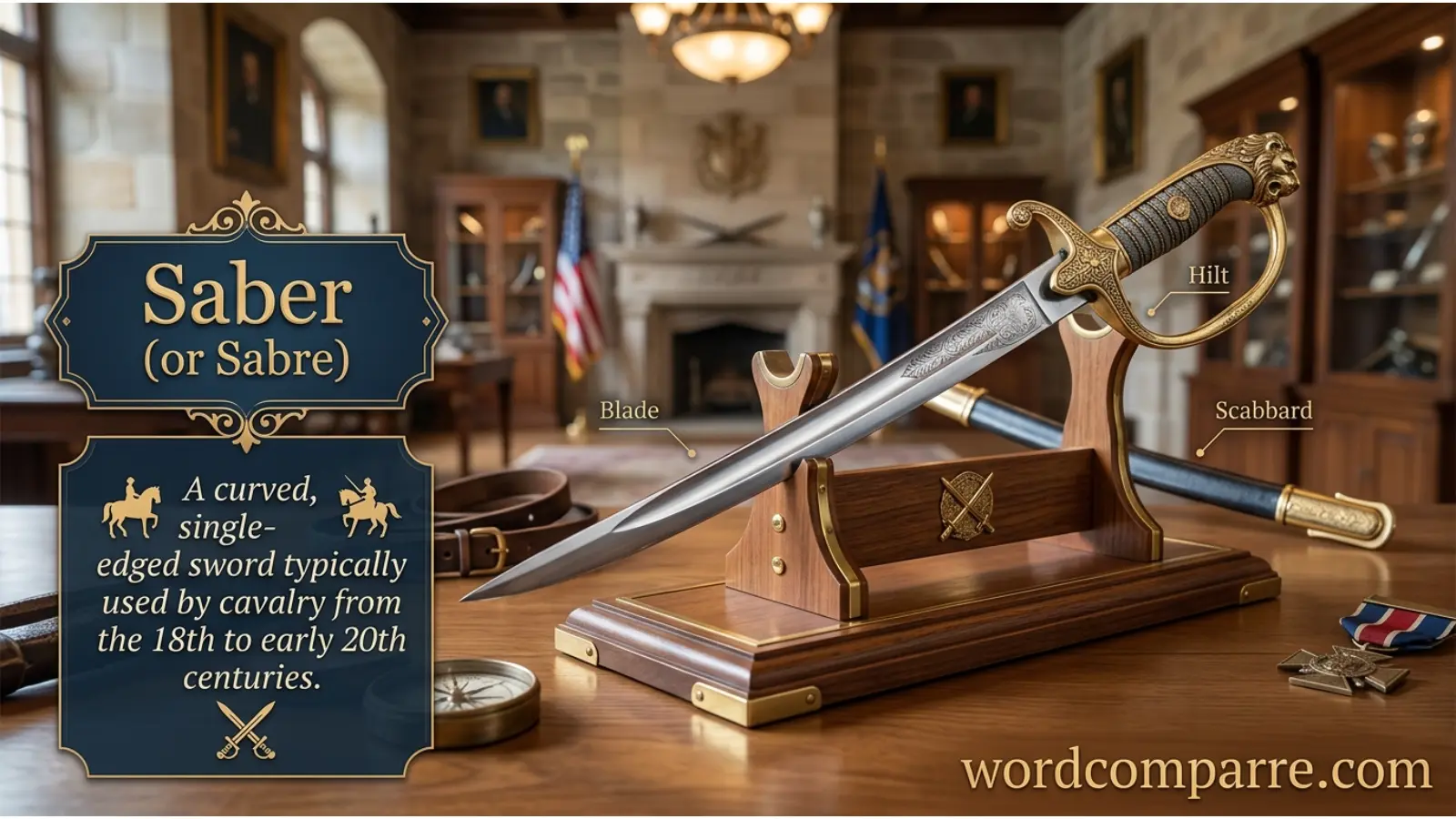
Saber or sabre is a common spelling question because both words refer to the same type of curved sword. If you’ve seen saber in American books but sabre in British publications, you’re not imagining things. Both spellings are correct, but they are used in different varieties of English.
This guide explains the difference between saber and sabre, why two spellings exist, which dictionaries recommend each version, and when you should choose one over the other. By the end, you’ll know exactly which spelling fits your audience and writing style.
Quick Answer
Both saber and sabre are correct spellings.
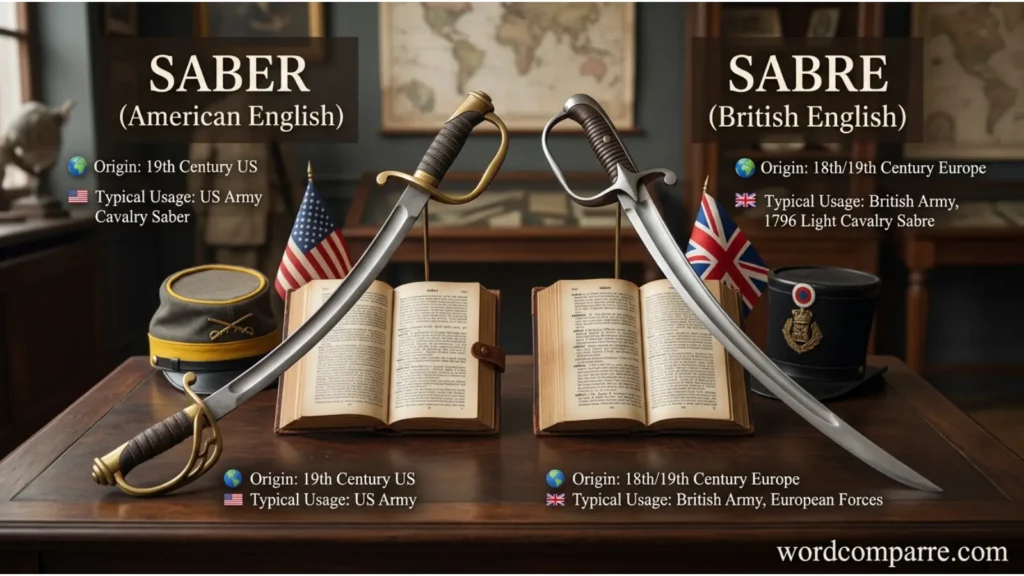
- Saber is the preferred spelling in American English.
- Sabre is the preferred spelling in British English, Canadian English, Australian English, and many other Commonwealth countries.
Neither spelling is wrong. The best choice depends on the type of English you are using.
What Do Saber and Sabre Mean?
Both saber and sabre refer to the same weapon.
A saber or sabre is a military sword with a slightly curved blade, traditionally used by cavalry soldiers. The word is also widely used in modern fencing, where the saber is one of the three official fencing weapons.
The spelling changes, but the meaning remains exactly the same.
Saber vs Sabre Comparison
| Feature | Saber | Sabre |
|---|---|---|
| Meaning | Curved sword | Curved sword |
| American English | Preferred | Rare |
| British English | Less common | Preferred |
| Canadian English | Less common | Preferred |
| Australian English | Less common | Preferred |
| Dictionary Status | Correct | Correct |
| Meaning Difference | None | None |
Where Did These Two Spellings Come From?
The word entered English through several European languages before becoming established in modern dictionaries.
As English developed separately in different regions, spelling conventions changed. American English gradually simplified many French-style endings, leading to saber, while British English kept the traditional sabre spelling.
This pattern is similar to many other British and American spelling differences.
Why Do People Get Confused?
The confusion happens because people regularly encounter both spellings online.
Someone reading American news, watching Hollywood movies, or using American dictionaries will usually see saber. Readers of British books, historical documents, or Commonwealth publications are much more likely to find sabre.
Since both spellings appear frequently, many writers wonder if one is incorrect. In reality, they simply reflect different regional spelling standards.
What Do Major Dictionaries Recommend?
Most major dictionaries recognize both spellings.
American dictionaries usually list saber as the primary spelling while noting sabre as a variant.
British dictionaries generally list sabre as the preferred spelling.
The important point is consistency. Choose the spelling that matches the English style of your document.
Real Life Examples Of
American English
- The museum displayed an officer’s saber from the Civil War.
- She practices Olympic saber fencing every weekend.
- The soldier carried a ceremonial saber.
British English
- The cavalry officer wore a polished sabre.
- He collected antique sabres from Europe.
- The fencing club specializes in sabre competitions.
Common Mistakes
One common mistake is assuming sabre is incorrect because it looks unfamiliar to American readers.
Another mistake is mixing both spellings in the same article, report, or academic paper.
Some writers also think the two words describe different swords, but they do not. They are simply regional spelling variations.
An Easy Memory Trick
Remember the letter E.
Saber ends with ER, which is common in American English spellings.
Sabre ends with RE, which appears in many traditional British English spellings.
If you’re writing for an American audience, choose saber.
If you’re writing for a British or Commonwealth audience, choose sabre.
Professional Writing Recommendation
Use saber when writing for readers in the United States or when following American English style guides.
Use sabre when writing for readers in the United Kingdom, Canada, Australia, New Zealand, or when following British English conventions.
Avoid switching between the two spellings within the same piece of writing unless you are directly quoting a source.
Frequently Asked Questions
Is saber correct?
Yes. Saber is the standard American English spelling.
Is sabre correct?
Yes. Sabre is the standard British English spelling.
Do saber and sabre have different meanings?
No. Both words refer to the same type of sword and the same fencing weapon.
Which spelling should I use in the United States?
Use saber.
Which spelling should I use in the United Kingdom?
Use sabre.
Which spelling is better for SEO?
Choose the spelling that matches your target audience. If your website serves American readers, use saber. If it targets British or Commonwealth readers, use sabre. If your audience is international, explain both spellings naturally as this article does.
Conclusion
The choice between saber and sabre is not about right or wrong. Both spellings are correct and carry exactly the same meaning. The only real difference is regional preference. Saber is the standard spelling in American English, while sabre is preferred in British and most Commonwealth varieties of English. For clear and professional writing, select the spelling that matches your audience and use it consistently throughout your document.

Alex Wordsmith is a comparison research writer and content specialist at WordComparre.com. He focuses on analyzing word meanings, spelling variations, grammar distinctions, and language usage to help readers make informed writing choices. Through clear explanations and practical examples, Alex simplifies complex language topics for students, writers, and professionals. His goal is to make English learning easier, more accurate, and accessible for everyone.