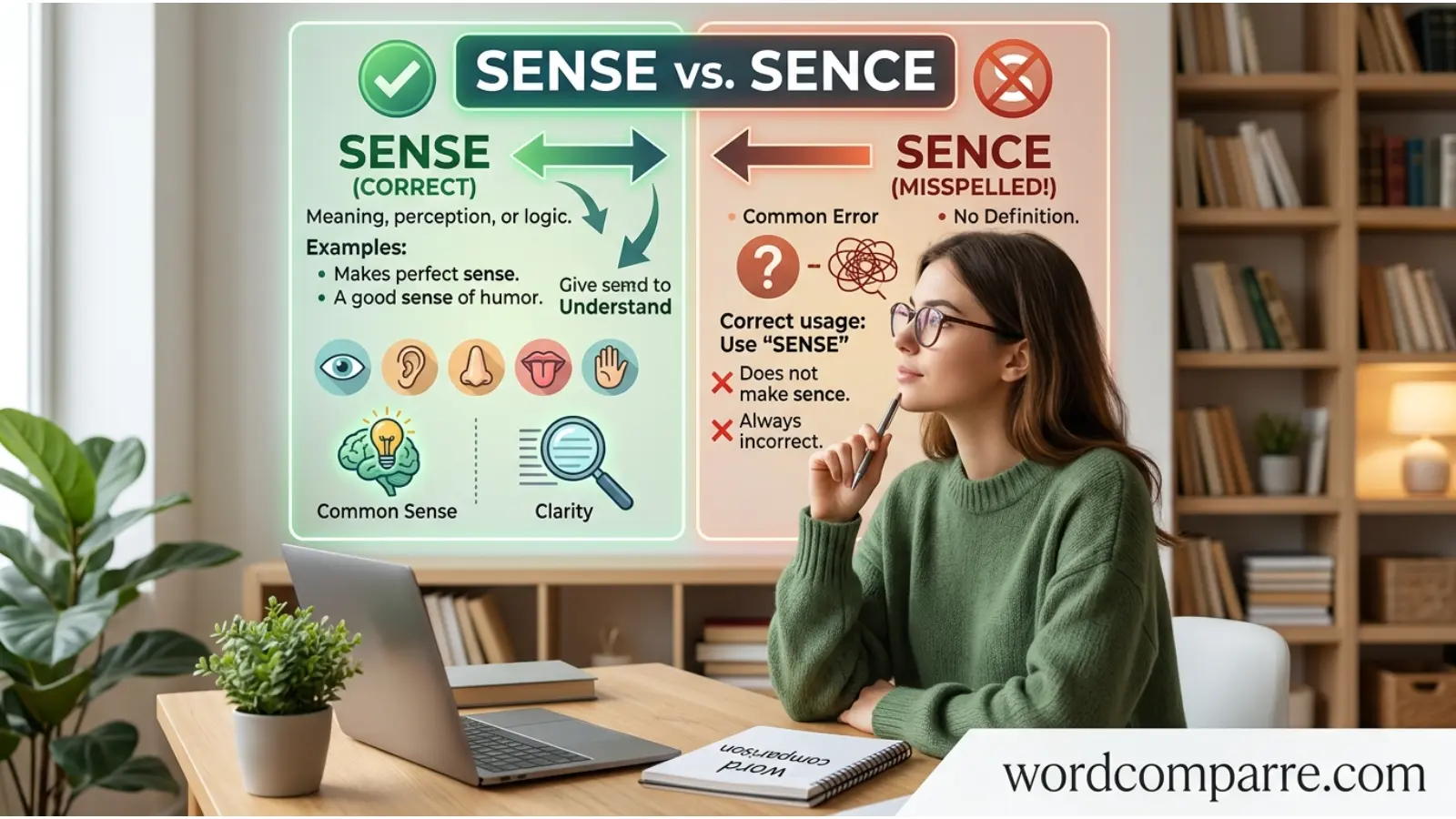
If you have ever wondered which one of sense vs sence is the correct spelling, you are not alone. Many English learners and native speakers accidentally type sence because it sounds almost identical to sense. English spelling is full of words that do not match their pronunciation perfectly, making mistakes like this very common.
In this guide, you will learn which spelling is correct, why the confusion happens, what major dictionaries recommend, and how to remember the right form. By the end, you will know exactly when to use sense and why sence should usually be avoided in standard English writing.
Quick Answer
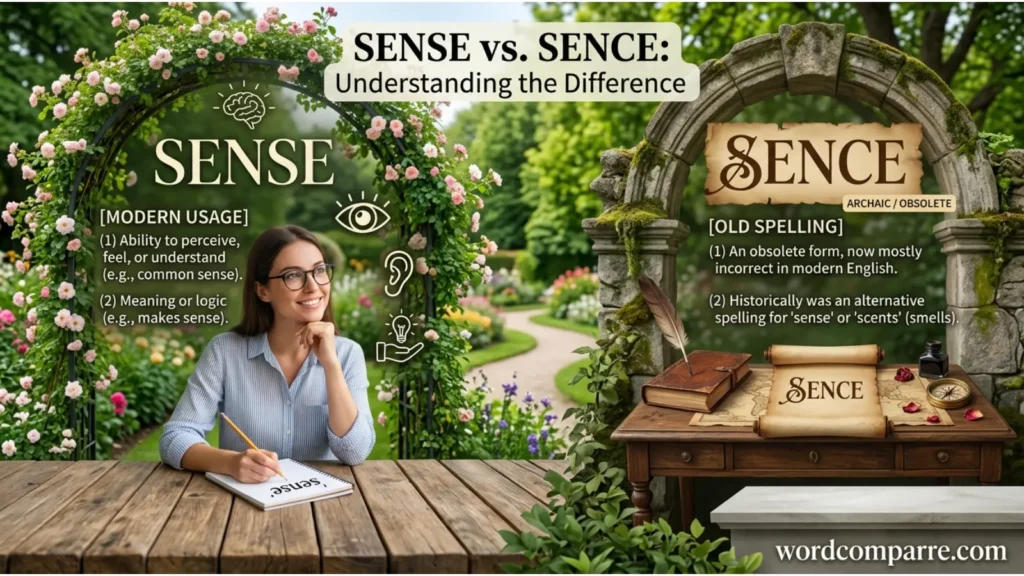
Sense is the correct English spelling.
Sence is a misspelling and is not recognized as a standard English word in major dictionaries. In professional, academic, and everyday writing, always use sense.
What Does “Sense” Mean?
Sense is a noun and a verb with several meanings.
As a noun, it can mean:
- The ability to perceive through sight, hearing, smell, taste, or touch.
- Good judgment or practical understanding.
- A particular meaning or interpretation.
- A feeling or awareness of something.
As a verb, sense means to detect, notice, or become aware of something.
Examples
- She has an excellent sense of humor.
- Dogs have a strong sense of smell.
- I sense that something is wrong.
- The sentence makes perfect sense.
What Does “Sence” Mean?
Sence has no accepted meaning in modern standard English.
It appears most often because:
- People spell the word based on its pronunciation.
- It is a typing error.
- English learners confuse the ending -se with -ce.
Unless it appears as part of a person’s name or a specific brand, sence should be treated as an incorrect spelling.
Sense vs Sence Comparison
| Feature | Sense | Sence |
|---|---|---|
| Standard English word | Yes | No |
| Found in major dictionaries | Yes | No |
| Correct for professional writing | Yes | No |
| Commonly mistaken spelling | No | Yes |
| Recommended spelling | Yes | No |
Origin of the Word “Sense”
The word sense comes from the Latin word sensus, meaning “feeling,” “perception,” or “understanding.” It entered English through Old French and has been used for centuries to describe perception, awareness, judgment, and meaning.
Its long history explains why the spelling follows traditional English patterns rather than modern pronunciation alone.
Why Do People Confuse Sense and Sence?
The confusion is mainly caused by pronunciation.
Both spellings sound almost identical when spoken, making it easy to assume that sence is acceptable. English also contains many words ending in -ence, such as:
- sentence
- science
- patience
- difference
Because of these familiar patterns, many writers mistakenly replace -se with -ce in sense.
Typing quickly and relying on sound instead of memory also contributes to the mistake.
What Do Dictionaries Recommend?
Leading English dictionaries recognize only sense as the correct spelling.
Major dictionaries consistently define sense as relating to perception, understanding, meaning, awareness, and good judgment.
Sence does not appear as a standard English word in respected dictionaries. When it does appear online, it is usually identified as a spelling error or a proper name.
Real Life Examples
Correct:
- That explanation makes perfect sense.
- She has a great sense of direction.
- Scientists use sensors to sense tiny changes.
- I had a strange sense that someone was watching me.
Incorrect:
- That explanation makes perfect sence.
- She has a good sence of humor.
- I can sence danger.
- His sence of responsibility is impressive.
Common Mistakes
Many writers make these errors:
- Writing sence instead of sense.
- Assuming both spellings are acceptable.
- Trusting pronunciation instead of dictionary spelling.
- Ignoring spell-check warnings.
Checking your writing before publishing can prevent these mistakes.
Easy Memory Trick
Remember this simple phrase:
Good ideas make sense, and sense ends with SE.
Another trick is to connect sense with words you already know:
- common sense
- sense of humor
- sense of direction
Seeing these familiar expressions repeatedly helps reinforce the correct spelling.
Professional Writing Recommendation
For emails, reports, academic papers, business communication, blogs, and social media, always use sense.
Using the correct spelling improves clarity, professionalism, and credibility. Since sence is not accepted in standard English, it may distract readers and reduce confidence in your writing.
Frequently Asked Questions
Is sence a real English word?
No. Sence is not recognized as a standard English word. It is generally considered a misspelling of sense.
Which spelling is correct: sense or sence?
Sense is the correct spelling in modern English.
Why do people write sense vs sence?
Most people spell it this way because it sounds similar to sense and many English words end in -ence.
Can I use sence in formal writing?
No. Professional and academic writing should always use sense.
Is sense a noun or a verb?
It can be both. It functions as a noun when referring to meaning, judgment, or perception, and as a verb when meaning to detect or notice something.
Conclusion
When comparing sense vs sence, the answer is straightforward. Sense is the correct and dictionary-approved spelling used in all forms of modern English. It refers to perception, understanding, meaning, awareness, and good judgment. Sence is simply a misspelling and should not be used in standard writing. If you remember that common sense always ends with SE, you will avoid this common spelling mistake with confidence.

Alex Wordsmith is a comparison research writer and content specialist at WordComparre.com. He focuses on analyzing word meanings, spelling variations, grammar distinctions, and language usage to help readers make informed writing choices. Through clear explanations and practical examples, Alex simplifies complex language topics for students, writers, and professionals. His goal is to make English learning easier, more accurate, and accessible for everyone.