If you are unsure whether to write shyer or shier, you are not alone. Both spellings appear in dictionaries, which makes the choice confusing for students, writers, and English learners. The good news is that both forms are correct, but they are not equally common in modern English. Knowing which spelling readers expect can make your writing look more natural and professional.
This guide explains the difference between shyer and shier, why both spellings exist, how major dictionaries treat them, and which version is recommended for everyday writing.
Quick Answer
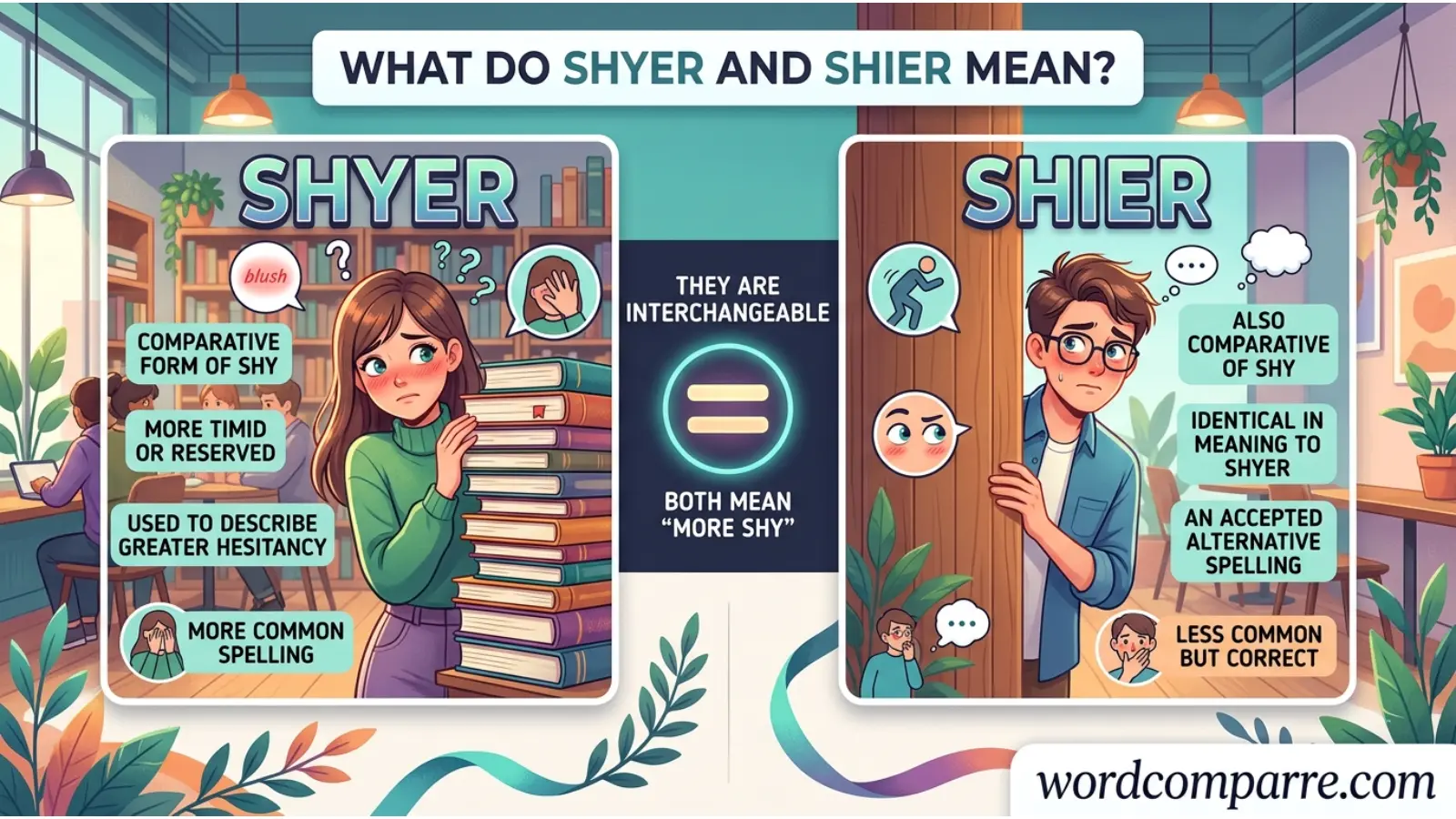
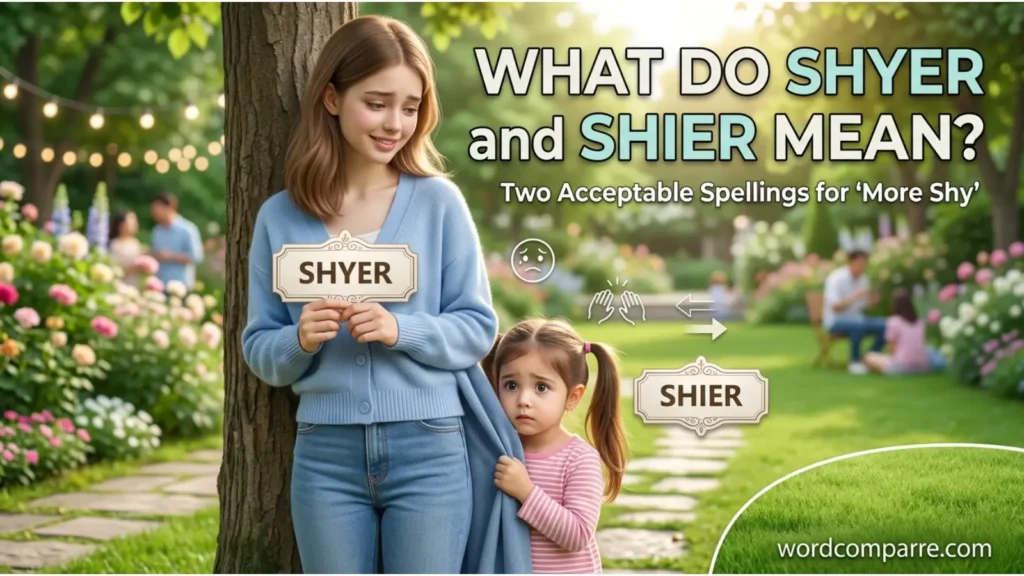
Both shyer and shier are correct comparative forms of the adjective shy.
- Shyer is the preferred and more common spelling in modern English.
- Shier is an accepted alternative but is used much less often.
- For professional, academic, and everyday writing, shyer is usually the best choice.
What Do Shyer and Shier Mean?
Both words have exactly the same meaning.
They describe someone who is more shy, more reserved, or less comfortable in social situations than another person.
Examples:
- Emma is shyer than her brother.
- Emma is shier than her brother.
The meaning does not change. Only the spelling is different.
Shyer vs Shier Comparison
| Feature | Shyer | Shier |
|---|---|---|
| Correct spelling | Yes | Yes |
| Meaning | More shy | More shy |
| Dictionary acceptance | Accepted | Accepted |
| Modern usage | Most common | Less common |
| Best for professional writing | Yes | Usually not preferred |
| Easy for readers to recognize | Yes | Less familiar |
Where Did These Two Spellings Come From?
The adjective shy ends with the letter y after a consonant. In English, comparative adjectives often change y to i before adding -er, producing forms like:
- happy → happier
- lazy → lazier
Following that pattern, shier developed naturally.
However, many writers preferred keeping the original y, creating shyer. Over time, shyer became the dominant spelling in newspapers, books, schools, and online writing.
Today, both forms remain acceptable, although shyer appears far more often.
Why Do People Get Confused?
Several factors create confusion.
First, English spelling rules are not always consistent. Some words ending in y change to i, while others keep the y.
Second, dictionaries list both spellings, so readers may see different versions in different sources.
Finally, many spell checkers, style guides, and editors prefer shyer, while older books sometimes use shier.
What Do Dictionaries Recommend?
Major English dictionaries recognize both spellings as correct comparative forms of shy.
However, they generally list shyer as the more common modern spelling, while shier is treated as a less common variant.
If your goal is clear, natural English that matches current usage, shyer is usually the safest choice.
Real Life Examples
Here are examples using the preferred spelling.
- My younger sister is much shyer around strangers.
- He became shyer after moving to a new school.
- The puppy is shyer than the older dog.
- She seemed shyer during the interview than she did in class.
- Children often become shyer in unfamiliar environments.
Examples using the alternative spelling:
- The new employee seemed shier than the rest of the team.
- She grew shier after the unexpected attention.
These sentences are grammatically correct, but many readers are more accustomed to seeing shyer.
Common Mistakes
Many writers assume shier is incorrect because they rarely encounter it.
Others believe shyer breaks the usual spelling rule for words ending in y.
Some people switch between both spellings within the same document, creating inconsistency.
The best approach is to choose one spelling and use it consistently. In most situations, shyer is the better choice.
Easy Memory Trick
Remember this simple tip:
Keep the “y” in shy, and you get the spelling most people expect: shyer.
If you remember the original word shy, choosing shyer becomes much easier.
Professional Writing Recommendation
Although shyer and shier are both correct, shyer is the stronger choice for modern writing.
Use shyer in:
- Academic papers
- Business communication
- School assignments
- Blog articles
- News writing
- Website content
- Professional emails
Reserve shier only if you are following a particular dictionary preference, an editor’s style guide, or reproducing older texts.
Frequently Asked Questions
Is shyer correct?
Yes. Shyer is correct and is the most widely used comparative form of shy.
Is shier a real word?
Yes. Shier is a valid dictionary spelling, although it is much less common today.
Which spelling is more common?
Shyer is significantly more common in modern English.
Do both words have the same meaning?
Yes. Both mean more shy.
Which spelling should students use?
Students should normally use shyer because it is the preferred spelling in modern educational and professional writing.
Which spelling is better for SEO and online content?
Shyer is generally the better choice because it matches the spelling most readers search for and expect.
Conclusion
Both shyer and shier are correct comparative forms of shy, so neither spelling is wrong. The difference lies in usage rather than meaning. Shyer has become the standard choice in modern English and is the spelling most readers, editors, and style guides expect. Shier remains a legitimate alternative, but it appears much less frequently. For clear, consistent, and professional writing, shyer is the spelling you should use in most situations.

Alex Wordsmith is a comparison research writer and content specialist at WordComparre.com. He focuses on analyzing word meanings, spelling variations, grammar distinctions, and language usage to help readers make informed writing choices. Through clear explanations and practical examples, Alex simplifies complex language topics for students, writers, and professionals. His goal is to make English learning easier, more accurate, and accessible for everyone.