Have you ever wondered whether to write programming or programing? The two spellings look almost identical, and both appear in English-language texts. However, one is far more common and widely preferred than the other.
Programming is the standard spelling used in modern English, particularly when discussing computer coding, software development, or the planning of television and radio content. Programing is a recognized but uncommon variant, mainly associated with American English.
Although both spellings can be found in dictionaries and published material, they are not equally suitable for everyday and professional writing. Understanding the difference helps you avoid unnecessary spelling errors in academic assignments, résumés, technical documentation, and online articles.
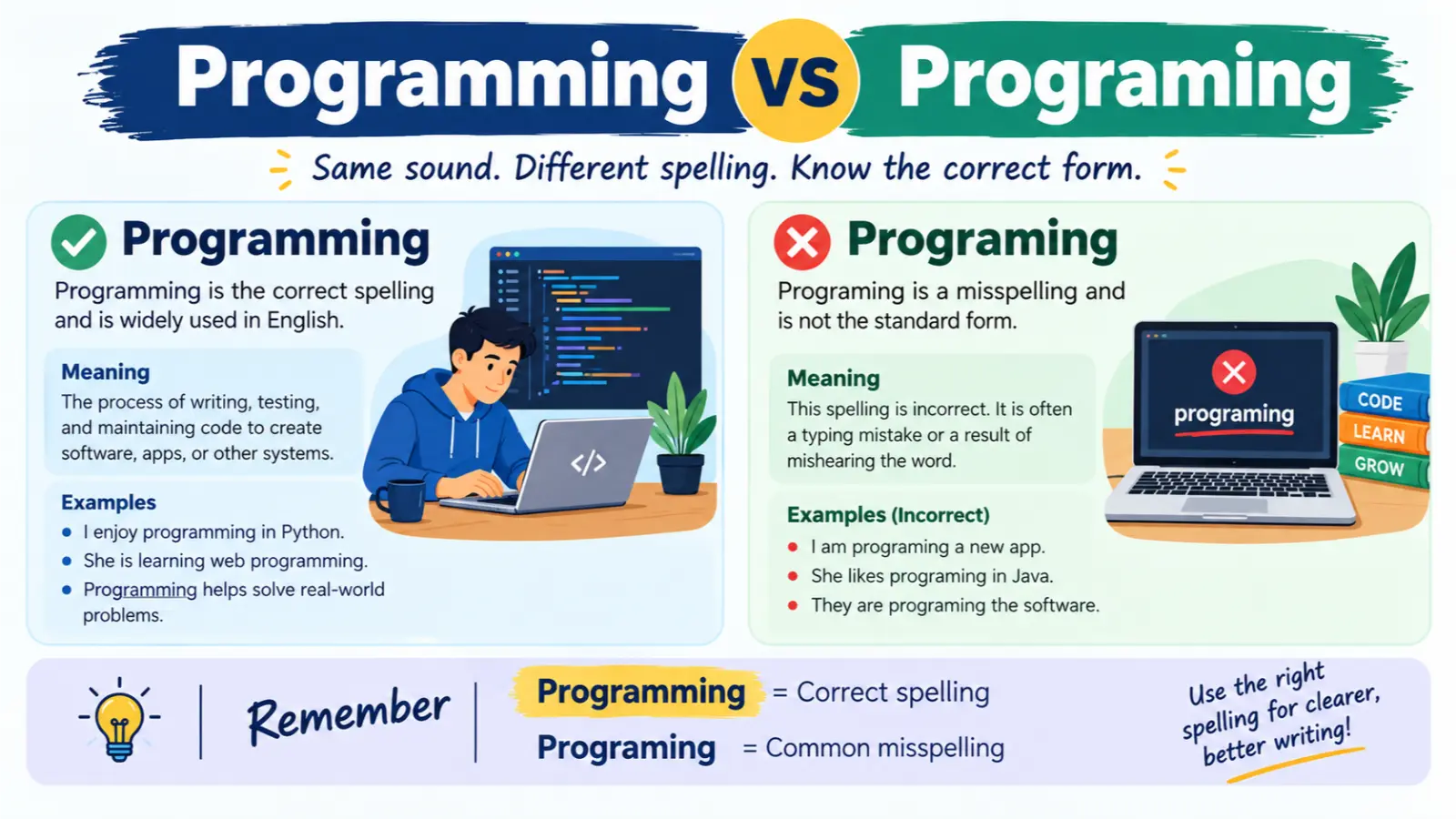
Quick Answer: Programming or Programing?
Programming is the recommended spelling for almost all writing situations.
- Programming: The standard and widely preferred spelling of the word.
- Programing: An accepted but much less common spelling variant, primarily in American English.
- Meaning: Both forms generally have the same meaning.
- British and American English: Programming is used in both varieties.
- Professional recommendation: Use programming in essays, résumés, software documentation, and website content.
For example:
- Correct and recommended: She is learning computer programming.
- Less common variant: She is learning computer programing.
The second spelling is not necessarily an error in every context, but the first is the safer choice for standard edited English.

What Does Programming Mean?
Programming is the process of writing, testing, and maintaining instructions that tell a computer or other digital device how to perform specific tasks.
The word is most commonly associated with computer science and software development. It can also refer to arranging or selecting television, radio, or other broadcast content.
Examples:
- She is learning programming at university.
- Computer programming requires logical thinking and problem-solving skills.
- The company is looking for someone with strong programming skills.
- The television network has changed its weekend programming schedule.
In technology, the word appears in familiar expressions such as computer programming, programming language, application programming interface, and object-oriented programming.
Because these terms are established throughout the technology industry, the double-m spelling is the best choice in technical and professional communication.
What Does Programing Mean?
Programing is an alternative spelling of programming. It generally carries the same meaning and is recognized in some American English dictionaries.
For example:
- He is studying computer programing.
- The course introduces students to basic programing concepts.
- She listed programing among her technical skills.
These examples communicate the intended meaning, but most contemporary readers are more familiar with programming.
The single-m spelling is much less common, so it may look like a typographical error in a résumé, academic paper, software manual, or technical article. Unless a specific publication or style guide requires the alternative, writers should choose programming.
Programming vs. Programing: Key Differences
| Feature | Programming | Programing |
|---|---|---|
| Spelling status | Standard, preferred spelling | Recognized alternative |
| Meaning | Writing computer instructions or arranging content | Generally the same |
| English variety | British and American English | Primarily an American variant |
| Frequency | Very common | Much less common |
| Technical writing | Recommended | Usually avoid |
| Résumés and academic work | Preferred | Less suitable |
| Example | She enjoys programming. | She enjoys programing. |
The primary difference is spelling preference and frequency, not meaning. Both forms can refer to the same activity, but programming is the established choice in modern English.
Why Are Programming and Programing Confused?
The confusion comes from English spelling rules and the way the word program changes when suffixes are added.
Many English verbs double their final consonant before adding -ing. For example:
- Run → running
- Sit → sitting
- Plan → planning
- Program → programming
The standard spelling follows this familiar pattern, producing programming, with two ms at the end of the base word and the beginning of the suffix combination.
However, English contains spelling variations that developed through historical usage and regional preferences. The forms programing and programed are recognized alternatives in some American English references, even though the double-consonant forms are much more common.
Another source of confusion is the British spelling programme. British English commonly uses programme for television broadcasts, organized events, and certain courses of study. However, program is the usual spelling in computing in both British and American English.
This distinction explains why programming remains the standard computing term regardless of whether the writer follows British or American English conventions.
Is Programming British or American English?
Programming is used in both British and American English. It is not a spelling that belongs exclusively to either variety.
The main regional distinction concerns the noun program and programme.
| Context | American English | British English |
|---|---|---|
| Computer software | program | program |
| Computer coding | programming | programming |
| Television broadcast | program | programme |
| Organized series of activities | program | programme |
| Person who writes computer code | programmer | programmer |
Examples:
- American English: I am learning computer programming.
- British English: I am learning computer programming.
- American English: I watched an interesting television program.
- British English: I watched an interesting television programme.
Notice that the spelling programming remains the same in both varieties. Choosing programing is not necessary to follow American English, and choosing programming does not make a sentence exclusively British.

Origin of Programming and Programing
The word program ultimately derives from the Greek programma, which referred to a written notice or something written in advance. The word passed through Latin and French before becoming part of English.
Over time, its meaning expanded to include plans, schedules, organized activities, and instructions for machines. With the development of computers, program became an important technical term for a set of instructions a computer can execute.
The verb program subsequently developed forms such as programmed, programmer, and programming.
The spelling programing also exists as a variant, but the double-m spelling became the dominant form in modern English. Today, programming is firmly established in computing terminology and is recognized by software developers, educators, publishers, and technical organizations worldwide.
What Do Dictionaries Recommend?
Major English dictionaries use programming as the established spelling for computer coding.
- Oxford Advanced Learner’s Dictionary: Uses programming for the activity of writing and testing computer programs.
- Cambridge Dictionary: Uses programming in definitions and examples related to computers and broadcast content.
- Dictionary.com: Recognizes programing as a variant spelling of programming.
These references support an important distinction: a dictionary may recognize a spelling variant without recommending it as the best choice for every situation.
For everyday writing, education, business communication, and software documentation, programming is the more reliable option.
Writers should also remember that dictionary entries can differ in how they label variants. When preparing work for a particular publisher, university, or organization, follow its editorial guidelines.
Real-Life Examples of Programming vs. Programing
Seeing both spellings in context makes their relationship easier to understand.
Examples Using Programming
1. Education
I am studying computer programming at university.
2. Software development
The company requires applicants to have strong programming skills.
3. Technology
Python is a popular language for programming and automation.
4. Career development
She wants to improve her programming skills before applying for a software development position.
5. Technical documentation
The manual explains the basics of application programming interfaces.
6. Broadcasting
The television channel has updated its weekend programming schedule.
In each sentence, programming is the standard spelling and fits naturally in modern English.
Examples Using Programing
1. Education
He is learning computer programing.
2. Technology
The course introduces students to basic programing concepts.
3. Career development
She listed programing among her technical skills.
4. Software development
The book includes an introduction to programing for beginners.
These sentences illustrate the alternative spelling, but they would normally be edited to use programming in contemporary professional writing.
Which Version Should You Choose?
For schoolwork, business documents, technical articles, and website content, use the double-m spelling. The single-m form may be acceptable under a particular dictionary or editorial convention, but it is rarely the best default.
Common Mistakes to Avoid
Writers sometimes make avoidable errors when choosing between these spellings.
1. Assuming Both Spellings Are Equally Common
Both forms are recognized, but their frequency differs considerably. Programming is the standard spelling and should be your first choice.
2. Using Programing in a Professional Résumé
A résumé should follow familiar spelling conventions. Write:
Recommended: Three years of experience in computer programming.
Avoid using the less common spelling unless a specific style requirement applies.
3. Writing Programing Language
The established technical expression is programming language. This term refers to a formal language used to write instructions that computers can execute.
4. Mixing Spellings in One Article
Consistency is important in edited writing. If you use programming in the introduction, continue using it throughout the article, headings, and examples unless you are specifically discussing the alternative spelling.
5. Confusing Program With Programme
American English generally uses program for both computing and non-computing contexts. British English commonly uses programme for broadcasts and organized activities but retains program for computing.
The related computing terms programmer and programming use the standard forms in both varieties.
Memory Trick: How to Remember Programming
A simple way to remember the preferred spelling is to associate it with other familiar English words that double their final consonant before -ing.
- Run → running
- Plan → planning
- Program → programming
Remember the double m in programming.
You can also memorize the phrase computer programming. It is the standard expression used in education, software development, and technical documentation.
Whenever you are unsure, choose programming. This spelling is widely accepted and is unlikely to need correction in professional editing.
Professional Writing Recommendation
For most writers, programming is the best spelling to use.
Choose it in:
- Résumés and cover letters
- Academic essays and research papers
- Programming tutorials and technology blogs
- Software documentation and user manuals
- Business reports and job descriptions
- Website content and SEO articles
- Training materials and educational resources
For example:
Less preferred: I have three years of experience in computer programing.
Recommended: I have three years of experience in computer programming.
The first sentence uses a recognized but uncommon variant. The second follows the standard spelling expected by most readers.
If you are writing for an organization that follows a particular dictionary or editorial style guide, follow its instructions. Otherwise, programming is the clearest and most widely accepted choice.
Frequently Asked Questions
1. Is programming or programing correct?
Both spellings are recognized, but programming is the standard and much more common form. It is the recommended choice for most writing situations.
2. Is programing a misspelling?
Not necessarily. Programing is recognized as a spelling variant, primarily in American English. However, because it is uncommon, it may be treated as an error in publications that follow standard contemporary usage.
3. Is programming American or British English?
It is used in both American and British English. The spelling programming remains the standard form in both varieties, especially when referring to computer coding.
4. Why does programming have two m’s?
The standard spelling doubles the final m of program when adding -ing. This follows a common English spelling pattern, as seen in running and planning.
5. Should I write programming language or programing language?
Use programming language. It is the established term for a language used to write computer instructions.
6. Is programing acceptable in a résumé?
It is a recognized alternative, but programming is the better choice for a résumé. Employers and recruiters are much more familiar with the standard spelling.
7. Is programming the correct spelling in British English?
Yes. British English uses programming for computer coding. Although programme is common for television broadcasts and organized activities, the computing form is program and its standard -ing form is programming.
8. Which spelling is better for SEO content?
Use programming in titles, headings, body text, and technical terminology when that is the intended word. It is the standard spelling most readers expect. Mention programing naturally when addressing the spelling comparison, but do not replace the standard form simply to repeat a keyword.
9. What is the past tense of program?
The standard past-tense form is programmed. The variant programed is also recognized in some American English references, but programmed is the more widely preferred form.
10. What is the difference between program, programmer, and programming?
- Program: A set of computer instructions or an organized plan.
- Programmer: A person who writes or develops computer programs.
- Programming: The process of writing, testing, and maintaining computer instructions.
These related words have different grammatical functions, but their standard spellings share the same program- base.
Conclusion
When comparing programming and programing, the key point is that both spellings are recognized, but they are not equally common. Programming is the preferred spelling in modern English, especially in computing, education, business, and professional writing.
Programing is a less common variant that generally carries the same meaning. It is not always incorrect, but it is unlikely to be the best choice when writing for a broad audience.
For clear communication, consistent spelling, and professional presentation, use programming unless a specific editorial style guide directs you otherwise.