Have you ever wondered whether to use sung or sang when talking about music or singing? Both words come from the verb sing, but they serve different grammatical purposes. Understanding their difference will help you write correct sentences and communicate more confidently.
The main difference is simple: sang is the simple past tense of sing, while sung is its past participle. You can easily understand the difference by learning when to use each form and how it works in everyday sentences.
What Is the Difference Between Sung and Sang?
The words sung and sang are two forms of the irregular verb sing. Although they have the same basic meaning, they are not interchangeable.
- Sing: The present form of the verb.
- Sang: The simple past tense of sing.
- Sung: The past participle of sing.
Here are some examples:
- I sing in the shower every morning.
- She sang beautifully at the school concert.
- They have sung together for many years.
These examples show how the verb changes according to the tense and sentence structure.
What Does Sang Mean?
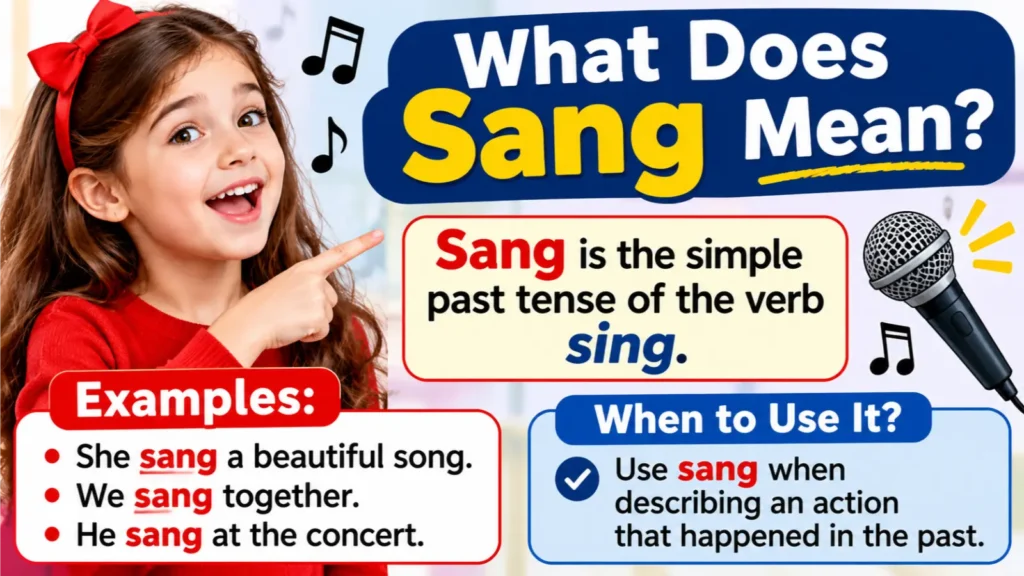
Sang is the simple past tense of the verb sing. Use it when describing an action that happened and finished in the past.
It usually appears without a helping verb when expressing a simple past action.
Examples:
- She sang a beautiful song yesterday.
- We sang together at the family party.
- He sang at the school competition.
- My brother sang his favorite song.
- The children sang during the celebration.
In each sentence, the singing happened in the past.
When Should You Use Sang?
Use sang when:
- An action happened yesterday.
- You describe a completed singing performance.
- You talk about a past event.
- You mention something someone did earlier.
For example, “I sang at my friend’s wedding last weekend” is correct because the event has already happened.
What Does Sung Mean?
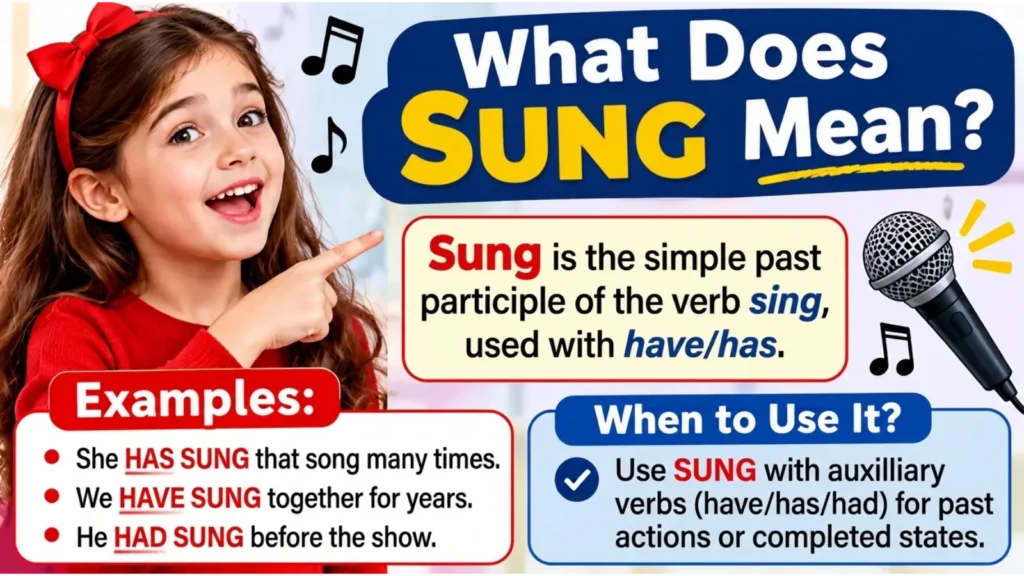
Sung is the past participle of the verb sing. It generally appears with helping verbs such as has, have, and had.
Unlike sang, sung normally cannot stand alone as the main past-tense verb in a standard sentence.
Examples:
- She has sung this song before.
- They have sung together many times.
- He had sung before the audience arrived.
- I have sung in several school programs.
- The national anthem was sung by the students.
Sung is also used in passive voice constructions with forms of the verb be.
When Should You Use Sung?
Use sung when:
- You use the present perfect tense.
- You use the past perfect tense.
- You form a passive sentence.
- You describe an experience without focusing on a specific finished time.
For example, “She has sung this song many times” is correct because has is followed by the past participle sung.
Sang vs. Sung: Grammar Rules You Should Know
The easiest way to understand these words is to remember their grammatical roles.
| Verb Form | Grammatical Use | Example |
|---|---|---|
| Sing | Present tense | I sing every day. |
| Sang | Simple past | I sang yesterday. |
| Sung | Past participle | I have sung before. |
Follow these basic rules:
Rule 1: Use sang for simple past tense.
Example: She sang at the concert last night.
Rule 2: Use sung after has, have, or had.
Example: She has sung at many concerts.
Rule 3: Use sung in passive voice.
Example: The song was sung by the children.
Rule 4: Do not use sang directly after has, have, or had.
Incorrect: He has sang a song.
Correct: He has sung a song.
Sentence Structure: How to Use Sang and Sung
Understanding sentence structure makes it easier to choose the correct verb.
Simple Past Tense
Structure: Subject + sang + object.
Examples:
- She sang a lovely melody.
- They sang the school song.
- I sang my favorite tune.
Present Perfect Tense
Structure: Subject + has/have + sung + object.
Examples:
- She has sung this song.
- We have sung together.
- He has sung professionally.
Past Perfect Tense
Structure: Subject + had + sung + object.
Examples:
- She had sung before the show started.
- They had sung the song already.
- I had sung that melody before.
Passive Voice
Structure: Subject + was/were + sung.
Examples:
- The song was sung beautifully.
- The national anthem was sung by the students.
- Several songs were sung during the event.
Common Mistakes When Using Sang and Sung
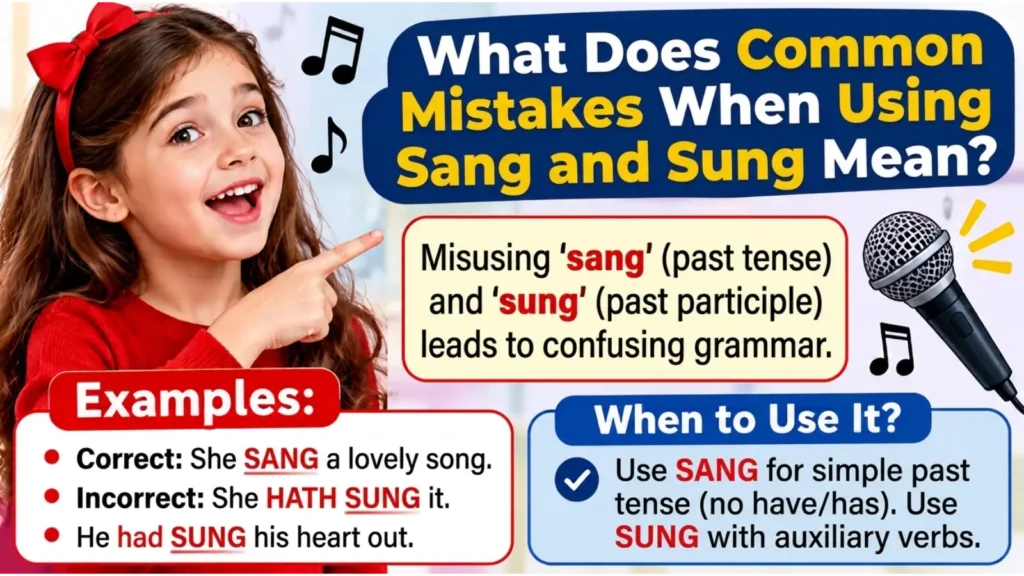
Many English learners confuse these forms because both describe singing in the past. However, using the wrong form can make a sentence grammatically incorrect.
Here are some common mistakes to avoid.
| Incorrect Sentence | Correct Sentence |
|---|---|
| She has sang a song. | She has sung a song. |
| I have sang before. | I have sung before. |
| They had sang together. | They had sung together. |
| He sung yesterday. | He sang yesterday. |
| We sung at the party. | We sang at the party. |
| She has sang beautifully. | She has sung beautifully. |
Why Do These Mistakes Happen?
People often use sung and sang interchangeably because they come from the same verb. The easiest solution is to check whether the sentence needs a simple past verb or a past participle.
Remember that sang describes a completed past action, while sung usually needs a helping verb or a passive construction.
Professional Usage of Sang and Sung
Both words are common in professional English. Writers, journalists, teachers, and editors use them according to standard grammar rules.
Professional examples with sang:
- The artist sang several popular songs during the event.
- The choir sang for the visiting guests.
- The performer sang a traditional melody.
Professional examples with sung:
- The artist has sung at international events.
- Several traditional songs have been sung by the choir.
- The anthem had been sung before the ceremony began.
Choosing the correct form makes professional writing clearer and more polished.
Are Sang and Sung Different in Formal and Informal Writing?
There is no difference in their grammatical rules between formal and informal English. Both forms are correct when used in the right sentence.
In informal conversations, people might make mistakes or use incorrect forms. However, standard written English follows the same rules in emails, essays, reports, and professional documents.
Examples:
- Informal: I sang that song yesterday.
- Formal: The performer sang the national anthem during the ceremony.
- Informal: I have sung that song before.
- Formal: The singer has sung this composition on several occasions.
The level of formality changes the wording, not the grammatical form of the verb.
Easy Ways to Remember Sang and Sung
If you frequently forget which word to use, these simple memory tricks can help.
Remember the Three Verb Forms:
Sing → Sang → Sung
Trick 1: Sang Goes With the Simple Past
Think of yesterday or last night. If someone completed a singing action in the past, use sang.
Example: I sang yesterday.
Trick 2: Sung Needs a Helping Verb
Remember common combinations such as has sung, have sung, and had sung.
Example: She has sung beautifully.
Trick 3: Learn a Simple Pattern
- Today: I sing.
- Yesterday: I sang.
- Before now: I have sung.
Practicing these three examples can help you remember the correct forms.
Real-Life Conversations Using Sang and Sung
Learning through everyday conversations makes grammar easier to understand.
Conversation 1: Talking About Yesterday
Anna: Did you sing at the party yesterday?
James: Yes, I sang my favorite song.
Anna: Was everyone enjoying it?
James: Yes, everyone loved it.
Conversation 2: Discussing Experience
Emma: Have you ever sung in front of a large audience?
David: Yes, I have sung at several school events.
Emma: That sounds exciting!
David: It really was.
Conversation 3: Talking About a Performance
Mike: Who sang at the concert last night?
Sarah: A local singer performed.
Mike: Has she sung there before?
Sarah: Yes, she has sung there several times.
Frequently Asked Questions About Sung or Sang
Is It Sang or Sung Yesterday?
Use sang with yesterday because it describes a completed action in the simple past tense.
Correct: She sang yesterday.
Is It Has Sang or Has Sung?
Use has sung because has must be followed by the past participle of sing.
Correct: He has sung this song before.
Is Sung the Past Tense of Sing?
No. Sang is the simple past tense of sing, while sung is its past participle.
Can I Use Sung Without a Helping Verb?
Yes, sung can appear in passive constructions, such as “The song was sung beautifully.” However, it does not normally replace sang in simple past sentences.
What Are the Three Forms of Sing?
The three main forms are sing, sang, and sung. Sing is the present form, sang is the simple past, and sung is the past participle.
Conclusion
Understanding sung or sang becomes easy when you learn their different grammatical roles. Use sang when describing a completed action in the past, such as “She sang at the concert yesterday.” Choose sung when using helping verbs such as has, have, or had, as in “She has sung at many concerts.”
Remember the simple pattern: Sing, Sang, Sung. With regular practice and a few everyday examples, you can use these verb forms correctly in conversations, schoolwork, and professional writing.