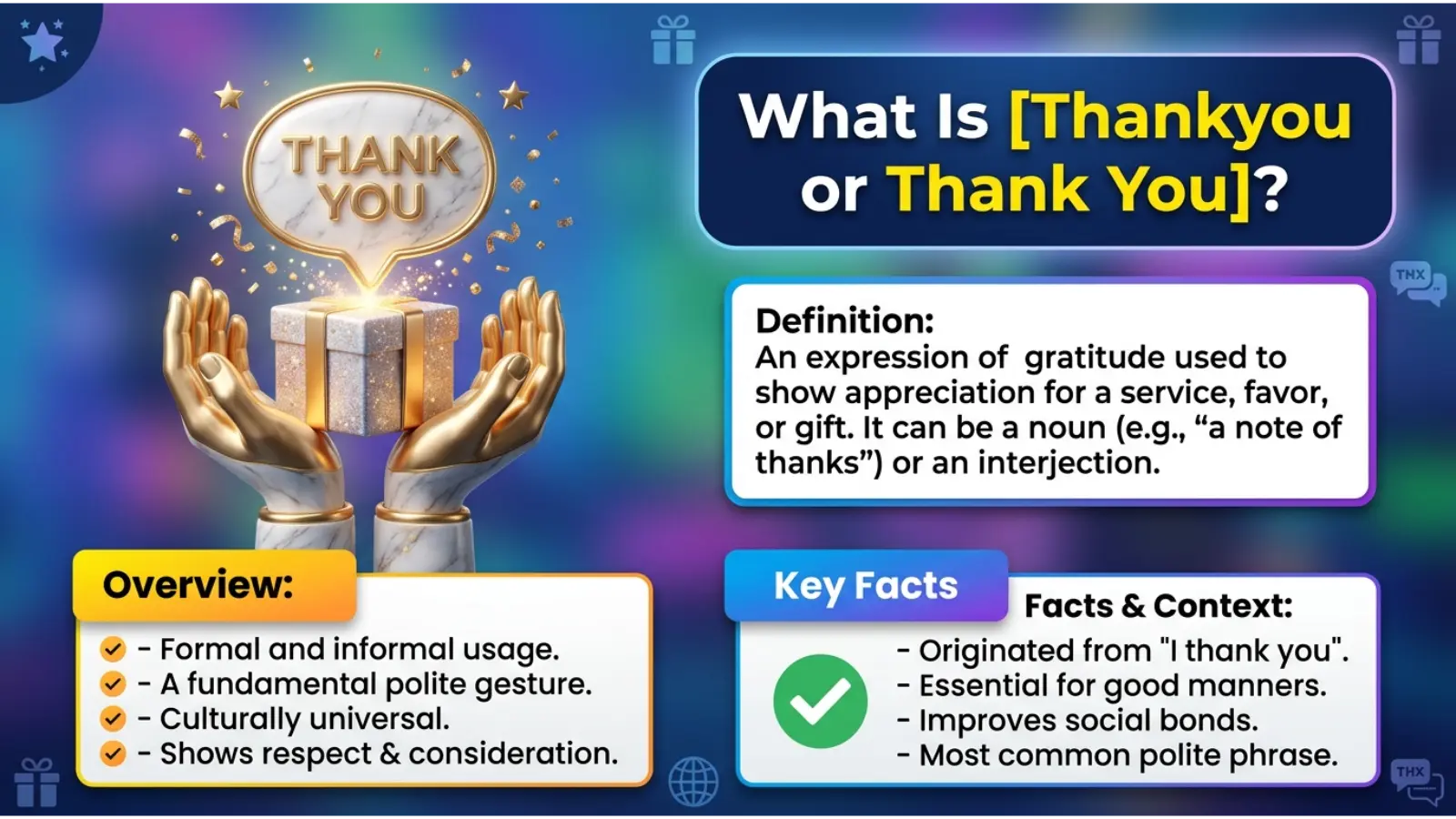
Is it thankyou or thank you? Many English learners and writers become confused when deciding whether this common expression should be written as one word or two. Although both forms appear in online conversations, only one is accepted as the standard spelling in modern English.
The correct form is thank you, written as two separate words. It is a polite expression used to show gratitude, appreciation, and kindness. However, people sometimes combine the words when typing quickly or sending informal messages. Therefore, understanding the spelling, meaning, and grammatical usage can help you avoid mistakes in everyday and professional writing.
Quick Answer: Thankyou or Thank You?
The correct spelling is thank you, not “thankyou.” This expression contains two separate words: “thank” and “you.” Together, they communicate appreciation toward another person.
Although “thankyou” sometimes appears in casual online communication, it is not the standard spelling. Therefore, you should always write “thank you” in school assignments, business emails, professional documents, and everyday messages.
Here are some examples:
- Correct: Thank you for your help.
- Incorrect: Thankyou for your help.
- Correct: Thank you for your kindness.
- Incorrect: Thankyou for your kindness.
- Correct: Thank you for your time.
Remember: Always leave a space between “thank” and “you” when expressing gratitude.
What Does Thank You Mean?
Thank you is a common English expression used to show appreciation for something someone has done, given, or offered. It communicates politeness and recognizes another person’s kindness or effort.
For example, you can say thank you when someone gives you a gift, helps you complete a task, or offers useful advice. Similarly, people use this expression to respond politely to invitations, compliments, and professional assistance.
Examples:
- Thank you for helping me with my homework.
- Thank you for the beautiful birthday gift.
- Thank you for your valuable advice.
- Thank you for inviting me to dinner.
- Thank you for answering my question.
Moreover, this expression works in almost every social situation. Whether you are talking to a friend, teacher, customer, or colleague, saying thank you helps create a respectful conversation.
What Does Thankyou Mean?
Thankyou is a nonstandard one-word spelling of the expression “thank you.” Although some people use it in text messages, social media captions, or informal online conversations, it is not recommended in standard English writing.
The confusion happens because both words are frequently spoken together. As a result, some writers assume they should also be joined when written.
However, standard English keeps them separate.
Examples of incorrect usage:
- Thankyou for your support.
- I want to say thankyou.
- Thankyou for coming to my party.
Correct alternatives:
- Thank you for your support.
- I want to say thank you.
- Thank you for coming to my party.
Additionally, remember that “thank-you” with a hyphen is a correct form when used as a noun or adjective. For example, “She sent a thank-you card.”
Thankyou vs. Thank You: Key Differences
Although these forms look similar, their spelling and standard usage are different. The following table explains the main differences.
| Feature | Thankyou | Thank You |
|---|---|---|
| Spelling | One word | Two words |
| Standard usage | Nonstandard | Correct |
| Word structure | Incorrect combination | Verb + object |
| Meaning | Intended gratitude | Expression of gratitude |
| Formal writing | Avoid | Recommended |
| Professional emails | Avoid | Appropriate |
| Example | Thankyou for helping. | Thank you for helping. |
As the table shows, “thank you” is the correct expression in standard English. Therefore, choosing the two-word form is the safest option for clear and professional communication.
Origin and History of Thank You
The expression “thank you” has a long history in the English language. The word “thank” comes from Old English, where it was associated with gratitude, appreciation, and expressing thanks.
Over time, English speakers developed the familiar expression “thank you” to acknowledge another person’s kindness or assistance. Meanwhile, the word “you” identifies the person receiving the gratitude.
Today, this expression is used throughout English-speaking countries. Furthermore, it appears in everyday conversations, business communication, academic writing, and formal correspondence.
Its traditional two-word structure also explains why joining the words into “thankyou” is not the standard spelling.
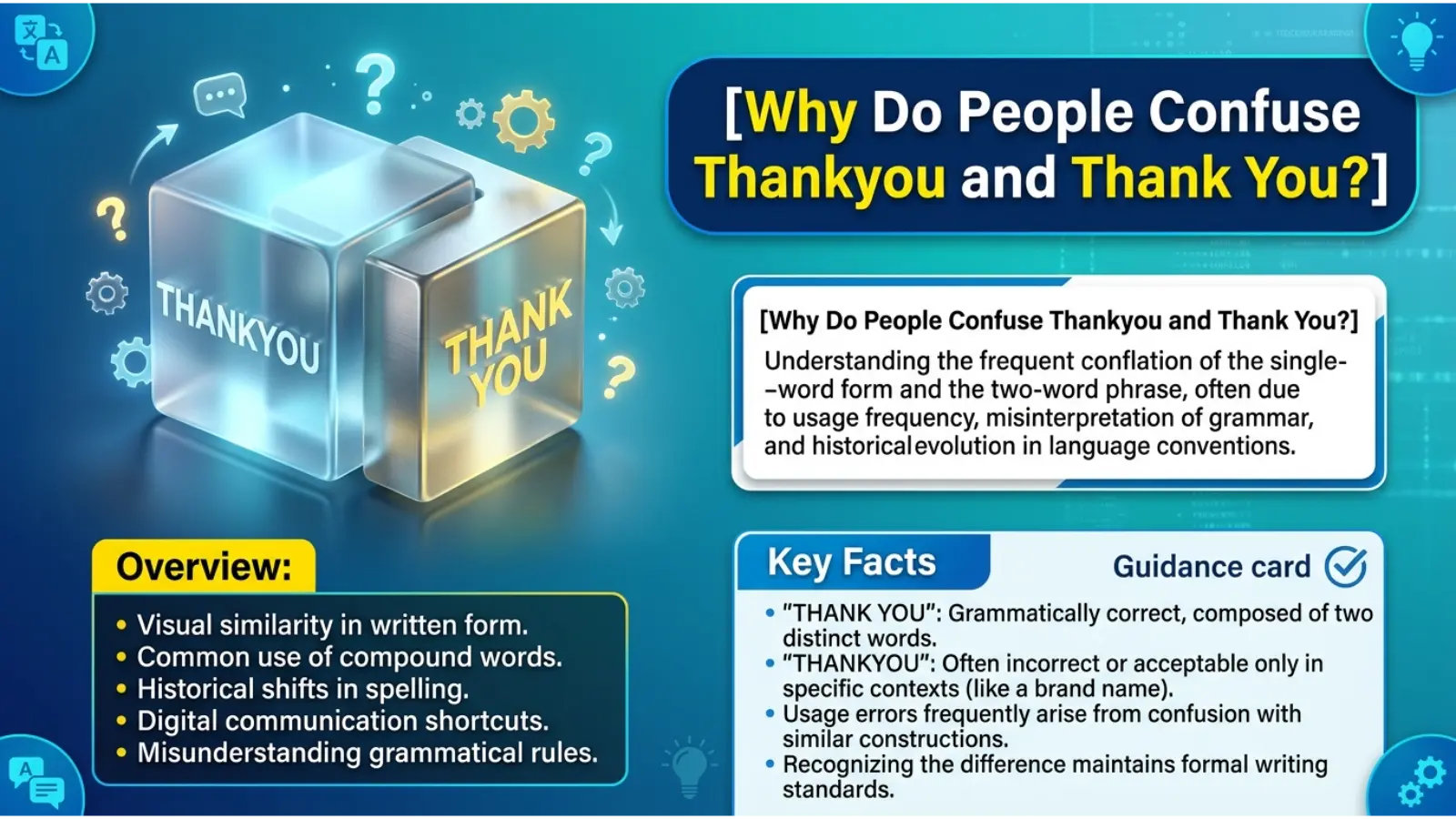
Why Do People Confuse Thankyou and Thank You?
There are several reasons why writers sometimes combine these words. Understanding these reasons can help you recognize and prevent the mistake.
Fast typing: People often type quickly when sending messages. Consequently, they may forget to include a space between two separate words.
Online communication: Social media encourages short and informal messages. Therefore, nonstandard spellings sometimes become familiar through repeated use.
Pronunciation: When spoken naturally, “thank you” sounds like one connected expression. As a result, some learners assume that it should also be written as one word.
Compound word confusion: English contains many combined words, such as “notebook” and “bedroom.” However, this does not mean every frequently used expression should be combined.
Autocorrect habits: Some writers become familiar with incorrect spellings after seeing them repeatedly online. Nevertheless, standard spelling rules still recommend “thank you.”
Dictionary Recommendations: Thankyou or Thank You?
Standard English dictionaries recognize thank you as the conventional expression used to communicate gratitude.
For example, major dictionaries such as Oxford, Cambridge, and Merriam-Webster document “thank you” as an expression of appreciation. Therefore, this two-word spelling is the appropriate choice for standard English.
However, there is another related form worth understanding: thank-you.
The hyphenated form can function as a noun or adjective.
Examples:
- Expression: Thank you for your assistance.
- Noun: She sent a thank-you after the interview.
- Adjective: I received a thank-you card.
- Plural noun: He received several thank-yous.
Consequently, the correct choice depends on how the expression functions in a sentence. Use “thank you” for expressing gratitude and “thank-you” when it functions as a noun or adjective.
Real-Life Examples of Thank You
The expression “thank you” is useful in many situations. Additionally, it can make everyday conversations sound more polite and respectful.
Everyday Conversations
- Thank you for opening the door.
- Thank you for waiting for me.
- Thank you for sharing your lunch.
- Thank you for listening to my story.
- Thank you for helping me today.
Professional Communication
- Thank you for your valuable feedback.
- Thank you for considering my application.
- Thank you for your time and attention.
- Thank you for your continued support.
- Thank you for your prompt response.
Personal Messages
- Thank you for remembering my birthday.
- Thank you for always being there.
- Thank you for making my day special.
- Thank you for your thoughtful gift.
- Thank you for making me smile.
Formal Situations
- Thank you for your consideration.
- Thank you for this wonderful opportunity.
- Thank you for your cooperation.
- Thank you for reviewing my documents.
- Thank you for your assistance.
As these examples demonstrate, the two-word spelling is appropriate in different communication styles. Moreover, you can use it in both short messages and longer professional sentences.
Common Mistakes When Writing Thank You
Even familiar expressions can cause spelling problems. Fortunately, a few simple rules can help you avoid these errors.
Writing Thankyou as One Word
Incorrect: Thankyou for your assistance.
Correct: Thank you for your assistance.
Always separate the two words when expressing gratitude. Otherwise, your writing may look unprofessional.
Adding Unnecessary Punctuation
Incorrect: Thank, you for helping me.
Correct: Thank you for helping me.
There is no need to place a comma between these two words. However, you can use a comma after the expression when the sentence structure requires it.
Confusing Thank You with Thank-You
Incorrect: I sent a thank you card.
Better: I sent a thank-you card.
In this example, “thank-you” works as an adjective describing the word “card.” Therefore, the hyphenated form is appropriate.
Using the Wrong Form in Emails
Incorrect: Thankyou for your quick response.
Correct: Thank you for your quick response.
Professional emails should follow standard spelling conventions. Consequently, using the correct two-word expression helps create a positive impression.
Memory Trick: How to Remember Thank You
Remembering the correct spelling is simple when you understand the purpose of each word.
- Thank: Expresses gratitude or appreciation.
- You: Identifies the person receiving the gratitude.
Think of the sentence “I thank you for your help.” Because “thank” and “you” perform separate grammatical roles, they should remain separate.
Another useful trick is to remember this simple rule:
Two words, one expression of gratitude.
Whenever you write this expression, check that there is a space between both words. This small habit can prevent repeated spelling mistakes.
Professional Writing Recommendation
In professional communication, always use thank you as two separate words when expressing gratitude. This spelling follows standard English conventions and is suitable for business emails, academic assignments, applications, reports, and formal letters.
For example:
- Thank you for reviewing my application.
- Thank you for your valuable suggestions.
- Thank you for your quick response.
- Thank you for considering my proposal.
- Thank you for your continued cooperation.
Additionally, use “thank-you” when the expression functions as a noun or adjective. For instance, you might write, “Please send a thank-you note after the meeting.”
Therefore, understanding the difference between these forms will help you write more accurately. Most importantly, avoid using “thankyou” as one word in professional documents.
Frequently Asked Questions
Is thankyou one word or two?
The standard expression is written as two words: “thank you.” Although “thankyou” appears in informal online communication, it is not the accepted standard spelling.
Is thankyou grammatically correct?
No, not as the ordinary expression of gratitude in standard English. Instead, use “thank you” to show appreciation.
Why is thank you written as two words?
The expression contains the verb “thank” and the pronoun “you.” Since both words have separate grammatical functions, they are written separately.
Is thank-you with a hyphen correct?
Yes. The hyphenated form is correct when used as a noun or adjective. For example, “thank-you note” and “thank-you gift” are standard expressions.
Can I write thankyou in a text message?
You may see this spelling in informal messages and social media posts. However, “thank you” remains the correct standard form, even in casual writing.
What is the plural of thank-you?
The plural noun is “thank-yous.” For example, “She received several thank-yous after the event.”
Is thank you formal or informal?
“Thank you” works in both formal and informal communication. For example, you can use it when speaking to friends, teachers, customers, or business colleagues.
Which is correct: Thank you or Thanks you?
“Thank you” is correct when expressing gratitude directly. “Thanks you” is generally incorrect as a standalone expression. However, “thanks” is also a correct alternative.
Conclusion
The correct spelling is thank you, not “thankyou.” Although both forms may appear online, standard English uses two separate words to express gratitude and appreciation.
Moreover, the hyphenated form “thank-you” is also correct when used as a noun or adjective. Therefore, understanding the difference between these forms will help you avoid common spelling and grammar mistakes.
Finally, whether you are writing a professional email, sending a personal message, or completing an academic assignment, always choose the appropriate form. Remember that “thank you” is the standard expression, and keeping both words separate will make your English clearer and more polished.