Have you ever wondered whether skied or skiied is the correct spelling when describing someone who went skiing? The confusion usually comes from the way English verbs change when we add -ed to form the past tense. Since the word ski ends with the letter i, some people mistakenly add another i before ed. However, English spelling rules do not require an extra i in this case.
The correct spelling is skied, not skiied. When you talk about skiing in the past, use skied in sentences, articles, emails, and other forms of writing. In this guide, you will learn the spelling rule, meaning, origin, examples, common mistakes, and easy ways to remember the correct form.
Quick Answer: Skied or Skiied?
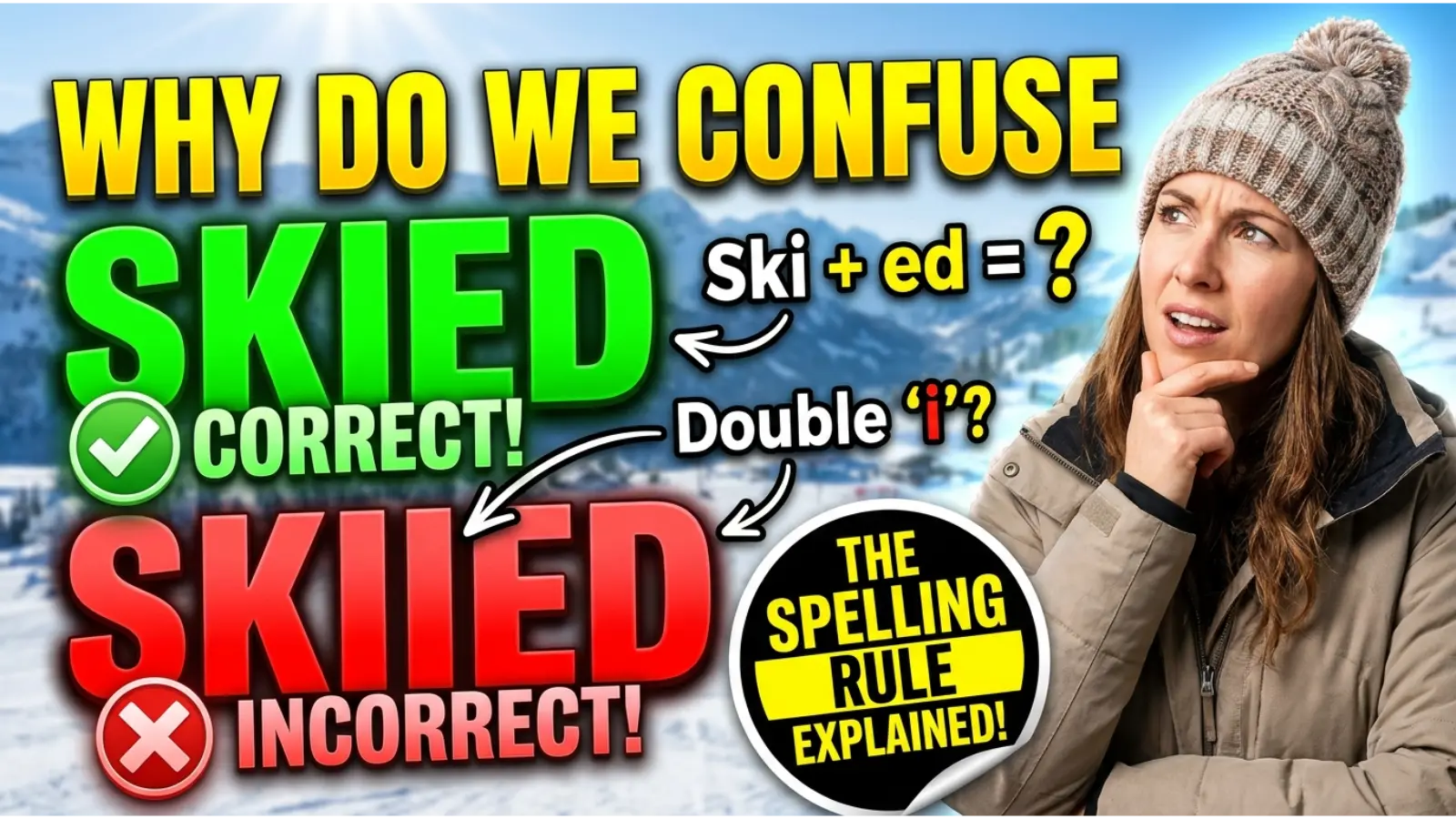
Skied is the correct past tense and past participle of the verb ski. The spelling skiied is incorrect in standard English.
For example:
- Correct: We skied down the mountain yesterday.
- Incorrect: We skiied down the mountain yesterday.
The verb ski takes -ed to form its past tense, but the spelling changes slightly. English drops the final i and replaces it with i before the e in the ending, resulting in skied.

What Does Skied Mean?
Skied is the past tense and past participle of ski. It describes the action of moving over snow on skis, usually for recreation, sport, or transportation.
People use the word when talking about skiing activities that happened in the past. It can describe a single person, a group, or an experience on a snowy slope.
Examples:
- She skied across the snowy valley last weekend.
- We skied in the mountains during our winter vacation.
- He has skied in several countries.
In each sentence, skied shows that the skiing activity happened in the past or has already been completed.

Why Is Skied Correct and Skiied Incorrect?
The confusion between skied and skiied comes from the unusual spelling of the base verb ski. Many English learners expect to keep all the original letters and simply add -ed to the end.
However, the verb ski follows a spelling pattern in which the final i becomes part of the -ied ending. Therefore, writers use skied rather than skiied.
| Word | Status | Explanation |
|---|---|---|
| Skied | Correct | Standard past tense and past participle of ski |
| Skiied | Incorrect | Adds an unnecessary extra i |
Although skiied may look logical at first, it does not follow the standard spelling used in modern English dictionaries.
Skied or Skiied: Spelling Rule Explained
The verb ski follows a spelling pattern that differs from verbs such as play or walk.
- Base form: Ski
- Past tense: Skied
- Past participle: Skied
- Present participle: Skiing
When forming the past tense, English uses -ed with the verb, but the final i combines with the ending’s i pattern in writing, giving skied.
Here are a few examples of verbs that follow different spelling patterns:
| Base Verb | Past Tense |
|---|---|
| Ski | Skied |
| Cry | Cried |
| Try | Tried |
| Play | Played |
| Walk | Walked |
Although ski and cry have different base forms, both become skied and cried in the past tense. These spellings help readers recognize the completed action without adding unnecessary letters.
Origin of the Word Ski and Skied
The word ski comes from Norwegian, where it originally referred to a long piece of wood used for traveling over snow. The term entered English through Scandinavian languages and became widely associated with winter sports and snow travel.
As English speakers adopted the verb ski, they also developed its regular grammatical forms, including skied and skiing.
Today, ski functions as both a noun and a verb. The noun describes the equipment used for skiing, while the verb describes the activity itself.
For example:
- Noun: He bought a new ski for the trip.
- Verb: They skied throughout the afternoon.
The past-tense form skied has become the standard spelling in modern English.
Why Do People Confuse Skied and Skiied?
Several reasons explain why writers confuse these two spellings.
The Word Ski Ends in I
The base word ski ends in the letter i. As a result, some writers assume that adding -ed requires two consecutive i letters.
However, the standard spelling is skied, not skiied.
English Spelling Rules Can Be Confusing
English verbs change in different ways when forming the past tense. For example, try becomes tried, play becomes played, and stop becomes stopped.
Because these patterns vary, writers sometimes apply the wrong spelling rule to ski.
People Follow the Wrong Visual Pattern
Some people believe that preserving every letter of the original word makes the spelling correct. Nevertheless, English spelling conventions do not always preserve the original letter sequence when forming new verb forms.
That is why skied is the accepted spelling.
What Do Dictionaries Recommend?
Major English dictionaries recognize skied as the standard past tense and past participle of ski.
Dictionary entries generally list the verb forms as:
- Ski
- Skied
- Skiing
The spelling skiied is not the standard form recommended for modern English writing.
Therefore, writers, students, bloggers, editors, and professionals should use skied whenever they describe a skiing activity that happened in the past.
Skied Examples in Real-Life Sentences
Understanding the spelling becomes easier when you see skied in different contexts.
Everyday Examples
- I skied with my friends last winter.
- She skied for three hours yesterday.
- We skied on the mountain during our holiday.
- My brother skied for the first time last year.
- They skied together after breakfast.
Professional and Formal Examples
- The athlete skied through the challenging course.
- The team skied across the designated training area.
- Several participants skied during the winter event.
- The instructor skied ahead to demonstrate the technique.
- The visitors skied safely under the supervision of trained guides.
Examples Using the Past Participle
- I have skied on several mountain resorts.
- She had skied before joining the competition.
- They have skied in difficult weather conditions.
- He has skied professionally for many years.
- We had skied all morning before taking a break.
These examples show how skied works in simple past, present perfect, and past perfect sentences.
Common Mistakes When Using Skied
Writers sometimes make spelling or grammatical mistakes when using skied. Here are some common errors to avoid.
| Incorrect | Correct |
|---|---|
| I skiied yesterday. | I skied yesterday. |
| She skiied in the Alps. | She skied in the Alps. |
| They skiied all morning. | They skied all morning. |
| He has skiied before. | He has skied before. |
| We skiied down the hill. | We skied down the hill. |
The most common mistake is adding an extra i. To avoid this problem, remember that the past tense of ski is always skied in standard English.
Memory Trick: How to Remember Skied
A simple trick can help you remember the correct spelling.
Ski + ed = Skied
Remember that ski does not need an extra i when forming the past tense. Simply use skied.
You can also remember this sentence:
“I skied yesterday, not skiied yesterday.”
Repeating this sentence whenever you write about skiing can help you remember the correct spelling.
Professional Writing Recommendation
In professional writing, always use skied rather than skiied. The correct spelling appears in standard English dictionaries and follows the accepted spelling convention for the past tense and past participle of ski.
Whether you write travel articles, sports reports, academic assignments, blog posts, emails, or social media captions, skied is the appropriate choice.
Moreover, using the correct spelling improves readability and helps readers trust your writing. If you are unsure, check a reliable dictionary before publishing your work.
Frequently Asked Questions
Is Skied or Skiied correct?
Skied is correct. Skiied is a misspelling because it adds an unnecessary extra i. Use skied when describing skiing that happened in the past.
Is skied the past tense of ski?
Yes. Skied is the simple past tense of ski. For example, “We skied last weekend.”
Is skied also a past participle?
Yes. Skied is both the simple past tense and the past participle of ski. For example, “She has skied before.”
Why is skiing spelled with two i letters?
Skiing uses two consecutive i letters because English adds -ing to the base verb ski without removing the final i. However, the past tense is skied, not skiied.
Is skiied ever acceptable in English?
Skiied is not accepted as the standard spelling in modern English. Writers should use skied in both casual and formal writing.
What is the difference between ski, skied, and skiing?
Ski is the base verb, skied is the past tense and past participle, and skiing is the present participle or gerund. Each form serves a different grammatical purpose.
Conclusion
The correct spelling is skied, not skiied. The word skied serves as both the past tense and past participle of ski, describing an activity that happened in the past or has been completed.
Although skiied may look reasonable because the base word ends in i, standard English uses skied. Therefore, remember the simple rule: ski becomes skied when you describe a past skiing activity.