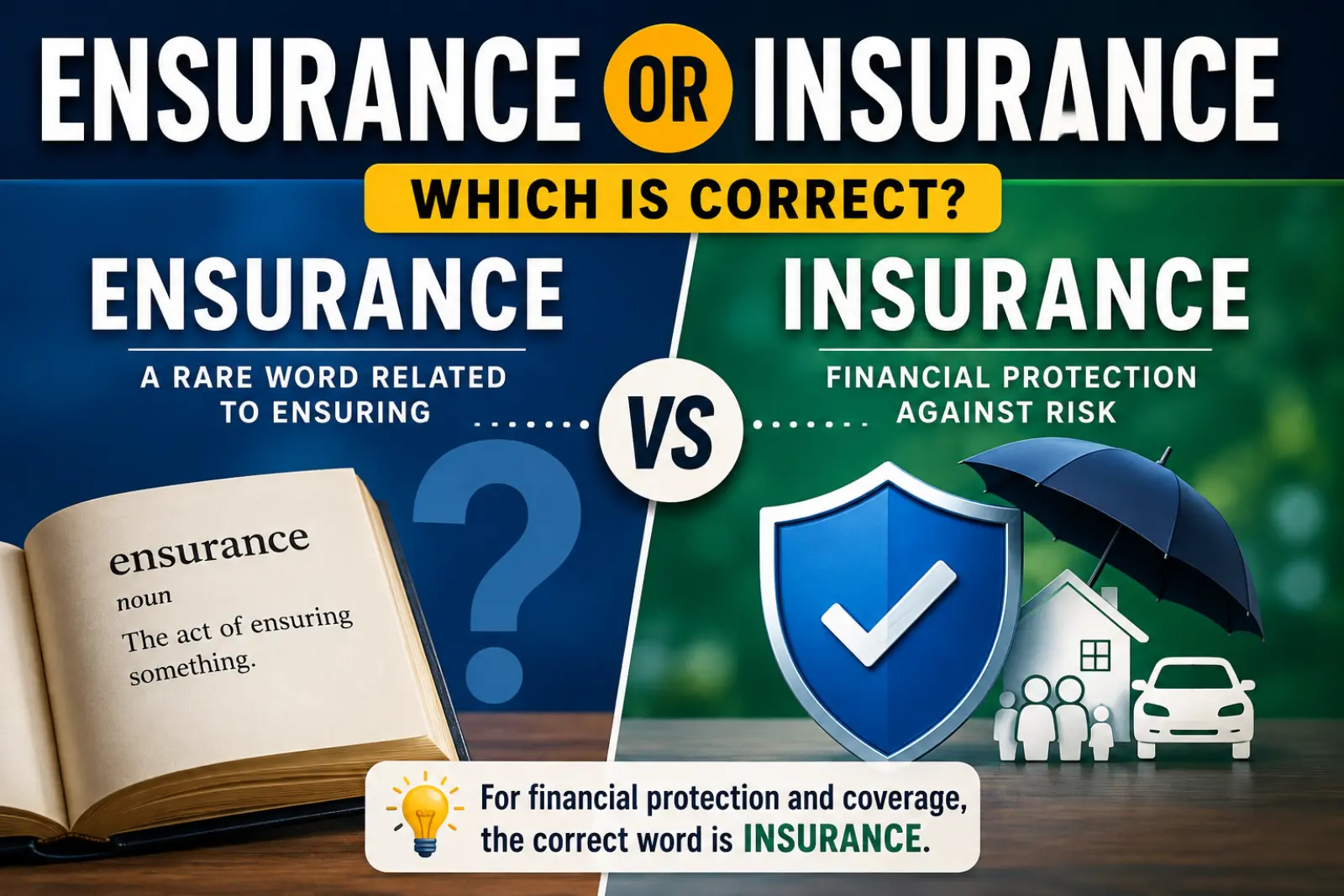
Ensurance or insurance is a common spelling question because both words look and sound similar. However, they are not equally common in modern English.
Insurance is the standard word used for financial protection against risks such as accidents, illness, property damage, or loss. It is the word you will see in phrases such as health insurance, car insurance, and life insurance.
Ensurance is a real word, but it is rare. It can refer to the act of ensuring something or making something certain. In modern everyday English, however, people normally use ensuring or assurance instead.
Therefore, if you are talking about an insurance policy or financial coverage, the correct choice is insurance.
Quick Answer
Insurance is the correct and standard word when you mean financial protection or coverage.
- ✅ Insurance = protection against financial loss or risk
- ⚠️ Ensurance = a rare word related to ensuring something
- Insurance is the normal choice in modern English.
- Use insurance in business, legal, financial, and professional writing when discussing coverage.
For example:
I need health insurance.
Not:
I need health ensurance.
What Does “Insurance” Mean?
Insurance is an arrangement that provides financial protection against a particular risk.
Usually, a person or organization pays a premium to an insurance company. In return, the company may provide financial compensation when a covered event occurs.
Common types include:
- Health insurance
- Car insurance
- Life insurance
- Home insurance
- Travel insurance
- Business insurance
- Property insurance
Examples
I need to renew my car insurance.
Her health insurance covers the treatment.
We bought travel insurance before our trip.
The company provides life insurance to its employees.
This is the standard modern meaning of insurance.
What Does “Ensurance” Mean?
Ensurance is a much less common word.
It is connected with the verb ensure, which means to make certain that something happens or is true.
In theory, ensurance can refer to the act of ensuring something.
However, modern speakers rarely use it this way. They are much more likely to say:
- ensuring
- assurance
- guarantee
- certainty
For example, instead of writing:
The ensurance of quality is important.
Modern English would normally use:
Ensuring quality is important.
Or:
Quality assurance is important.
This is why ensurance can look familiar but still sound unusual to most readers.
Ensurance vs. Insurance: Comparison Table
| Word | Meaning | Modern Usage | Example |
| Insurance | Financial protection against risk | Very common | I have car insurance. |
| Ensurance | The act of ensuring something | Rare | The ensurance of safety was discussed. |
| Ensure | Make certain | Common | We must ensure quality. |
| Assurance | Confidence or a promise that something is certain | Common | The company gave an assurance of quality. |
The biggest difference is not simply spelling. The words belong to different meanings and uses.
Why Is It “Insurance” Instead of “Ensurance”?
The confusion makes sense because insurance looks like it should come from ensure.
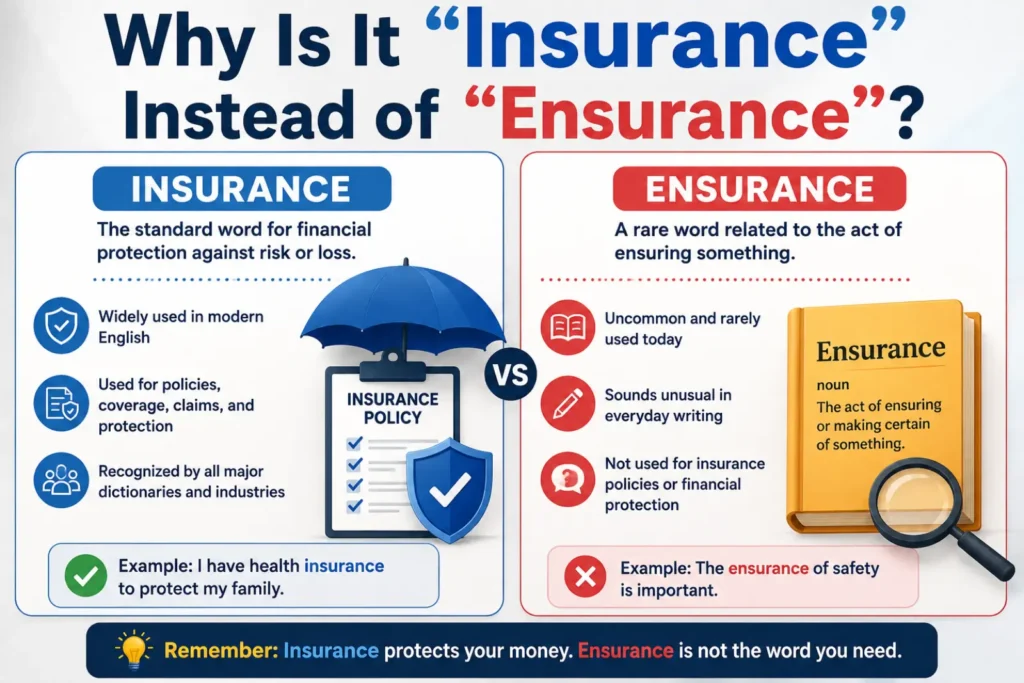
The two words are historically related to the broader idea of making something safe or certain. Over time, however, insurance developed its specific modern meaning connected with protection against risk.
Today, English treats insurance as the established term for financial coverage.
This is why expressions such as these are standard:
- health insurance
- auto insurance
- home insurance
- insurance policy
- insurance company
- insurance claim
Ensurance company and ensurance policy are not the normal terms.
The Difference Between Ensure and Insure
Understanding ensure and insure makes this spelling issue much easier.
Ensure
Ensure means make certain.
Please ensure that the door is locked.
The sentence is about making something certain.
Insure
Insure commonly means provide or obtain insurance.
We need to insure the car.
The sentence is about insurance coverage.
Insurance
Insurance is the noun related to this financial protection.
We need car insurance.
So remember:
ensure → make certain
insure → protect through insurance
insurance → financial protection
Where Does “Insurance” Come From?
The word insurance developed from forms related to insure, which came through French from Latin roots associated with making something safe or secure.
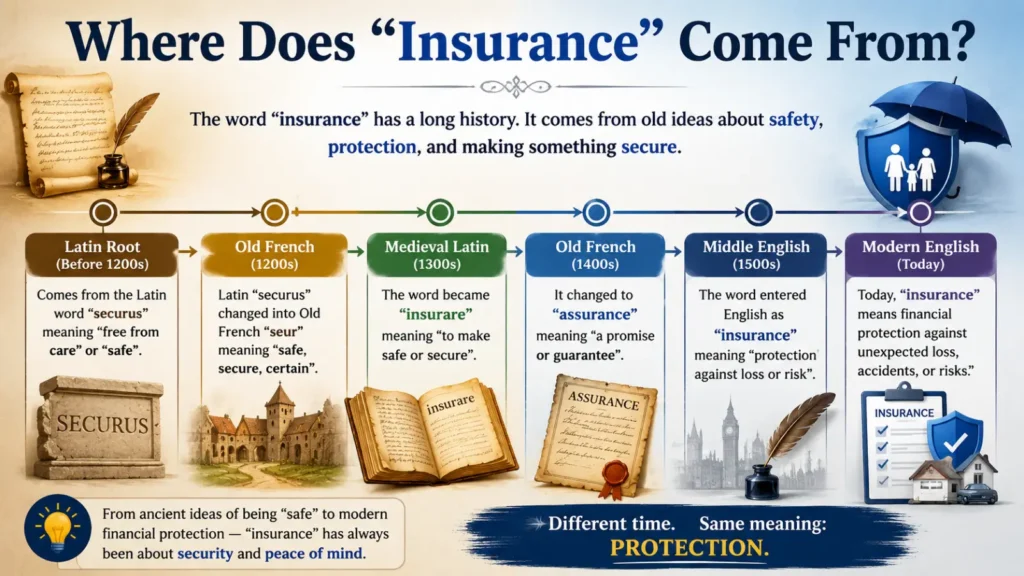
Its meaning gradually developed around the idea of protection and security. In modern English, it became strongly associated with financial arrangements that protect people and organizations from specified risks.
That is why insurance now has a very specific everyday meaning.
Where Does “Ensurance” Come From?
Ensurance is formed from ensure with the noun-forming ending -ance.
The basic idea is:
ensure → ensurance
However, English does not use every possible word formation equally often.
Although ensurance can be found in dictionaries and historical usage, it has never become as common as insurance in everyday modern English.
This is an important lesson in English vocabulary: a word can be grammatically possible and dictionary-recognized without being the normal choice for modern readers.
Why Do People Confuse “Ensurance” and “Insurance”?
There are several reasons for the confusion.
1. They look almost identical
The words differ by only a few letters:
ensurance
insurance
That makes typing errors easy.
2. They are related in meaning
Both words are connected with ideas such as certainty, safety, and protection.
This makes the distinction less obvious.
3. “Ensure” is a common word
People know the word ensure, so they may naturally assume that its noun form should be ensurance.
However, when talking about financial protection, English uses insurance.
4. Pronunciation can cause uncertainty
Depending on the speaker and accent, the words can sound similar enough to create confusion.
Written English makes the difference clearer.
Dictionary Recommendations
Major dictionaries recognize insurance as the standard modern term for protection against financial loss or risk.
Merriam-Webster defines insurance as a contract or arrangement in which an insurer provides financial protection against specified risks. Cambridge Dictionary likewise defines insurance around arrangements that protect against financial loss or harm.
Dictionaries may also record ensurance, but it is marked or treated as uncommon, obsolete, or rare depending on the dictionary and sense.
This difference in frequency matters. A dictionary entry does not mean that two words are equally useful in modern writing.
For ordinary English, insurance is the clear recommendation when discussing coverage or financial protection.
Real-Life Examples of “Insurance”
Health Insurance
My health insurance covers the cost of the treatment.
Car Insurance
You must have valid car insurance before driving.
Travel Insurance
We purchased travel insurance before leaving the country.
Life Insurance
He has a life insurance policy.
Home Insurance
Our home insurance covers certain types of damage.
These are all standard uses.
Examples of “Ensurance”
Because ensurance is rare, it is not commonly used in everyday conversation.
A formal or historical text might use it to describe the act of making something certain or secure.
For example:
The ensurance of safety was considered essential.
However, modern readers would usually find this wording unnecessarily unusual.
A clearer version would be:
Ensuring safety was considered essential.
Or:
Safety assurance was considered essential.
This is why simply knowing that ensurance exists does not mean you should choose it.
Common Mistakes
Mistake 1: “Health ensurance”
❌ I need health ensurance.
✅ I need health insurance.
When discussing medical coverage, always use insurance.
Mistake 2: “Car ensurance”
❌ Do you have car ensurance?
✅ Do you have car insurance?
The standard term is car insurance.
Mistake 3: Assuming “ensure” becomes “ensurance”
It may seem logical to create:
ensure → ensurance
But that does not make ensurance the normal noun for financial protection.
Use:
ensure → ensuring
and:
insure → insurance
when talking about coverage.
Mistake 4: Using “ensurance” in professional documents
Although the word can be found in English, it may sound unusual or outdated to modern readers.
In business and professional writing, choose familiar wording whenever possible.
Is “Ensurance” Wrong?
Not necessarily.
Ensurance is a recognized word in some dictionary sources, but it is rare and has limited modern use.
So it would be inaccurate to simply say:
“Ensurance is always wrong.”
A better explanation is:
Ensurance exists, but insurance is the standard word for financial protection and coverage.
If you are writing for a general audience, ensurance will usually be the wrong choice for clarity.
Is “Insurance” Always Correct?
No.
Insurance is correct when you mean financial protection against risk.
For example:
I bought travel insurance.
But if you mean making something certain, the better word is usually ensuring.
For example:
We are ensuring that every customer receives support.
You would not normally replace ensuring with insurance.
A Simple Memory Trick
Use this easy rule:
INSURANCE = MONEY + PROTECTION
If you are talking about:
- A policy
- A premium
- A claim
- Coverage
- Financial protection
choose insurance.
Think:
Insurance protects your money from risk.
For ensure, remember:
ENSURE = MAKE SURE
For example:
Please ensure that all documents are complete.
So:
Ensure = make sure
Insurance = financial protection
Professional Writing Recommendation
For professional writing, use insurance when referring to policies, coverage, risk protection, or financial compensation.
This applies to:
- Business documents
- Websites
- Legal and financial content
- Insurance forms
- Marketing materials
- Emails
- Reports
- Blog articles
Avoid ensurance unless you have a specific reason to use the rare noun.
In most cases, a modern alternative such as ensuring, assurance, or guarantee will communicate the idea more clearly.
Better professional examples
Instead of:
The ensurance of customer safety is our priority.
Write:
Ensuring customer safety is our priority.
Instead of:
We offer vehicle ensurance.
Write:
We offer vehicle insurance.
The second examples sound more natural and are easier for readers to understand.
Frequently Asked Questions
Is “ensurance” a real word?
Yes. Ensurance is a dictionary-recognized word, but it is rare and has limited modern usage.
Is insurance the correct spelling?
Yes, when you mean financial protection against risk.
For example:
I need health insurance.
What is the difference between ensurance and insurance?
Insurance refers to financial protection against risk. Ensurance refers to the act of ensuring something and is rarely used in modern English.
Is “ensurance” the same as insurance?
No. Although the words are related in their broader ideas of security and certainty, insurance has the established modern meaning of financial protection.
Should I use ensurance in formal writing?
Usually, no. Even where ensurance is technically possible, ensuring, assurance, or another clearer word is normally better.
Is it “health ensurance” or “health insurance”?
The correct standard phrase is health insurance.
Is it “car ensurance” or “car insurance”?
The standard phrase is car insurance.
Is “ensurance” an American English word?
It is not the normal American English term for financial coverage. Insurance is the standard word.
What is the difference between ensure and insure?
Ensure means to make something certain.
Please ensure the door is locked.
Insure commonly means to protect something through insurance.
We should insure the car.
What is the noun of insure?
The standard noun is insurance.
They bought insurance for the house.
Conclusion
When choosing between ensurance or insurance, the correct word depends on the meaning.
If you mean financial protection, coverage, or a policy, use insurance. It is the standard and widely accepted word in modern English.
Ensurance does exist, but it is rare and is not the normal word for insurance coverage. In modern writing, alternatives such as ensuring, assurance, or guarantee are usually clearer when you mean making something certain.
The easiest way to remember the difference is:
Insurance = protection against financial risk.
Ensure = make sure.
So, when talking about a health policy, car coverage, life policy, or insurance claim, choose insurance.

Alex Wordsmith is a comparison research writer and content specialist at WordComparre.com. He focuses on analyzing word meanings, spelling variations, grammar distinctions, and language usage to help readers make informed writing choices. Through clear explanations and practical examples, Alex simplifies complex language topics for students, writers, and professionals. His goal is to make English learning easier, more accurate, and accessible for everyone.