
If you are unsure whether to write frige or fridge, you are not alone. The two spellings look almost identical, and the word comes from the longer word refrigerator, which makes its spelling less obvious.
The correct spelling is fridge when you mean a refrigerator. Frige is not the standard spelling for the appliance.
This small spelling difference is easy to miss because fridge is pronounced /frɪdʒ/, while the letters do not seem to follow the spelling pattern of the word refrigerator. The extra d is important because it helps show the intended pronunciation.
Quick Answer: Frige or Fridge?
Fridge is the correct spelling.
- Fridge = a refrigerator, especially an informal term.
- Frige = an incorrect spelling when referring to a refrigerator.
For example:
Please put the milk in the fridge.
Not:
Please put the milk in the frige.
Major dictionaries, including Merriam-Webster, Cambridge, Oxford, and Collins, recognize fridge as the standard word. Merriam-Webster lists its first known use as 1926, while Oxford describes it as an abbreviation influenced by the brand name Frigidaire.
What Does “Fridge” Mean?
Fridge is an informal noun meaning refrigerator. It refers to an electrical appliance used to keep food and drinks cold and fresh.
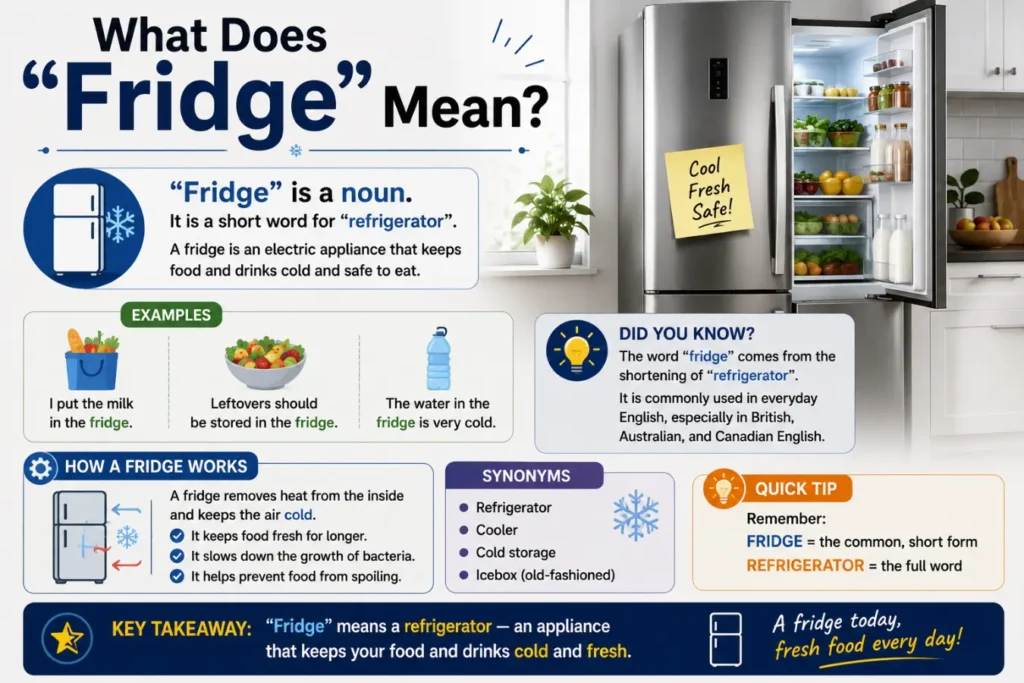
For example:
- I put the vegetables in the fridge.
- There is some juice in the fridge.
- The fridge is almost empty.
- Please close the fridge door.
Cambridge defines fridge as kitchen equipment that uses electricity to preserve food at a cold temperature. Oxford likewise defines it as electrical equipment in which food is kept cold so that it stays fresh.
What Does “Frige” Mean?
Frige is not the standard English spelling of the appliance.
If you write frige when you mean fridge, readers will generally understand what you mean, but the spelling is considered an error in standard English.
The correct form is:
fridge
not:
frige
Frige vs. Fridge: Comparison Table
| Word | Correct? | Meaning | Usage |
| fridge | Yes | Refrigerator | Informal and common |
| frige | No | Intended to mean refrigerator | Spelling mistake |
| refrigerator | Yes | Appliance used to keep food cold | More formal and standard |
| frig | Yes, but uncommon | Refrigerator | Less common informal variant |
Merriam-Webster recognizes frig as a less common spelling of fridge, but this should not be confused with frige.
Why Is “Fridge” Spelled With a D?
This is the part that causes most of the confusion.
At first glance, fridge seems strange because it is a shortened form of refrigerator, which does not contain a d.
However, spelling does not always follow the exact letters of the original word.
Merriam-Webster explains that fridge developed as a shortened form of refrigerator. The d was used to help make the pronunciation clear, particularly because the g in fridge has the same soft sound found in words such as bridge and lodge.
So:
refrigerator → fridge
The spelling is not simply:
refrigerator → frige
The d is part of the established spelling of the shortened word.
Where Did “Fridge” Come From?
The word fridge appeared in English in the early 20th century. Merriam-Webster gives 1926 as its first known use.
Its development is connected to refrigerator and may also have been influenced by Frigidaire, an early and well-known refrigerator brand.
Oxford dates the word to the 1920s and says it was probably influenced by the proprietary name Frigidaire. Collins similarly gives its origin as a shortening of refrigerator or Frigidaire.
The longer word refrigerator itself is much older. Etymonline traces its use as a noun to the early 1600s, with its modern appliance-related meaning developing later.
Why Do People Write “Frige”?
There are several reasons people accidentally write frige.
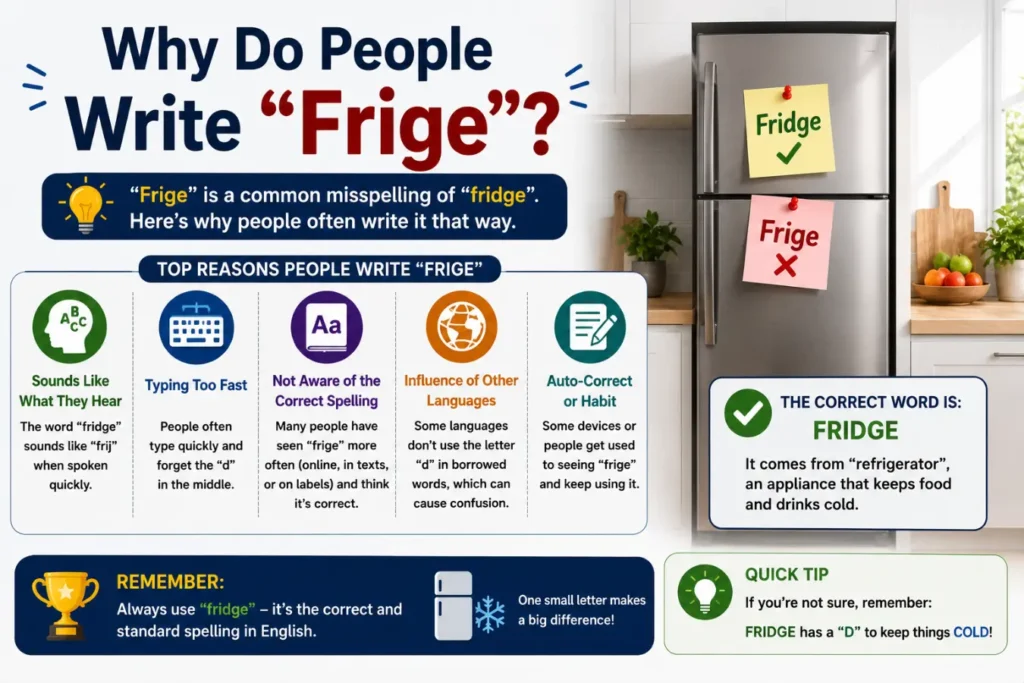
1. The word is a shortened form
People naturally expect a shortened word to preserve the letters from its original form. Because refrigerator contains no d, frige can look logical.
2. The pronunciation can be misleading
Fridge is pronounced /frɪdʒ/. The final sound is similar to the sound in words such as:
- bridge
- badge
- lodge
- edge
This makes the d easy to overlook when spelling the word from memory.
3. “Frige” looks visually simple
When people pronounce the word, they hear something close to “frij.” Someone who is spelling it based on sound may naturally choose frige.
But English spelling often uses letter combinations that are not completely predictable from pronunciation.
What Do Dictionaries Say?
The major dictionaries consistently recognize fridge.
Merriam-Webster
Merriam-Webster defines fridge as a shortened and altered form and records its first known use in 1926.
Cambridge Dictionary
Cambridge lists fridge as a noun meaning a refrigerator. It identifies the word as especially British or informal in American English, where refrigerator is more usual.
Oxford
Oxford lists fridge as especially British English and notes that refrigerator is used in North American English or in formal contexts.
Collins
Collins also lists fridge as an informal shortened form of refrigerator and notes that it is mainly British in its learner dictionary entry.
Across these sources, the important point is clear: fridge is the established spelling.
British vs. American Usage
There is a useful regional difference to remember.
In British English, fridge is extremely common:
The milk is in the fridge.
In American English, refrigerator is often preferred in more formal or neutral contexts, although fridge is also understood and used informally. Cambridge identifies fridge as UK or informal US usage, while Oxford lists it as informal in North American English.
So this is not mainly a spelling difference between British and American English.
The spelling remains:
fridge
The main difference is which word is preferred in a particular variety or situation:
- British English: fridge is very common.
- American English: refrigerator is often preferred in formal writing, while fridge is common in informal speech and writing.
Real-Life Examples of “Fridge”
Here are natural examples of the correct spelling:
Everyday conversation
I’ll put the leftovers in the fridge.
Recipe instructions
Chill the mixture in the fridge for 30 minutes.
Household writing
The new fridge has a larger freezer compartment.
Informal message
Can you get some milk from the fridge?
British English
There’s nothing in the fridge for dinner.
American informal English
I’ll check the fridge before we order food.
These uses agree with dictionary examples and common modern usage.
Common Mistakes With “Fridge”
Mistake 1: Writing “frige”
Incorrect:
The milk is in the frige.
Correct:
The milk is in the fridge.
Mistake 2: Removing the D because it is not in “refrigerator”
Incorrect reasoning:
Refrigerator has no D, so the short form should be frige.
The established spelling is fridge, regardless of the spelling of refrigerator.
Mistake 3: Using “fridge” in every formal context
Although fridge is a correct word, it is informal.
For a technical report, academic paper, formal instruction, or professional document, refrigerator may be the better choice.
For example:
Informal:
Keep the medicine in the fridge.
More formal:
Keep the medicine in the refrigerator.
The choice here is about register, not correctness. Both words can be correct depending on context.
A Simple Memory Trick
Use this trick:
FRIDGE has a D — just like BRIDGE.
Both end with the familiar -dge spelling:
- bridge
- fridge
If you remember “fridge has a bridge-like ending,” you are less likely to write frige.
Another simple reminder is:
The fridge has a D.
Think of the D as the letter that helps the G make its soft /dʒ/ sound.
Fridge or Refrigerator: Which Should You Use?
The choice depends on the situation.
Use “fridge” when:
- writing casually
- chatting with friends
- writing an informal blog
- giving everyday instructions
- speaking naturally
- using British English in ordinary situations
Example:
Put the cake in the fridge.
Use “refrigerator” when:
- writing formally
- preparing technical documentation
- writing an academic paper
- describing an appliance professionally
- following a style guide that favors formal vocabulary
- writing for an American audience where a formal tone is important
Example:
The refrigerator must remain at the recommended temperature.
Oxford specifically identifies refrigerator as the North American or formal alternative to fridge.
Professional Writing Recommendation
For professional writing, fridge is not a spelling error, but it can sound informal.
If your content is conversational, lifestyle-focused, or aimed at a general audience, fridge is perfectly natural.
If your writing is technical, academic, legal, scientific, or highly formal, refrigerator is usually the safer choice.
Most importantly, never replace fridge with frige. If you want the shorter word, use the established spelling fridge.
Frequently Asked Questions
Is “frige” a correct spelling?
No. Frige is not the standard spelling of the word meaning refrigerator. The correct spelling is fridge.
Is “fridge” short for “refrigerator”?
Yes. Fridge is an informal shortened form of refrigerator. Dictionaries such as Oxford, Cambridge, Collins, and Merriam-Webster recognize it.
Why does “fridge” have a D?
The d helps represent the pronunciation of the final /dʒ/ sound and distinguishes the spelling from a simple shortening such as frige. Merriam-Webster specifically discusses the role of the d in making the pronunciation clear.
Is “fridge” British or American?
It is particularly common in British English, but it is also used in American English, especially informally. In formal American English, refrigerator is often preferred.
Is “frig” another spelling of “fridge”?
Yes, frig is listed by Merriam-Webster as a less common spelling of fridge. However, fridge is the normal and much more recognizable choice.
What is the plural of “fridge”?
The plural is fridges.
Example:
The store sells refrigerators, freezers, and fridges.
Collins explicitly lists fridges as the plural form.
Is “fridge” formal English?
It is a correct English word, but dictionaries generally classify it as informal or identify it as especially common in British English. For formal writing, refrigerator is often preferable.
Which is correct: “frige or fridge”?
Fridge is correct.
I left the food in the fridge.
Not:
I left the food in the frige.
Conclusion
If you are choosing between frige or fridge, choose fridge.
Fridge is the established spelling for the informal word meaning refrigerator. It has been used in English since the 1920s and is recognized by major dictionaries. The unusual d is not a mistake; it is part of the standard spelling and helps represent the word’s pronunciation.
For everyday and informal writing, fridge is natural and widely understood. For formal or technical writing, refrigerator may be a better choice. But frige should be avoided when you mean the appliance.
Easy rule to remember: Fridge has a D, just like bridge.

Alex Wordsmith is a comparison research writer and content specialist at WordComparre.com. He focuses on analyzing word meanings, spelling variations, grammar distinctions, and language usage to help readers make informed writing choices. Through clear explanations and practical examples, Alex simplifies complex language topics for students, writers, and professionals. His goal is to make English learning easier, more accurate, and accessible for everyone.