Many English learners search for wrote vs written because both words come from the same verb, write, yet they cannot always be used in the same sentence. They often look similar in meaning, but they serve different grammatical purposes. Using the wrong one can make a sentence sound unnatural or grammatically incorrect.
This guide explains the difference in simple English. You’ll learn what each word means, when to use it, why people confuse them, what dictionaries recommend, common mistakes to avoid, and an easy trick to remember the correct choice.
Quick Answer
Both wrote and written are correct English words, but they are used differently.
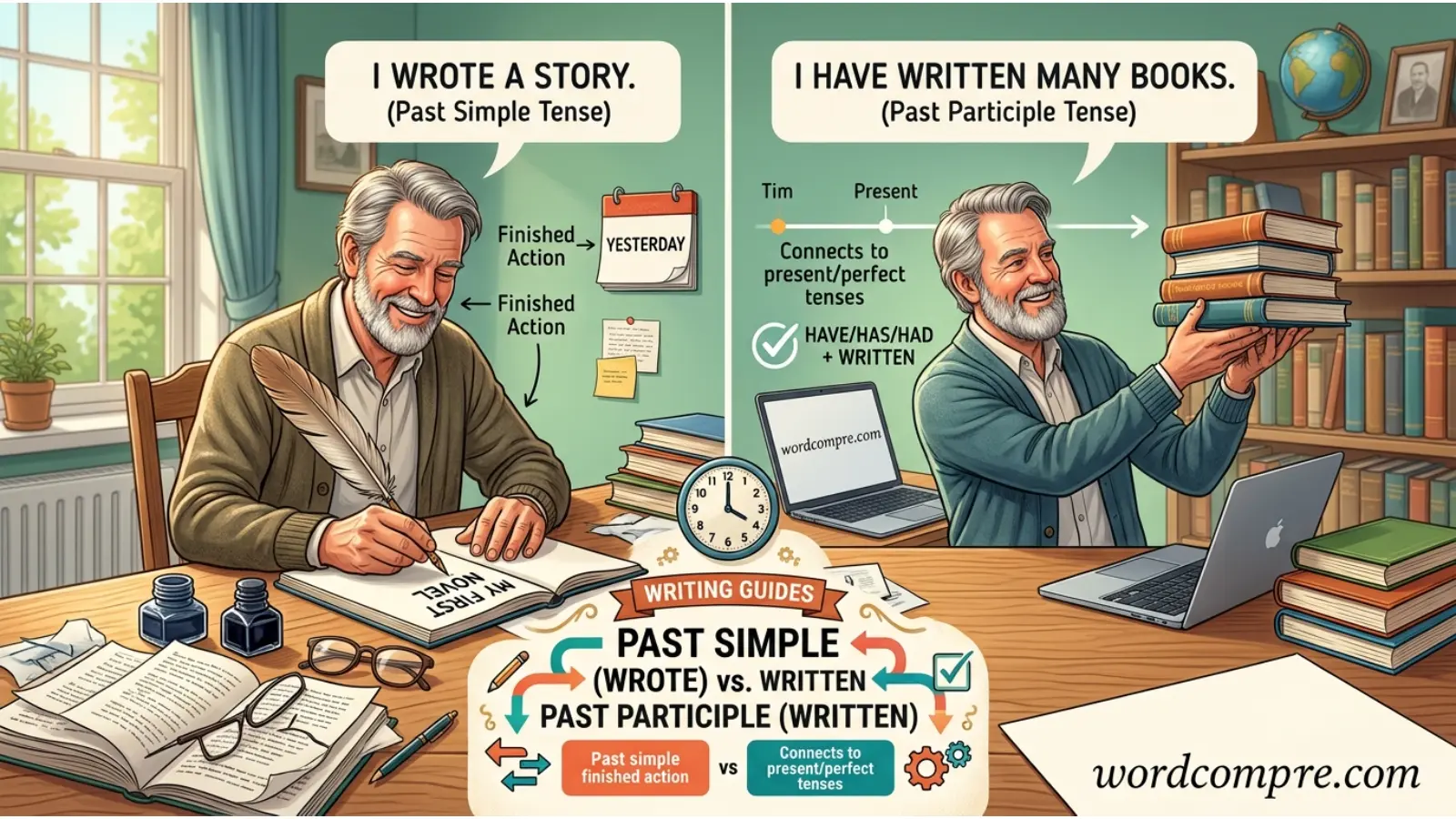
- Wrote is the simple past tense of write.
- Written is the past participle of write and is normally used with helping verbs such as has, have, had, is, was, were, or been.
Correct examples
- I wrote a letter yesterday.
- She has written three novels.
- The report was written by the manager.
What Do Wrote and Written Mean?
Although both words refer to creating text, they belong to different verb forms.
Wrote
Wrote is the simple past tense of write. It describes an action that happened and finished in the past.
Examples:
- I wrote an email this morning.
- They wrote a wonderful story.
- He wrote his name on the form.
Written
Written is the past participle of write. It cannot usually stand alone as the main verb. It works with helping verbs or in passive voice.
Examples:
- She has written several articles.
- The letter was written in French.
- We had written the report before the meeting.
Wrote vs Written Comparison
| Feature | Wrote | Written |
|---|---|---|
| Grammar form | Simple past tense | Past participle |
| Can stand alone as the main verb | Yes | Usually no |
| Needs a helping verb | No | Yes, in most cases |
| Used in passive voice | No | Yes |
| Example | I wrote a book. | I have written a book. |
Where Do These Words Come From?
Both words come from the Old English verb writan, meaning “to score, carve, or write.” As English grammar developed, different forms of the verb were created to express different tenses.
The modern forms are:
- Base form: write
- Present: write
- Past: wrote
- Past participle: written
These forms have remained standard in modern English for centuries.
Why Do People Confuse Wrote and Written?
The confusion happens because both words describe a completed writing action.
People often assume they can replace one with the other because they share the same meaning. However, English grammar assigns each word a different role.
Another reason is that many languages use only one past form, while English separates the simple past from the past participle.
What Do Dictionaries Recommend?
Major English dictionaries agree on the grammatical distinction.
They define:
- Wrote as the simple past tense of write.
- Written as the past participle of write.
There is no competition between these words. Both are standard English and should be used according to grammar rather than preference.

When Should You Use Wrote?
Choose wrote when describing a completed action in the past without a helping verb.
Examples:
- I wrote the report yesterday.
- She wrote a beautiful poem.
- They wrote to their grandparents.
- The student wrote the answer quickly.
- We wrote our names on the list.
When Should You Use Written?
Use written after helping verbs or in passive constructions.
Examples:
- I have written five emails today.
- She had written the speech before the event.
- The novel was written in 1998.
- Have you written your assignment?
- The instructions were written clearly.
Real Life Examples
Correct:
- My grandfather wrote many letters during the war.
- She has written a new children’s book.
- The contract was written by a lawyer.
- We had written everything before class started.
- He wrote the message on the whiteboard.
Incorrect:
- I have wrote a letter.
- She written a book.
- The report wrote yesterday.
- They have wrote the article.
Correct versions:
- I have written a letter.
- She has written a book.
- The report was written yesterday.
- They have written the article.
Common Mistakes
One common mistake is using wrote after helping verbs.
Incorrect:
- I have wrote the email.
Correct:
- I have written the email.
Another mistake is using written without a helping verb.
Incorrect:
- She written a story yesterday.
Correct:
- She wrote a story yesterday.
Many learners also forget that passive voice requires written, not wrote.
Incorrect:
- The book was wrote by him.
Correct:
- The book was written by him.
Easy Memory Trick
Think of this simple rule:
Wrote works alone.
Written works with a helper.
If you see words like has, have, had, was, were, or been, you almost always need written instead of wrote.
Professional Writing Recommendation
For professional emails, academic writing, business documents, and formal communication, always match the correct verb form with the sentence structure.
Use wrote for completed past actions.
Use written after helping verbs and in passive voice.
Following this rule improves grammar, readability, and credibility in every type of writing.
Frequently Asked Questions
Is wrote correct?
Yes. Wrote is the correct simple past tense of write.
Is written correct?
Yes. Written is the correct past participle of write.
Can I say “I have wrote”?
No. The correct sentence is I have written.
Can I say “I written a letter yesterday”?
No. The correct sentence is I wrote a letter yesterday.
Which word is more formal?
Neither is more formal. Both are standard English. The correct choice depends entirely on grammar.
Which one is used in passive voice?
Only written is used in passive voice.
Example:
- The report was written yesterday.
How can I remember the difference?
Remember this simple rule:
Wrote stands alone. Written needs a helper.
Conclusion
The comparison between wrote vs written is not about choosing the better word because both are correct. The real difference lies in grammar. Wrote is the simple past tense used for completed actions, while written is the past participle used with helping verbs and in passive voice. Once you understand this distinction, choosing the correct form becomes straightforward and your writing becomes more accurate, natural, and professional.

Alex Wordsmith is a comparison research writer and content specialist at WordComparre.com. He focuses on analyzing word meanings, spelling variations, grammar distinctions, and language usage to help readers make informed writing choices. Through clear explanations and practical examples, Alex simplifies complex language topics for students, writers, and professionals. His goal is to make English learning easier, more accurate, and accessible for everyone.