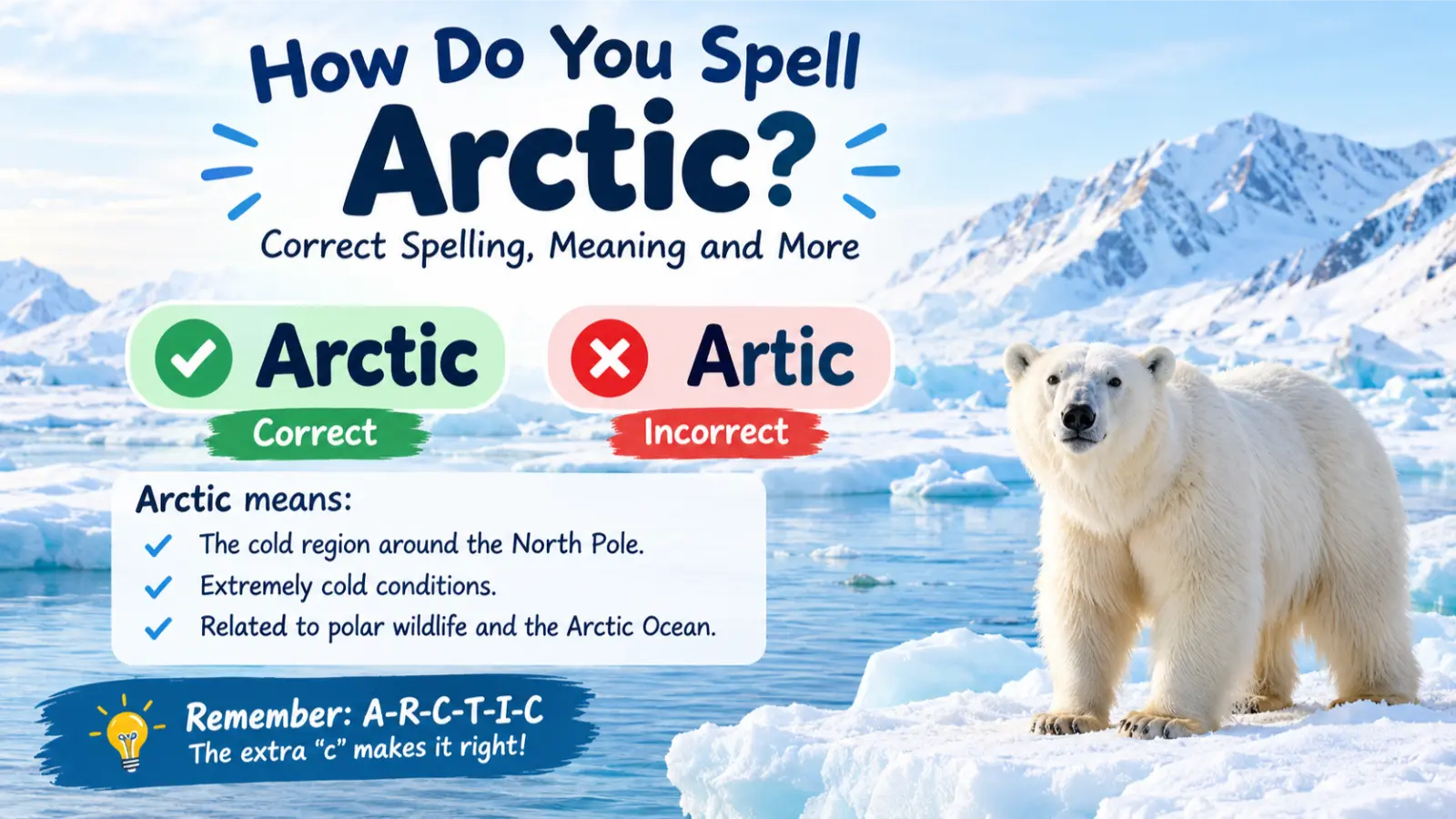
Knowing how to spell Arctic correctly can help you avoid common spelling mistakes in school assignments, professional documents, emails, and everyday writing. The correct spelling is Arctic, not Artic. This word describes the cold region surrounding the North Pole and can also refer to extremely cold weather.
Many people misspell Arctic because its first c is often silent or difficult to hear in ordinary speech. As a result, they may write the word the way they pronounce it. Learning its meaning, pronunciation, and history makes the correct spelling easier to remember.
Quick Answer: How Do You Spell Arctic?
The correct spelling is Arctic.
- Correct: Arctic
- Incorrect: Artic
- Pronunciation: ARK-tik or, in some speech, AR-tik.
- Meaning: Related to the North Pole or extremely cold conditions.
Example: The Arctic region experiences long, cold winters.
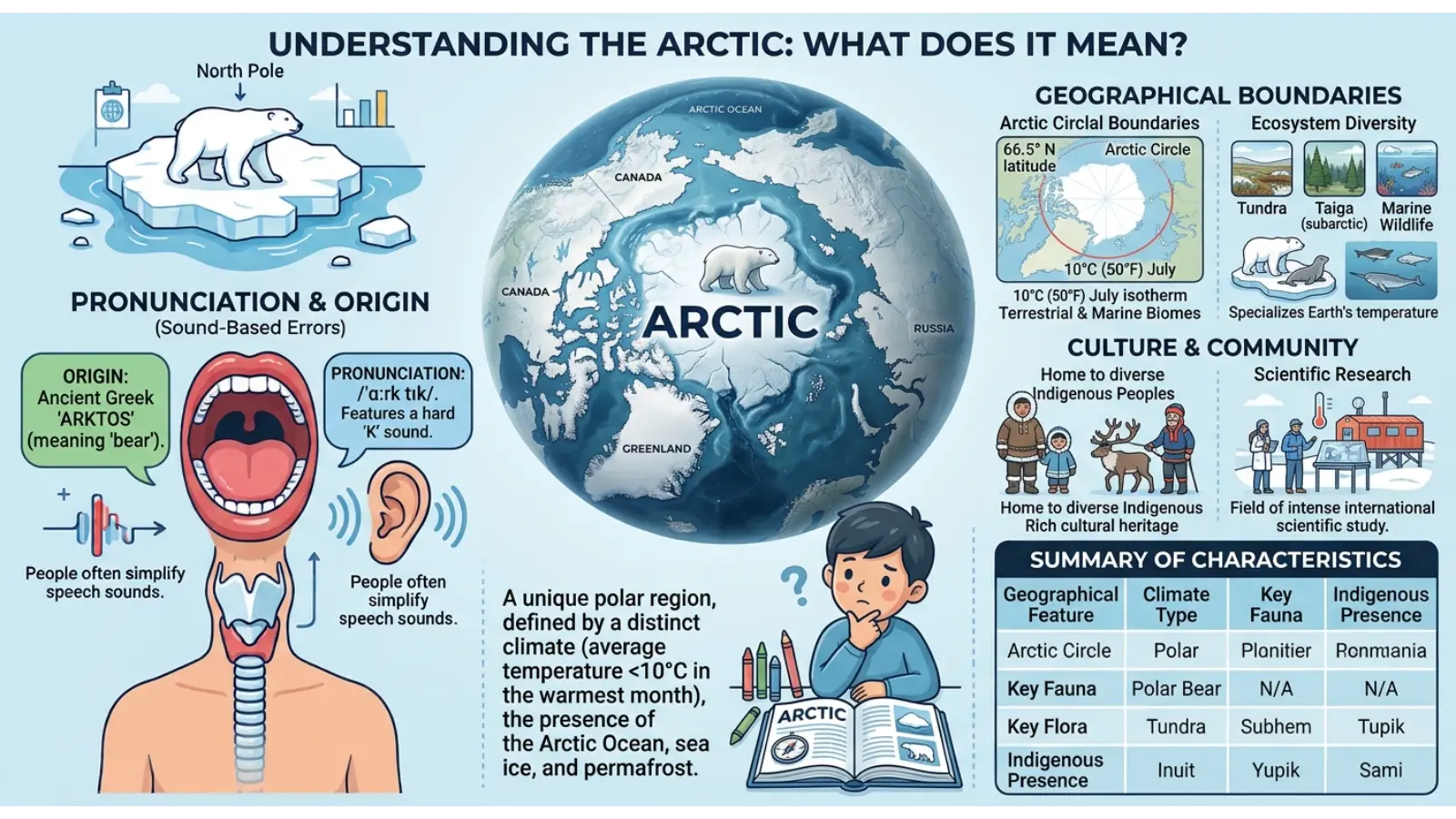
What Does Arctic Mean?
The word Arctic has two common uses.
1. Arctic as a geographical term
As a noun, the Arctic refers to the cold northern polar region surrounding the North Pole. As an adjective, it describes places, animals, climates, and other things associated with this region.
Examples:
- The Arctic is home to polar bears.
- Arctic foxes are adapted to cold environments.
- Scientists study the Arctic Ocean to understand climate change.
2. Arctic as a description of extreme cold
The word can also describe something that feels extremely cold, even when it has nothing to do with the North Pole.
Examples:
- Arctic winds swept across the town.
- We faced Arctic temperatures during our winter trip.
- The room felt Arctic without a working heater.
Cambridge Dictionary recognizes both the geographical meaning and the figurative use for very cold conditions.
Arctic vs. Artic: Comparison Table
| Feature | Arctic | Artic |
|---|---|---|
| Spelling status | Correct standard spelling | Common misspelling |
| Meaning | Relating to the North Pole or extreme cold | No equivalent standard meaning in this context |
| Pronunciation | ARK-tik or AR-tik | Often reflects a simplified pronunciation |
| Formal writing | Recommended | Avoid |
| Academic writing | Correct choice | Incorrect for the intended meaning |
| Example | Arctic animals survive in cold environments. | Artic animals survive in cold environments. |
The key difference is the letter c after r. Although that letter may be difficult to hear, it must remain in the standard spelling.
Origin of the Word Arctic
The word Arctic has roots in ancient Greek. It comes from arktikos, meaning northern or associated with the bear. This connection refers to the constellation Ursa Major, traditionally known as the Great Bear.
The word passed through Latin and French before becoming part of English. Earlier English forms included artik. The spelling later regained the c, reflecting its Latin and Greek origins.
This history helps explain why people sometimes write Artic: the shorter form resembles an older spelling and matches a pronunciation that omits the first /k/ sound. However, Arctic is the standard modern English spelling.
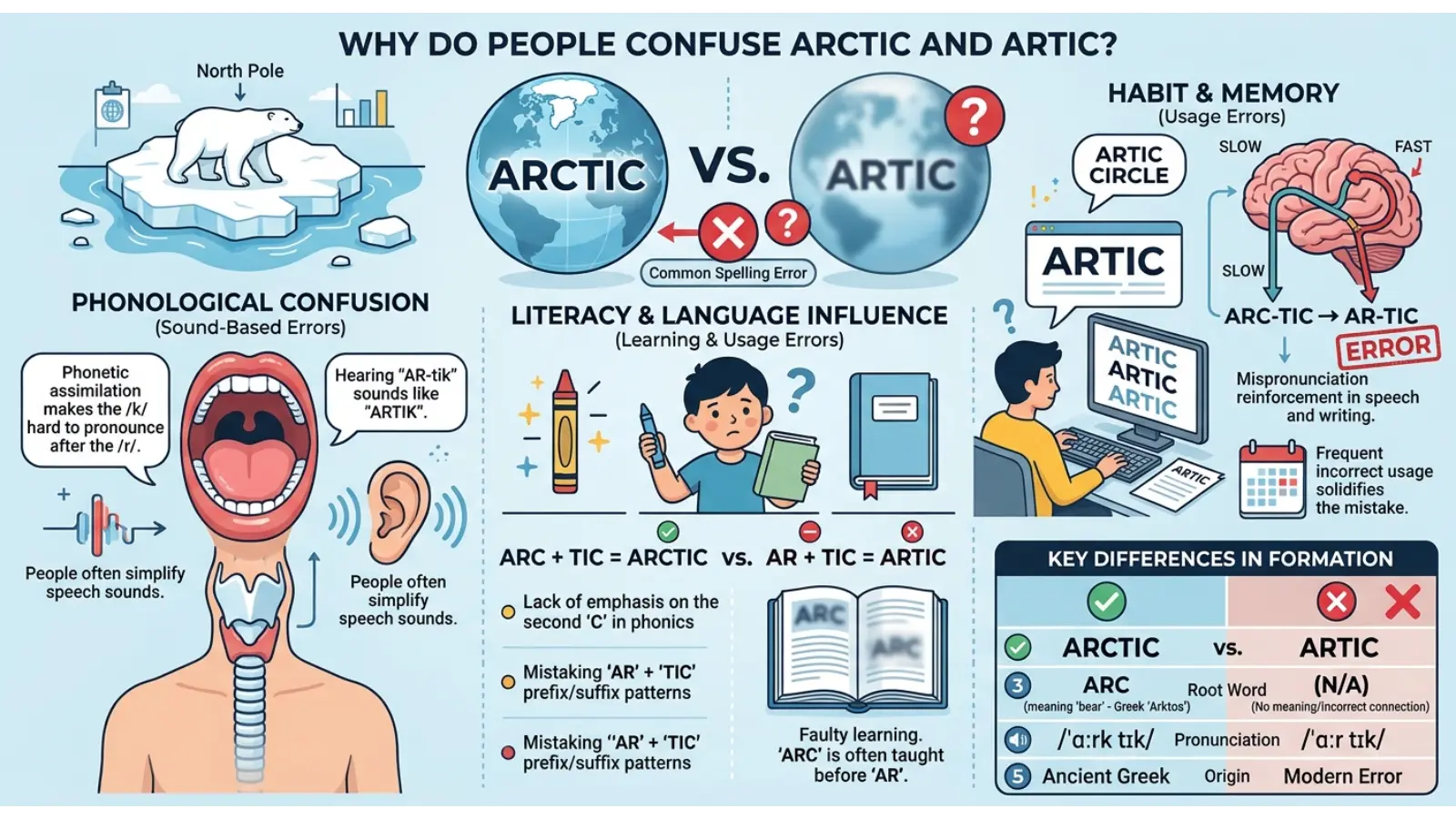
Why Do People Confuse Arctic and Artic?
Several factors make this spelling difficult to remember.
The first c can be hard to hear
In careful pronunciation, Arctic is commonly pronounced with a /k/ sound before the /t/. In casual speech, some speakers simplify the consonant combination, making the word sound like Artic.
The spelling does not always match everyday speech
English spelling often preserves historical letters even when pronunciation changes. Arctic is one example of this pattern.
People write what they hear
When a speaker does not clearly pronounce the first /k/ sound, a listener may assume that the letter is unnecessary. This can lead to the misspelling Artic.
Familiar words create confusion
Words such as article and artist begin with similar letter combinations. Remembering the complete spelling of Arctic helps prevent accidental omissions.
Dictionary Recommendations
Major English dictionaries recognize Arctic as the standard spelling.
- Cambridge Dictionary: Defines the Arctic as the cold area around the North Pole and uses Arctic for related geographical and environmental descriptions.
- Merriam-Webster: Lists arctic as an adjective meaning related to the northern polar region or extremely cold. It also records the word’s historical roots.
- Oxford-style dictionary usage: Uses Arctic for the northern polar regions and recognizes arctic as a description of very cold conditions.
These references support using Arctic in standard writing. The form Artic should not be used as a substitute when referring to the polar region or cold weather.
Real-Life Examples of Arctic
Seeing the word in different contexts makes its spelling easier to remember.
Everyday sentences
- The Arctic is one of the coldest regions on Earth.
- Polar bears live in parts of the Arctic.
- We packed heavy coats for the Arctic expedition.
- Arctic winds made the morning feel colder.
- The documentary explored wildlife in the Arctic.
Academic and professional sentences
- Researchers are studying changes in Arctic sea ice.
- Arctic ecosystems are affected by rising global temperatures.
- The report examines shipping routes through Arctic waters.
- Scientists collected samples from the Arctic Ocean.
- The research team documented several Arctic species.
Figurative examples
- An Arctic breeze entered through the open window.
- The house became Arctic after the heating system failed.
- She gave him an Arctic stare.
- Arctic conditions delayed the outdoor event.
- The frozen lake looked like an Arctic landscape.
These examples show that Arctic works as both a geographical term and a description of extreme cold.
Common Mistakes When Spelling Arctic
Avoid these frequent errors.
- Writing Artic: Include the first c to spell the word correctly.
- Forgetting the second c: The correct letter sequence is A-R-C-T-I-C.
- Confusing pronunciation with spelling: A simplified spoken form does not change the standard written form.
- Using inconsistent capitalization: Capitalize Arctic when referring to the region. Lowercase arctic can be used for a general description of extreme cold, depending on context and style.
- Relying only on autocorrect: Proofreading helps you catch errors that spelling tools may overlook.
Memory Trick: How to Remember Arctic
Try this simple memory trick: Arctic contains the letters ARC followed by TIC.
Break the word into two parts:
ARC + TIC = ARCTIC
You can also connect the word with the Arctic Circle, an imaginary line around the northern polar region. Both Arctic and Circle begin with the idea of a circular shape, which may help you remember the extra c.
Another useful method is to write the word three times while saying each letter aloud:
- A-R-C-T-I-C
- A-R-C-T-I-C
- A-R-C-T-I-C
Practicing the full letter sequence can help make the spelling automatic.
Professional Writing Recommendation
Always use Arctic when writing about the North Pole, polar wildlife, the Arctic Ocean, or extremely cold conditions.
For professional emails, academic papers, blog posts, news articles, and reports, use the standard spelling and check capitalization according to context.
Examples:
- Correct: The Arctic Ocean contains important marine ecosystems.
- Correct: The hikers experienced arctic conditions.
- Incorrect: The Artic Ocean contains important marine ecosystems.
When writing for a general audience, a short explanation of the word may help readers unfamiliar with polar geography. However, there is no need to replace the word with a simpler term when Arctic accurately communicates your meaning.
Frequently Asked Questions
1. How do you spell Arctic correctly?
Spell Arctic the correct spelling is Arctic, with six letters: A-R-C-T-I-C. The spelling Artic is a common error when referring to the polar region.
2. Is Arctic or Artic correct?
Arctic is the standard spelling. Use it for the northern polar region and for descriptions of extremely cold conditions.
3. Why is the c in Arctic silent for some speakers?
Some speakers simplify the /kt/ consonant combination, so the word sounds like AR-tik. Others pronounce it as ARK-tik. Pronunciation varies, but the standard spelling remains Arctic.
4. Should Arctic always be capitalized?
Capitalize Arctic when referring to the named polar region, as in the Arctic. Lowercase arctic is often used figuratively to describe extreme cold, such as arctic winds. Follow your publication’s style guide for consistency.
5. What is an easy way to remember the spelling of Arctic?
Remember the sequence A-R-C-T-I-C. Thinking of the Arctic Circle can also help you recall the extra c.
Conclusion
The correct spelling is Arctic, not Artic. The spell Arctic word refers to the northern polar region and can also describe extremely cold weather or conditions. Although some speakers do not clearly pronounce the first c, it remains part of the standard written form.
Remember the six-letter sequence A-R-C-T-I-C, use the word in example sentences, and proofread your work before publishing. These simple habits will help you spell Arctic confidently in everyday, academic, and professional writing.