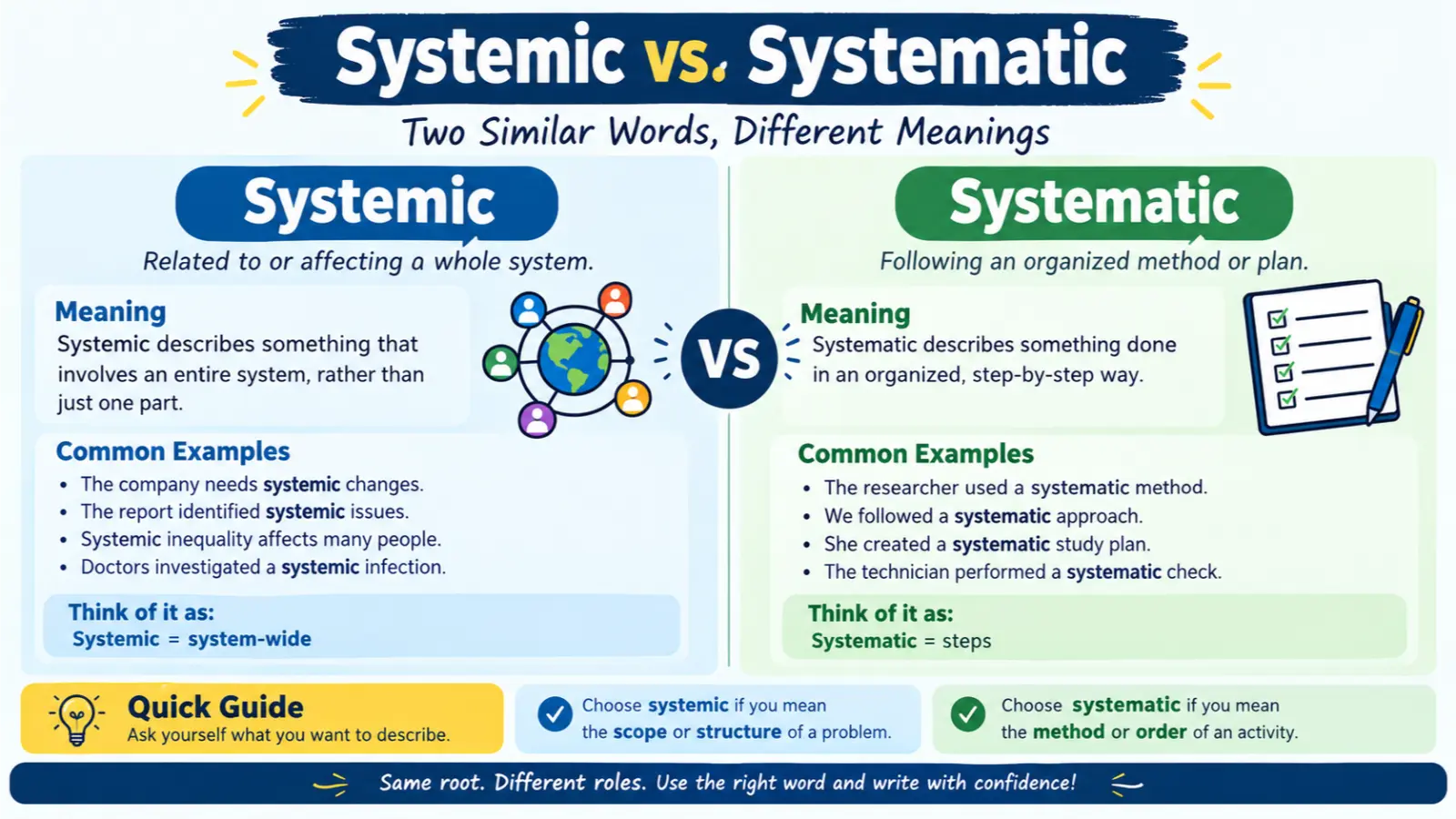
Understanding the difference between Systemic vs. Systematic can help you communicate more clearly in academic, professional, and everyday writing. Although these words look similar, they have different meanings and uses. Systemic describes something that affects an entire system, while systematic refers to an organized and methodical approach to completing a task.
In this guide, you will learn the meanings of Systemic vs. Systematic, explore practical examples, and discover common mistakes to avoid. Whether you are writing an academic paper, discussing workplace problems, or explaining a process, understanding these two words will help you choose the correct term with confidence.
The easiest way to remember the distinction is that systemic refers to something affecting a system as a whole, while systematic refers to following an organized method or plan. You can use this guide to learn the difference, explore practical examples, and avoid common writing mistakes.
What Does Systemic Mean?
The word systemic is an adjective that describes something connected to, or affecting, an entire system rather than just one isolated part.
It is commonly used when discussing organizations, healthcare, economics, society, and science. A systemic problem usually involves deeper structures or interconnected parts of a system.
Examples of systemic in sentences.
- The company needs systemic changes to improve its workplace culture.
- Doctors investigated a systemic infection affecting several parts of the body.
- The report identified systemic problems within the education system.
- Systemic inequality can affect opportunities across an entire society.
In these examples, the word describes issues or effects that extend beyond a single, isolated situation.

What Does Systematic Mean?
The word systematic is also an adjective, but it describes something performed according to an organized plan, method, or sequence.
A systematic approach helps people complete tasks logically and consistently. It is especially useful in research, education, business, and problem-solving.
Examples of systematic in sentences.
- The researcher used a systematic method to collect data.
- We conducted a systematic review of the available evidence.
- She took a systematic approach to organizing her office.
- The technician performed a systematic inspection of the equipment.
In these sentences, the word describes an organized process rather than an effect on an entire system.
Systemic vs. Systematic: Key Differences
Although the two words are related, they are not interchangeable in most situations.
| Feature | Systemic | Systematic |
|---|---|---|
| Main meaning | Related to or affecting a whole system | Following an organized method |
| Focus | Structure, connections, and overall effects | Process, order, and planning |
| Common use | Healthcare, society, economics, organizations | Research, education, inspections, problem-solving |
| Typical phrases | Systemic problem, systemic risk, systemic change | Systematic approach, systematic review, systematic process |
| Main question | What part or system is affected? | How is the task being performed? |
Remember: Systemic describes the nature or reach of a problem or effect. Systematic describes the organization of an action or process.
Grammar Rules for Systemic and Systematic
Both systemic and systematic are adjectives. They describe nouns and can appear before a noun or after a linking verb.
1. Use the word before a noun
Place the adjective before the noun it describes.
- The organization faces a systemic challenge.
- The team followed a systematic procedure.
- The doctor examined the patient for systemic symptoms.
- The student developed a systematic study plan.
2. Use the word after a linking verb
Both adjectives can also follow verbs such as is, was, seems, and became.
- The problem is systemic.
- Her research method is systematic.
- The changes became systemic over time.
- The inspection was systematic and thorough.
3. Use adverbs when describing actions
The corresponding adverbs are systemically and systematically.
- The disease affected the body systemically.
- The team systematically reviewed the evidence.
The first sentence describes how an effect extends through the body. The second describes how a review was carried out.
Sentence Structure and Practical Examples
Learning the sentence patterns makes it easier to select the correct word.
Pattern 1: Systemic + problem or issue
Use systemic when describing a problem that involves the wider structure of a system.
- The investigation revealed systemic weaknesses in the organization.
- Systemic barriers prevented some students from accessing resources.
- The financial crisis exposed systemic risks in the banking sector.
Pattern 2: Systematic + action or process
Use systematic when describing an organized activity.
- The team followed a systematic process to solve the problem.
- Researchers conducted a systematic analysis of the results.
- The mechanic used a systematic procedure to identify the fault.
Pattern 3: A systemic problem and a systematic solution
Both words can correctly appear in the same sentence.
- The company identified a systemic problem and developed a systematic plan to address it.
- Researchers studied systemic inequality using a systematic research method.
- The hospital investigated systemic failures and introduced systematic safety checks.
These examples show how the words complement each other without having the same meaning.
Common Mistakes When Using Systemic and Systematic
Even experienced writers sometimes confuse these words because they look and sound similar. The following examples show how to avoid the most common errors.
Mistake 1: Using systematic to describe a widespread problem
Incorrect: The investigation uncovered systematic failures affecting the entire healthcare system.
This sentence may be correct if the failures happened in an organized or repeated manner. However, if the intended meaning is that the failures are built into the healthcare system, systemic is more precise.
Better: The investigation uncovered systemic failures in the healthcare system.
Mistake 2: Using systemic to describe an organized process
Incorrect for the intended meaning: The researcher used a systemic method to organize the experiment.
Better: The researcher used a systematic method to organize the experiment.
The second sentence emphasizes a planned and orderly process.
Mistake 3: Assuming the words are interchangeable
Incorrect for the intended meaning: We need a systemic approach to checking every document in order.
Better: We need a systematic approach to checking every document in order.
The focus is on an organized procedure, so systematic is the better choice.
Mistake 4: Thinking systemic always means negative
Systemic is not automatically a negative word. It can describe beneficial changes or effects across a system.
Example: The organization introduced systemic improvements to its employee support services.
Similarly, systematic is not always positive or harmless. An organized process can be used for a good or bad purpose.
Systemic vs. Systematic in Professional Writing
Choosing the right word matters in professional communication because each term conveys a different meaning.
Business and management
Use systemic to describe structural issues that affect an organization.
Example: The audit identified systemic weaknesses in the company’s internal controls.
Use systematic to describe an organized business process.
Example: The management team introduced systematic procedures for reviewing expenses.
Healthcare and medicine
Use systemic when discussing conditions or effects involving the body as a whole.
Example: The medication may produce systemic effects.
Use systematic when describing an organized medical investigation or review.
Example: The research team completed a systematic review of clinical studies.
Academic research
Use systemic to discuss problems or effects involving interconnected structures.
Example: The paper examines systemic inequalities in educational access.
Use systematic to explain a planned research process.
Example: The researchers used systematic sampling to select participants.
Technology and cybersecurity
Use systemic when a weakness or risk affects a wider technological or organizational system.
Example: The security assessment identified systemic vulnerabilities across the network.
Use systematic when describing an organized testing procedure.
Example: The engineer performed systematic testing of each component.
Systemic vs. Systematic in Formal and Informal Writing
Both words are suitable for formal writing, and both can appear in everyday conversations. The main difference is their meaning, not their level of formality.
Formal writing examples.
- Systemic: The study identified systemic barriers to healthcare access.
- Systematic: The researchers conducted a systematic evaluation of the evidence.
Informal writing examples.
- Systemic: There seems to be a systemic problem with how the office handles complaints.
- Systematic: Let’s take a systematic approach and check each item one by one.
In casual conversation, people may choose simpler expressions such as a problem throughout the system or a step-by-step method. These phrases can make the meaning easier to understand without changing the underlying distinction.
Memory Tricks to Remember the Difference
Try these simple techniques to remember which word belongs in your sentence.
Systemic = system-wide.
Both words begin with “system.” Think of systemic as something connected to the wider system or its structure.
Example: Systemic problems affect the organization’s overall functioning.
Systematic = steps.
Think of a systematic process as a series of planned steps that lead toward a goal.
Example: A systematic inspection checks each component in an organized order.
Use this quick test.
Ask yourself what you want to describe.
- If you mean the scope or structure of a problem, choose systemic.
- If you mean the method or order of an activity, choose systematic.
This simple distinction will help you make the correct choice in most everyday and professional situations.

Real-Life Conversations Using Systemic and Systematic
These short conversations show how people use both words naturally.
Conversation 1: At the office
Manager: Why do we keep receiving the same customer complaints?
Employee: It may be a systemic problem with our customer service process.
Manager: How can we investigate it?
Employee: We should use a systematic approach and review each stage of the process.
Conversation 2: During a research project
Student: How should we review all these research papers?
Teacher: Start with a systematic method so you can evaluate each paper consistently.
Student: What if the results reveal a wider issue?
Teacher: You might identify a systemic problem that requires further investigation.
Conversation 3: In a healthcare setting
Patient: What does systemic infection mean?
Doctor: It means the infection involves the body more broadly rather than remaining limited to one local area.
Patient: How will you examine the results?
Doctor: We will follow a systematic process to assess your symptoms and test results.
Frequently Asked Questions
1. What is the main difference between systemic and systematic?
Systemic describes something connected to or affecting a whole system. Systematic describes something done according to an organized plan or method.
2. Are systemic and systematic synonyms?
They are related words, but they are not direct synonyms. Their meanings overlap in the general idea of a system, yet they serve different purposes in sentences.
3. Is a systemic problem the same as a systematic problem?
Not necessarily. A systemic problem is connected to the structure or functioning of a wider system. A systematic problem may refer to an issue involving an organized or repeated process, depending on the context.
4. What is an example of systemic in a sentence?
“The report identified systemic weaknesses in the education system.” Here, systemic describes weaknesses that involve the wider system.
5. What is an example of systematic in a sentence?
“The researcher used a systematic approach to analyze the data.” Here, systematic describes an organized method.
6. Can both words be used in the same sentence?
Yes. For example, “The team identified a systemic issue and developed a systematic plan to resolve it.” Each word has a different role.
7. Which word should I use in academic writing?
Use systemic when discussing structural or widespread effects, and use systematic when describing an organized research method or procedure. The correct choice depends on your intended meaning.
Conclusion
Understanding systemic vs. systematic is easier when you focus on what each word describes. Systemic refers to something connected to or affecting a wider system, while systematic refers to a planned, organized, and methodical process.
Use systemic problem when discussing an issue rooted in a system, and use systematic approach when describing an orderly way to complete a task. With these examples and memory tricks, you can choose the right word confidently in everyday conversations, academic writing, and professional communication.