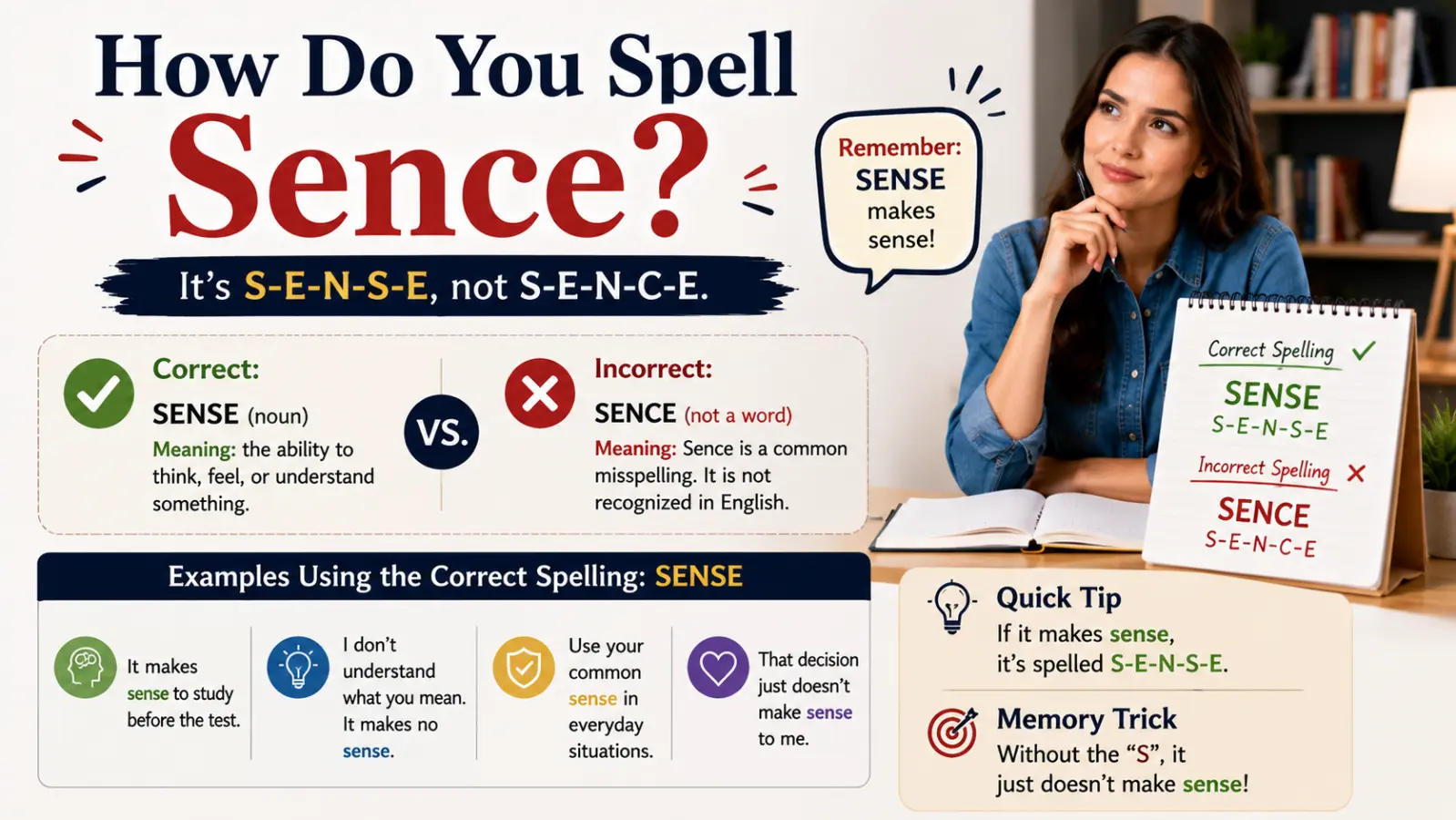
If you are wondering, “How do you spell sence?”, the correct modern English spelling is sense. The spelling sence is usually a mistake when you mean the word related to meaning, awareness, judgment, or perception.
This confusion is easy to understand. Sense and sence sound the same when spoken. However, English spelling does not always match pronunciation. In modern standard English, the word is spelled sense.
There is also an interesting historical detail. Sence has appeared in older forms of English, but it is not the normal modern spelling. Today, writers should use sense in everyday, academic, business, and professional writing.
Quick Answer
How do you spell sence?
The correct spelling is sense.
- ✅ Sense — correct modern English spelling
- ❌ Sence — usually a misspelling of sense
- Pronunciation: /sens/
- Use: meaning, understanding, judgment, awareness, or a physical faculty
For example:
This explanation makes sense.
Not:
This explanation makes sence.
What Does “Sense” Mean?
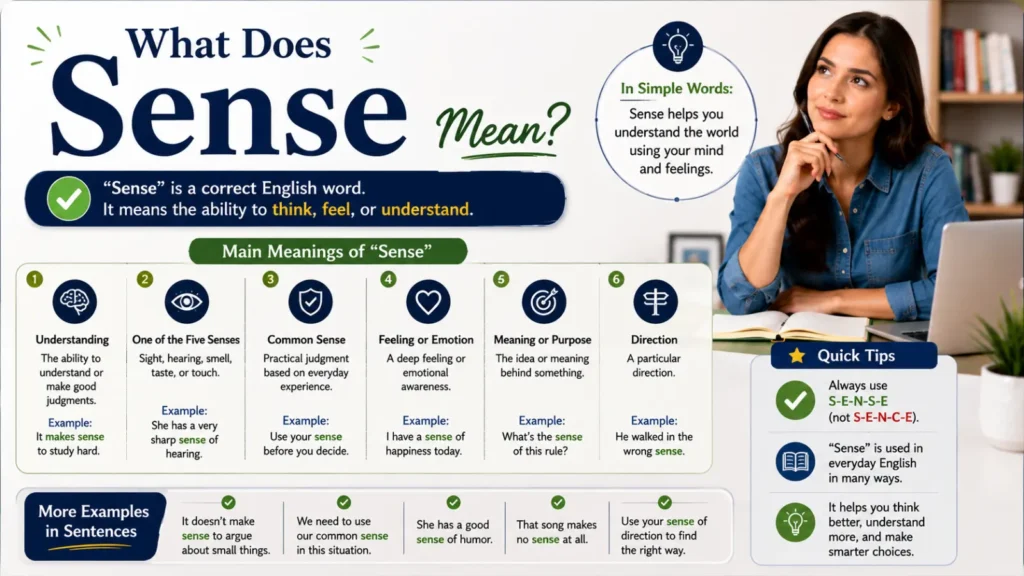
Sense is a common English word with several meanings.
As a noun, it can describe understanding, judgment, awareness, or one of the five physical senses.
Examples include:
- The sentence makes sense.
- She has good sense.
- He lost his sense of direction.
- Our five senses include sight and hearing.
As a verb, sense means to notice or feel something without necessarily being told directly.
For example:
I could sense that something was wrong.
So, whether you use the word as a noun or verb, the spelling remains sense.
What Does “Sence” Mean?
In modern standard English, sence is not the normal spelling of the word sense. It is generally treated as a misspelling when someone intends to write sense.
There is a historical exception. Older English sources contain sence as an archaic spelling of sense. Historical Scottish sources also record forms such as sence in older usage.
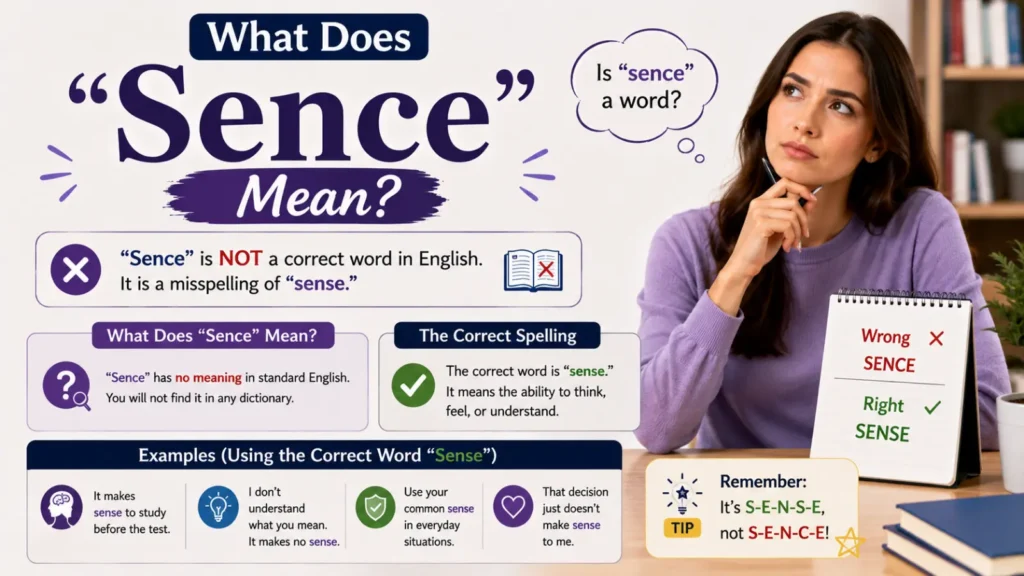
That historical use does not make sence appropriate in modern everyday writing.
Therefore, if you are writing an email, essay, article, résumé, school assignment, or website content, choose sense.
Sense vs. Sence: Comparison Table
| Feature | Sense | Sence |
| Modern standard spelling | ✅ Yes | ❌ No |
| Common modern English | Yes | No |
| Meaning “understanding” | ✅ Yes | ❌ No |
| Meaning “physical faculty” | ✅ Yes | ❌ No |
| Used as a verb | ✅ Yes | ❌ No |
| Historical usage | Yes | Yes, historically |
| Recommended today | ✅ Yes | ❌ No |
The key difference is simple: sense is the standard modern spelling, while sence is normally a spelling error.
Why Do People Write “Sence”?
The main reason is pronunciation.
Sense is pronounced like “sens.” The pronunciation does not clearly tell you whether the word should contain s or another letter pattern.
English has many words whose spellings cannot be predicted perfectly from their sounds. This can lead people to spell sense as sence.
The mistake becomes especially common in familiar phrases such as:
- make sense
- common sense
- sense of humor
- sense of smell
- sense of direction
Because these phrases are often written quickly, a person may type the word according to how it sounds.
Is “Sence” Ever Correct?
For modern standard English, sence should not be used when you mean sense.
However, historical dictionaries and language records show that sence has existed as an older spelling. Wiktionary, for example, identifies it as an archaic spelling of sense as well as a misspelling in modern usage.
This distinction matters when reading old texts or studying language history. It does not change the recommendation for modern writing.
If your goal is clear and professional English, write sense.
Dictionary Recommendations
Modern usage references consistently favor sense for standard English.
Scribbr identifies sense as the correct spelling and describes sence as a spelling mistake.
Historical language resources provide useful context by showing that sence has appeared in older English varieties. The Dictionaries of the Scots Language records historical forms including sence alongside sense.
So the dictionary evidence leads to a practical conclusion:
Use “sense” in modern English.
Real-Life Examples of “Sense”
Here are natural examples showing how sense works in modern English.
1. Meaning or understanding
Your explanation makes sense.
2. Good judgment
You should use your common sense.
3. Awareness
I had a sense that someone was watching me.
4. Physical ability
Dogs have an excellent sense of smell.
5. Direction
I have a poor sense of direction.
6. As a verb
She could sense that he was nervous.
Notice that all these meanings use the same spelling: sense.
Common Mistakes
Here are some frequent examples of the error.
| Incorrect | Correct |
| It doesn’t make sence. | It doesn’t make sense. |
| Use your common sence. | Use your common sense. |
| I can sence danger. | I can sense danger. |
| She has a good sence of humor. | She has a good sense of humor. |
| That makes no sence. | That makes no sense. |
A useful rule is to check the word whenever you are about to write sence. In almost every modern English situation, you need sense instead.
A Simple Memory Trick
Remember this:
Sense = Sensible
Both words begin with sens-.
- sense
- sensible
- senseless
- sensitivity
This gives you a useful spelling pattern to remember.
You can also remember the phrase:
“Sense makes sense.”
If you mean understanding, judgment, awareness, or perception, use sense.
Professional Writing Recommendation
Always use sense in professional and academic writing.
This includes:
- Business emails
- Résumés and cover letters
- School assignments
- Academic papers
- Blog posts
- Website content
- Reports
- Formal messages
Writing sence may look like a simple typing error, but repeated spelling mistakes can make otherwise strong writing appear less polished.
If you notice sence in your draft, replace it with sense unless you are intentionally discussing historical language.
FAQ
How do you spell sence correctly?
The modern correct spelling is sense when you mean meaning, understanding, judgment, awareness, or perception.
Is “sence” a word?
Sence appears in historical language records as an older spelling, but it is not the standard modern spelling of sense.
Is “sense” or “sence” correct?
Sense is correct in modern standard English. Sence is normally a misspelling.
Why do people spell sense as sence?
The two forms sound the same, so people sometimes spell the word based on pronunciation. English spelling often contains patterns that cannot be predicted from sound alone.
How do you spell “common sence”?
The correct phrase is common sense.
Example:
Use your common sense before making a decision.
How do you spell “make sence”?
The correct phrase is make sense.
Example:
That explanation doesn’t make sense.
Is “sence” an old spelling of “sense”?
Yes. Historical sources record sence as an older spelling of sense. It should not normally be used in modern English.
Conclusion
If you are asking “How do you spell sence?”, the answer is sense.
Sense is the correct modern spelling for the word meaning understanding, judgment, awareness, perception, or physical ability. Sence may appear in historical texts, but it is not the spelling you should normally use today.
When writing an email, essay, article, résumé, or professional document, choose sense.
Correct: I can sense that something is wrong.
Incorrect: I can sence that something is wrong.
When in doubt, remember: sense = sensible.

Alex Wordsmith is a comparison research writer and content specialist at WordComparre.com. He focuses on analyzing word meanings, spelling variations, grammar distinctions, and language usage to help readers make informed writing choices. Through clear explanations and practical examples, Alex simplifies complex language topics for students, writers, and professionals. His goal is to make English learning easier, more accurate, and accessible for everyone.