If you are unsure whether to say rang or rung, you are not alone. Both words come from the verb ring, but they do not work in the same sentence.
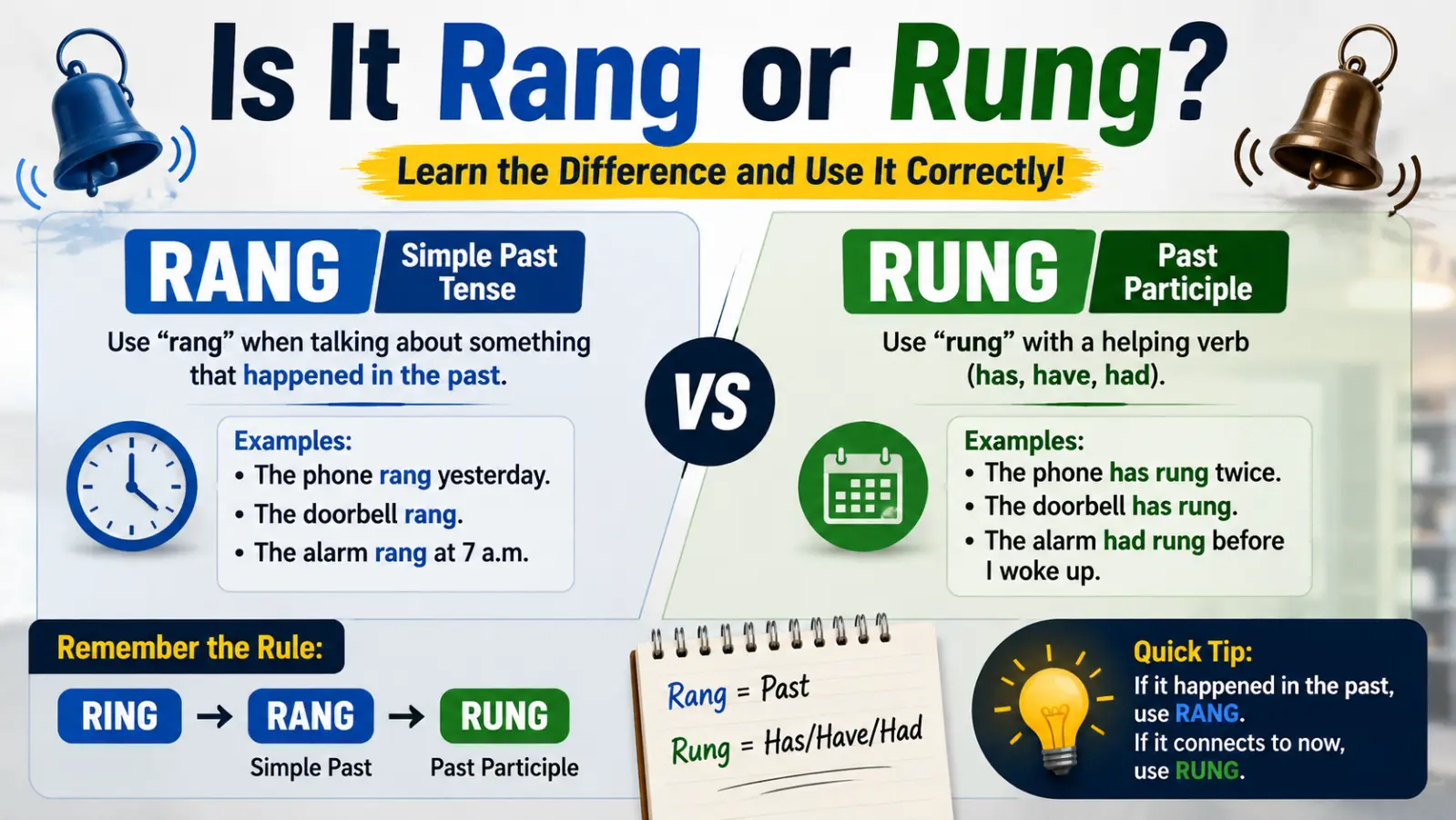
The main difference is simple. Rang is the simple past tense of ring. Rung is the past participle of ring.
For example:
The phone rang yesterday.
But:
The phone has rung several times.
The biggest mistake is using rung by itself as a past-tense verb. In standard English, you normally need a helping verb before rung, such as has, have, or had.
Once you understand this small rule, choosing between rang and rung becomes much easier.
Quick Answer: Rang or Rung?
Use rang when talking about something that happened in the past.
The doorbell rang at noon.
Use rung after a helping verb such as has, have, or had.
The doorbell has rung three times.
Easy rule
Ring → rang → rung
- Ring = present
- Rang = simple past
- Rung = past participle
So, you can say:
I rang the bell.
But:
I have rung the bell.
What Does “Rang” Mean?
Rang is the simple past form of ring.
Use it when an action happened and finished in the past.
Examples
- The telephone rang this morning.
- She rang the doorbell.
- The alarm rang at 7 a.m.
- Someone rang my phone last night.
- The school bell rang at noon.
In these sentences, the action happened in the past. No helping verb is needed.
Sentence pattern
Subject + rang + object/complement
For example:
She rang the bell.
Here, rang directly shows that the action happened in the past.
What Does “Rung” Mean?
Rung is the past participle of ring.
A past participle normally works with a helping verb to form perfect tenses.
Common helping verbs include:
- has
- have
- had
Examples
The phone has rung twice.
The bell has rung already.
Someone had rung the doorbell before I arrived.
I have rung him several times.
Notice that rung does not normally stand alone as the simple past tense.
The Main Grammar Difference
The easiest way to understand the difference is to look at the three forms of ring:
| Form | Word | Example |
| Present | ring | I ring the bell. |
| Simple past | rang | I rang the bell yesterday. |
| Past participle | rung | I have rung the bell. |
This is an irregular verb, so it does not follow the normal -ed pattern.
You do not say:
❌ I ringed the bell.
You say:
✅ I rang the bell.
And with a perfect tense:
✅ I have rung the bell.
When Should You Use “Rang”?
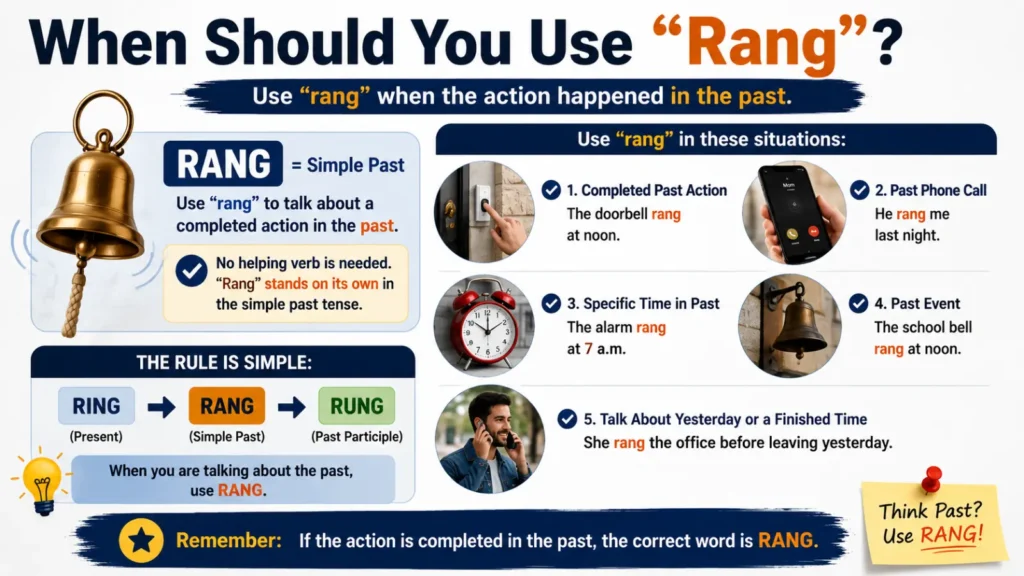
Use rang when the action happened in the past and you are using the simple past tense.
Example 1
My phone rang during dinner.
The ringing happened in the past.
Example 2
She rang the bell before entering.
The action happened before another past event.
Example 3
The alarm rang at six o’clock.
The sentence describes a completed past action.
Example 4
He rang me last night.
The phone call happened last night.
When Should You Use “Rung”?
Use rung when it follows a suitable helping verb in a perfect construction.
Present Perfect
Use has/have + rung.
The phone has rung three times.
I have rung the office.
Past Perfect
Use had + rung.
The phone had rung before I answered it.
Examples
- She has rung the bell.
- They have rung the alarm.
- He had rung me earlier.
- We have rung the number several times.
A Common Mistake: “I Have Rang”
One of the most common errors is:
❌ I have rang you.
The correct sentence is:
✅ I have rung you.
Why?
Because have requires the past participle.
The verb forms are:
ring → rang → rung
Therefore:
have + rung
not:
have + rang
Another Common Mistake: “I Rung”
You should not normally use rung alone as the simple past form.
❌ I rung the bell yesterday.
✅ I rang the bell yesterday.
The word yesterday points to a completed past action, so the simple past rang is needed.
Compare:
I rang the bell yesterday.
I have rung the bell already.
The first uses simple past. The second uses present perfect.
Rang vs. Rung in Everyday Sentences
Here is a quick comparison:
| Rang | Rung |
| She rang the bell. | She has rung the bell. |
| The phone rang last night. | The phone has rung twice. |
| He rang me yesterday. | He has rung me several times. |
| The alarm rang at 6 a.m. | The alarm had rung before I woke up. |
| Someone rang the doorbell. | Someone has rung the doorbell. |
The difference is not about the meaning of ring. It is mainly about grammar and tense.
Real-Life Conversations
Conversation 1: Simple Past
A: Why didn’t you answer the phone?
B: I was asleep when it rang.
Here, rang describes a completed past event.
Conversation 2: Present Perfect
A: Has anyone called?
B: Yes. The phone has rung several times.
Here, has rung connects a past action with the present situation.
Conversation 3: Talking About Yesterday
A: Who rang the doorbell yesterday?
B: I think it was John.
Because the question refers to a specific past event, rang is correct.
Conversation 4: Earlier Past Action
A: Why was the door already open?
B: Someone had rung the bell before we arrived.
The earlier action uses had rung.
Formal and Professional Usage
There is no major formal-versus-informal difference between rang and rung.
The important issue is correct grammar.
Both forms are standard English when used correctly.
In professional writing, make sure the tense matches the meaning.
Professional examples
The alarm rang at 9:00 a.m.
The customer has rung the support line three times.
The bell had rung before the meeting began.
Using rang or rung correctly makes your writing clearer and more professional.
How to Choose the Right Word
Ask yourself one question:
Am I using a helping verb such as has, have, or had?
If no, and you are describing a completed past action, use rang.
She rang me yesterday.
If yes, use rung.
She has rung me.
This simple test works in most everyday situations.
A Memory Trick That Actually Works
Remember the three forms as a sequence:
Ring → Rang → Rung
Think of them as three steps:
Now → Past → Completed with a helper
- Ring → I ring the bell.
- Rang → I rang the bell yesterday.
- Rung → I have rung the bell.
Another useful trick is:
Rang can stand alone. Rung needs a helper.
For example:
✅ I rang.
✅ I have rung.
❌ I rung.
This is a simple way to avoid the most common mistake.
Is “Rang” or “Rung” More Correct?
Neither word is more correct.
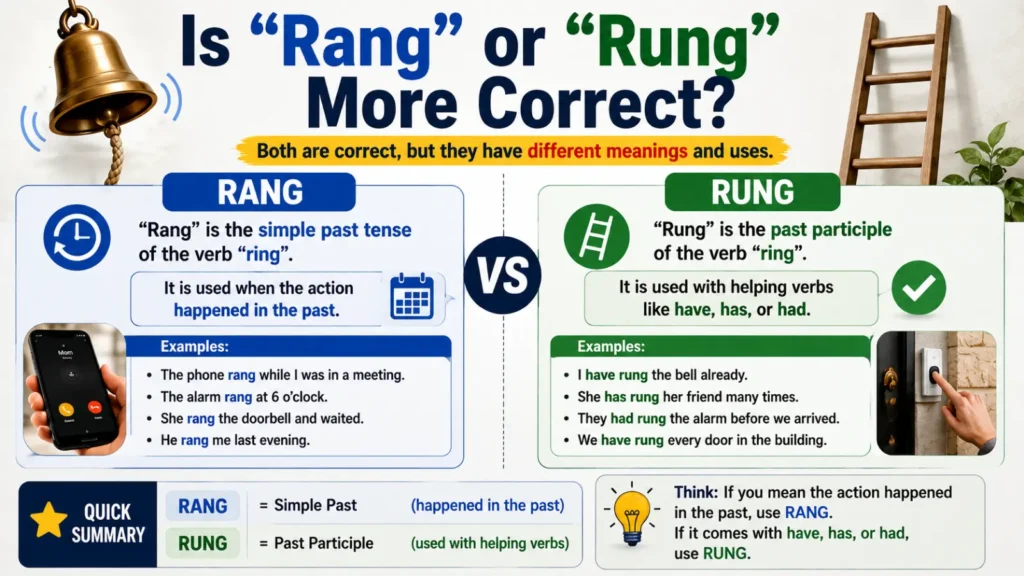
They are both correct forms of ring, but they have different grammatical jobs.
Use rang as the simple past form.
Use rung as the past participle.
The correct choice depends on the sentence.
Common Questions
Is it “I rang” or “I rung”?
The correct form is:
I rang.
For the simple past, use rang.
Is it “I have rang” or “I have rung”?
The correct form is:
I have rung.
After have, use the past participle rung.
Is “rung” past tense?
Not exactly. Rung is the past participle of ring. The simple past form is rang.
What are the three forms of ring?
The three main forms are:
ring → rang → rung
Is “I rung the bell” correct?
No, not in standard English when you mean the simple past.
Say:
I rang the bell.
Is “The phone has rang” correct?
No.
The correct sentence is:
The phone has rung.
Is “The phone rang” correct?
Yes.
Rang is the simple past form of ring.
Is “The phone had rung” correct?
Yes.
Had rung is the past perfect form.
Which is correct: “rang” or “rung”?
Both are correct. Use rang for simple past and rung as a past participle with a helping verb.
Final Takeaway
The difference between rang and rung is easy once you remember the verb’s three forms:
Ring → Rang → Rung
Use rang for the simple past:
The phone rang yesterday.
Use rung with a helping verb:
The phone has rung twice.
The most important rule is:
Rang = simple past.
Rung = past participle.
So, if you are writing a sentence and cannot decide between the two, check the verb before it. If you see has, have, or had, rung is usually the form you need.

Alex Wordsmith is a comparison research writer and content specialist at WordComparre.com. He focuses on analyzing word meanings, spelling variations, grammar distinctions, and language usage to help readers make informed writing choices. Through clear explanations and practical examples, Alex simplifies complex language topics for students, writers, and professionals. His goal is to make English learning easier, more accurate, and accessible for everyone.