Have you ever wondered whether the plural of syllabus is syllabuses or syllabi? Both spellings are correct, and each refers to more than one syllabus. However, understanding their grammatical rules, historical background, and common usage can help you choose the best form for your writing.
In this guide, you will learn the meaning of syllabus, why it has two accepted plural forms, how to pronounce each form, and which spelling works best in academic and everyday English.
What Is the Meaning of Syllabus?
A syllabus is a document that outlines the subjects, topics, readings, assignments, and other requirements of a course or class. Teachers and educational institutions use syllabuses to explain what students will study during a particular course.
For example, a university professor may provide a syllabus at the beginning of a semester. It might include the course schedule, learning objectives, grading policies, required textbooks, and examination dates.
The word is a countable noun, so it can refer to one course outline or several course outlines.
Example sentences:
- The teacher distributed a syllabus to every student.
- Each course has its own syllabus.
- The students reviewed the course syllabuses before registering for classes.
What Is the Correct Plural of Syllabus?
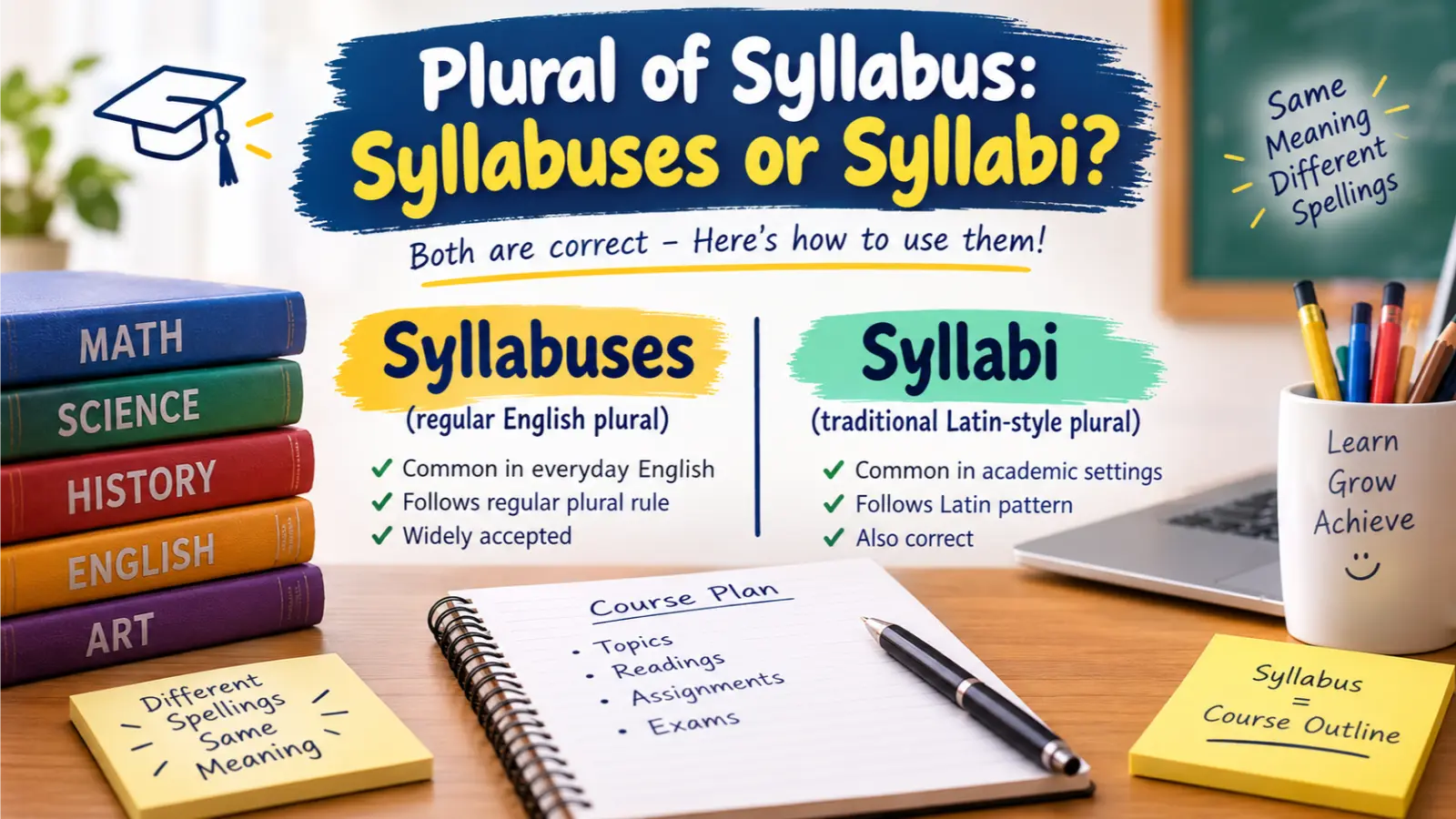
The two accepted plural forms are syllabuses and syllabi. Both are recognized by major English dictionaries, including Cambridge and Oxford. Neither form is grammatically incorrect.
| Singular | Plural | Usage |
|---|---|---|
| Syllabus | Syllabuses | Regular English plural |
| Syllabus | Syllabi | Traditional Latin-style plural |
The difference comes from how English handles nouns borrowed from other languages. The regular form adds -es, while the traditional form changes the ending to -i.
Oxford lists syllabuses as the more common form and syllabi as less frequent. Both remain acceptable in modern English.
Why Does Syllabus Have Two Plural Forms?
English has borrowed many words from Latin and other languages. Some borrowed words retain traditional plural patterns, while others follow ordinary English grammar.
Syllabuses follows the regular English pluralization rule. Because syllabus ends in s, adding -es produces a natural plural form.
Syllabi follows a traditional Latin-style pattern in which an ending resembling -us changes to -i. Similar patterns appear in words such as alumnus and alumni.
However, not every English word ending in -us follows this pattern. The plural form depends on the individual word and its accepted usage.
Origin and Historical Background of Syllabus
The history of syllabus is more complicated than its spelling suggests. According to the Oxford Advanced Learner’s Dictionary, the word entered English in the mid-seventeenth century through New Latin.
Its development is associated with an earlier Greek word referring to a label or title slip attached to a papyrus roll. The Latin form is thought to have resulted from a misreading in manuscripts of the Roman writer Cicero.
The traditional plural syllabi became associated with the word’s scholarly and Latin-influenced history. Meanwhile, syllabuses developed according to the regular plural rules of English.
Today, both forms are established in standard English.
Syllabuses vs. Syllabi: Key Differences
Although both words have the same basic meaning, their style and frequency can differ slightly.
Syllabuses
Syllabuses is the regular English plural. It is straightforward, easy to understand, and consistent with common English spelling patterns.
Examples:
- The school revised its science and mathematics syllabuses.
- Teachers submitted their proposed syllabuses to the department.
- The examination board published the new course syllabuses.
Syllabi
Syllabi is the traditional Latin-style plural. It is frequently encountered in university and college settings, particularly in American academic writing.
Examples:
- The professors uploaded their syllabi before the semester began.
- Students should read their course syllabi carefully.
- The department reviewed several university syllabi.
Which Form Should You Choose?
Choose the form that best fits your audience and writing style. If your institution has a preferred spelling, follow its guidelines. Otherwise, either form is appropriate.
For general educational writing, syllabuses is an especially clear choice because it follows regular English grammar. In academic settings where syllabi is customary, that form works equally well.
Pronunciation of Syllabus, Syllabuses, and Syllabi
Pronunciation can help you distinguish the singular noun from its plural forms.
- Syllabus: SIL-uh-buhs.
- Syllabuses: SIL-uh-buh-siz.
- Syllabi: SIL-uh-bye.
The first syllable receives the main stress in all three forms. The final sound differs because syllabuses uses the regular -es ending, whereas syllabi ends with a sound similar to bye.
Pronunciation may vary slightly by accent, but these guides represent common English pronunciations.
Common Mistakes When Using the Plural of Syllabus
Writers sometimes become confused because the word has two correct plural forms. The following mistakes are worth avoiding.
Treating Syllabuses as Incorrect
Some people assume that syllabi is the only correct form because it follows a traditional Latin pattern. This is incorrect. Syllabuses is also a standard plural.
Treating Syllabi as Incorrect
Other writers believe that every English noun must follow the regular plural rule. However, syllabi is an accepted form and is widely used in academic contexts.
Using the Wrong Singular or Plural
Use syllabus when referring to one course outline and either syllabuses or syllabi when referring to more than one.
Incorrect: The professor handed out three syllabus.
Correct: The professor handed out three syllabuses.
Also correct: The professor handed out three syllabi.
Confusing Syllabus With Curriculum
A syllabus usually describes the content and requirements of a particular course. A curriculum generally refers to the broader educational program or collection of learning experiences.
For example, a biology course may have its own syllabus, while the science curriculum covers biology, chemistry, physics, and other subjects.
Examples of Syllabuses and Syllabi in Sentences
These examples show how both plural forms work in everyday and academic writing.
- The university published the syllabuses for all first-year courses.
- Students downloaded their syllabi from the online learning portal.
- The department compared several mathematics syllabuses.
- All instructors must submit their syllabi before classes begin.
- The school updated its English and history syllabuses.
- The professor reviewed the syllabi before planning the semester.
- Parents requested copies of the examination syllabuses.
- The academic committee examined the syllabi for consistency.
- Different schools may use different science syllabuses.
- Students should check their syllabi for assignment deadlines.
Each sentence uses the plural correctly.
Frequently Asked Questions
What is the plural of syllabus?
The plural of syllabus is either syllabuses or syllabi. Both forms are correct in standard English.
Is syllabuses grammatically correct?
Yes. Syllabuses is the regular English plural and is accepted by major dictionaries.
Is syllabi grammatically correct?
Yes. Syllabi is an accepted traditional Latin-style plural that is commonly used in academic settings.
Which is better, syllabuses or syllabi?
Neither is universally better. Syllabuses is a clear regular plural, while syllabi is a familiar choice in many academic contexts. Follow your institution’s style guide when one exists.
Is syllabi singular or plural?
Syllabi is plural. Its singular form is syllabus.
Can I use syllabuses in formal writing?
Yes. Syllabuses is suitable for formal, professional, educational, and academic writing.
What is the difference between a syllabus and a curriculum?
A syllabus generally outlines one course’s content and requirements. A curriculum describes a broader educational program or plan of study.
Conclusion
The plural of syllabus can be syllabuses or syllabi. Both forms are grammatically correct, and both refer to more than one course outline. Syllabuses follows the regular English plural rule, whereas syllabi follows a traditional Latin-style pattern.
For everyday and general educational writing, syllabuses is a clear and reliable option. In university settings, syllabi is also widely understood and commonly used. Choose either form according to your audience, context, and preferred style guide.