If you are unsure whether to write undescribable or indescribable, you are not alone. Both forms look logical because English uses several prefixes to create words with opposite or negative meanings.
However, there is an important difference in modern standard English. Indescribable is the established and widely accepted word for something that cannot be described adequately with words.
Undescribable does appear in English, but it is much less common and is generally not the preferred choice when you mean “impossible to describe.”
For most writing, especially professional, academic, and published content, indescribable is the safer and more natural word.
Quick Answer
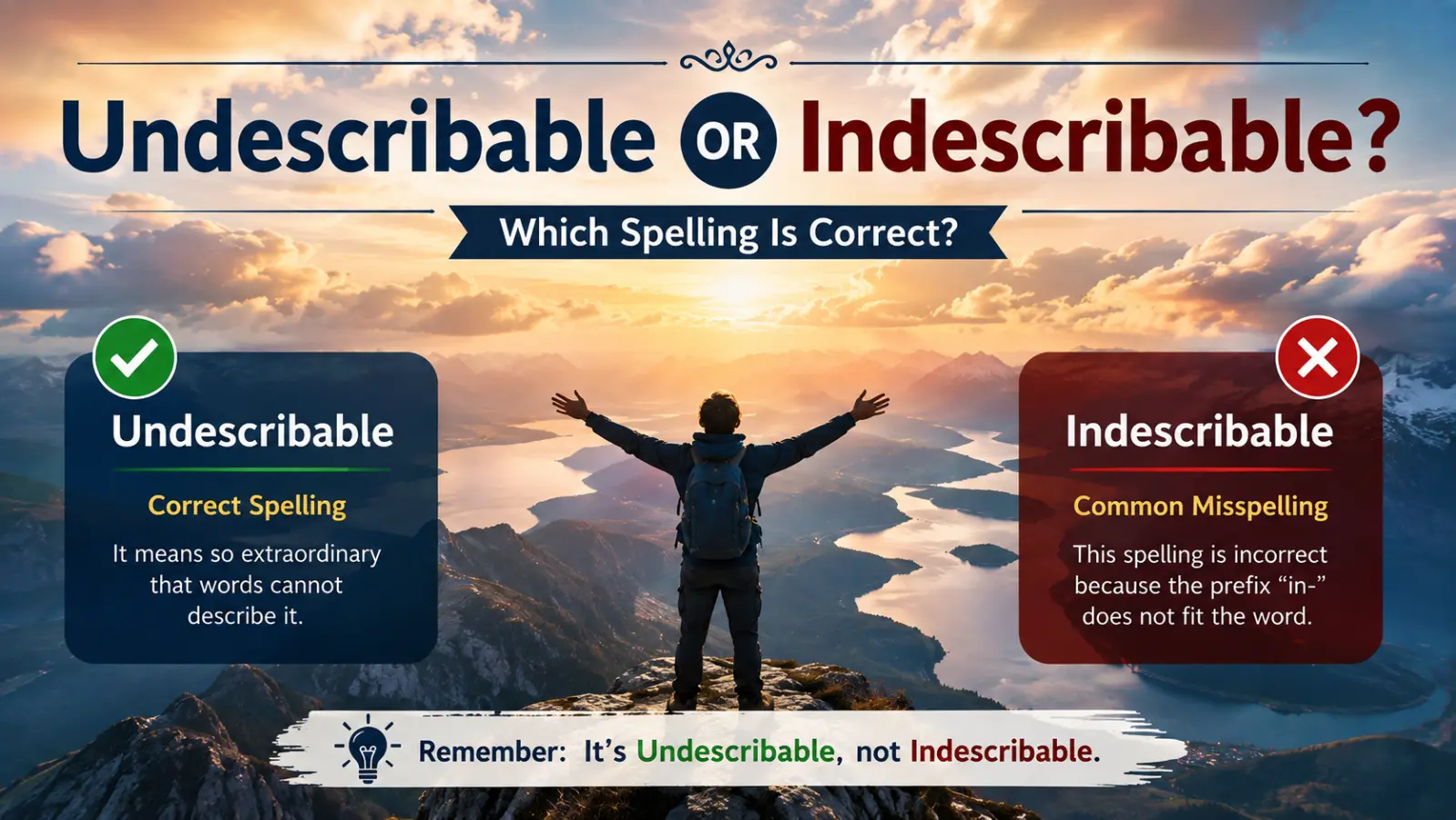
Indescribable is the standard and preferred spelling.
- ✅ Indescribable — established modern English word
- ⚠️ Undescribable — possible but uncommon
- Meaning: too extraordinary, extreme, or difficult to describe in words
Example:
The beauty of the sunset was indescribable.
If you want the most natural choice, use indescribable.
Indescribable vs. Undescribable
This is not simply a case of one spelling being correct and the other being a basic spelling mistake.
Indescribable is the normal modern form. It is formed from in- + describable, meaning “not describable” or “impossible to describe.”
Undescribable uses un- + describable. Although this formation is understandable and can be found in English usage, it is far less established.
The two forms can therefore overlap in meaning, but they are not equally common or equally preferred.
Comparison Table
| Feature | Indescribable | Undescribable |
| Standard modern usage | ✅ Very common | ⚠️ Uncommon |
| Meaning | Impossible or extremely difficult to describe | Not describable |
| Dictionary preference | ✅ Preferred | Less established |
| Natural in everyday English | ✅ Yes | Rare |
| Suitable for professional writing | ✅ Yes | Usually avoid |
| Commonly recognized by readers | ✅ Yes | Less familiar |
For modern English, indescribable is clearly the better choice.
What Does “Indescribable” Mean?

Indescribable describes something that is so unusual, powerful, beautiful, unpleasant, or extreme that ordinary words cannot properly express it.
For example:
She felt indescribable joy when she saw her family again.
The word does not always mean that something is literally impossible to describe. It can also suggest that words are not strong enough to capture the full experience.
You might describe:
- indescribable happiness
- indescribable beauty
- indescribable pain
- indescribable sadness
- an indescribable feeling
- an indescribable experience
What Does “Undescribable” Mean?
Undescribable can be understood as meaning “not describable” or “unable to be described.”
The construction follows a normal English pattern:
un- + describable = undescribable

However, native English usage strongly favors indescribable for this meaning.
That makes undescribable a word you may encounter, but it is not usually the form a writer should choose when a polished, standard expression is needed.
Why Is There Confusion?
The confusion mainly comes from English prefixes.
Both un- and in- can create negative meanings.
For example:
- happy → unhappy
- clear → unclear
- visible → invisible
- possible → impossible
- complete → incomplete
Because undescribable seems to follow the pattern of unhappy or unclear, it looks perfectly reasonable at first glance.
But English does not let us freely choose between un- and in-. Many negative forms became established through historical usage, and some combinations sound natural while others do not.
In this case, indescribable became the standard form.
The Word Structure of “Indescribable”
The word can be understood as:
in- + describable = indescribable
The base word is describe.
From it, we get:
describe → describable → indescribable
The prefix in- gives the word a negative meaning.
So:
describable = able to be described
while:
indescribable = unable or extremely difficult to describe
This pattern helps explain why indescribable is the established form.
Origin
Indescribable is built from describe, which ultimately comes from Latin roots meaning to write or represent in detail.
The negative prefix in- also comes from Latin and developed into a common English prefix used in words such as:
- invisible
- incapable
- incomplete
- inaccurate
- indescribable
The form indescribable therefore fits a long-established English word-building pattern.
Dictionary Recommendation
Major English dictionaries recognize indescribable as the standard word.
For example, Cambridge Dictionary defines indescribable as something that is impossible to describe, especially because it is extremely good, bad, or unusual. Merriam-Webster also lists indescribable as an established English adjective.
This dictionary evidence supports using indescribable as the default modern form.
Undescribable is much less common and should not normally be chosen simply because it seems like a logical construction.
Real-Life Examples
Beauty
The view from the mountain was indescribable.
Happiness
The birth of her child brought her indescribable happiness.
Experience
It was an indescribable experience.
Emotion
He felt an indescribable sense of relief.
Pain
The accident caused indescribable pain.
Surprise
Her reaction was indescribable.
In each example, indescribable communicates that ordinary words cannot fully express the subject.
Common Mistakes
Mistake 1: Choosing “Undescribable” Automatically
Some writers assume that un- must be used to mean “not.”
English does not work that way. The established word is indescribable.
Mistake 2: Writing “Indescrible”
A common spelling error is leaving out the second i or changing the middle of the word.
Correct:
indescribable
Not:
indescrible
Mistake 3: Using “Indescriptive”
Indescriptive is not the normal word for something that cannot be described.
When you mean “impossible or extremely difficult to describe,” use indescribable.
Mistake 4: Assuming Both Forms Are Equally Common
Although undescribable can be understood, it is not used nearly as often as indescribable.
Choosing the familiar standard form makes your writing clearer.
A Simple Memory Trick
Remember this phrase:
“I cannot describe it.” → “It is indescribable.”
The word indescribable begins with in-, just like:
- invisible
- incomplete
- incredible
- incapable
Think:
In + describable = indescribable
This makes the preferred spelling easier to remember.
Professional Writing Recommendation
Use indescribable in professional, academic, editorial, and website writing.
It is familiar to readers and clearly communicates the intended meaning.
Although undescribable may appear occasionally, it can look unusual or less polished. There is little reason to choose it when indescribable expresses the idea naturally.
For SEO content, formal articles, business writing, and published material, indescribable should be your default choice.
FAQ
Is it undescribable or indescribable?
Indescribable is the standard and preferred modern form.
Is “undescribable” a correct word?
Undescribable can be found in English, but it is uncommon. Indescribable is the established form most writers should use.
What does indescribable mean?
It means something is impossible or extremely difficult to describe adequately with words.
Why is it “indescribable” instead of “undescribable”?
English negative prefixes are based on established word patterns and historical usage. Although undescribable looks logical, indescribable became the standard form.
How do you spell indescribable?
The correct spelling is:
I-N-D-E-S-C-R-I-B-A-B-L-E
Is indescribable a positive word?
Not necessarily. It can describe positive experiences such as joy or beauty, but it can also describe negative experiences such as pain or sadness.
What is the opposite of indescribable?
Depending on the context, possible opposites include describable, expressible, or explainable.
Is “indescribable” formal?
Yes. Indescribable is suitable for formal and informal English.
Which is better for professional writing: undescribable or indescribable?
Choose indescribable. It is the more established and widely recognized form.
Conclusion
When choosing between undescribable or indescribable, the best modern English choice is indescribable.
Indescribable means something cannot be adequately expressed or described with words. Although undescribable is understandable and occasionally appears in English, it is much less common and is not the preferred form.
For everyday communication, professional writing, academic work, and published content, remember:
✅ indescribable
⚠️ undescribable — uncommon
The easiest memory trick is: “I cannot describe it, so it is indescribable.”

Alex Wordsmith is a comparison research writer and content specialist at WordComparre.com. He focuses on analyzing word meanings, spelling variations, grammar distinctions, and language usage to help readers make informed writing choices. Through clear explanations and practical examples, Alex simplifies complex language topics for students, writers, and professionals. His goal is to make English learning easier, more accurate, and accessible for everyone.