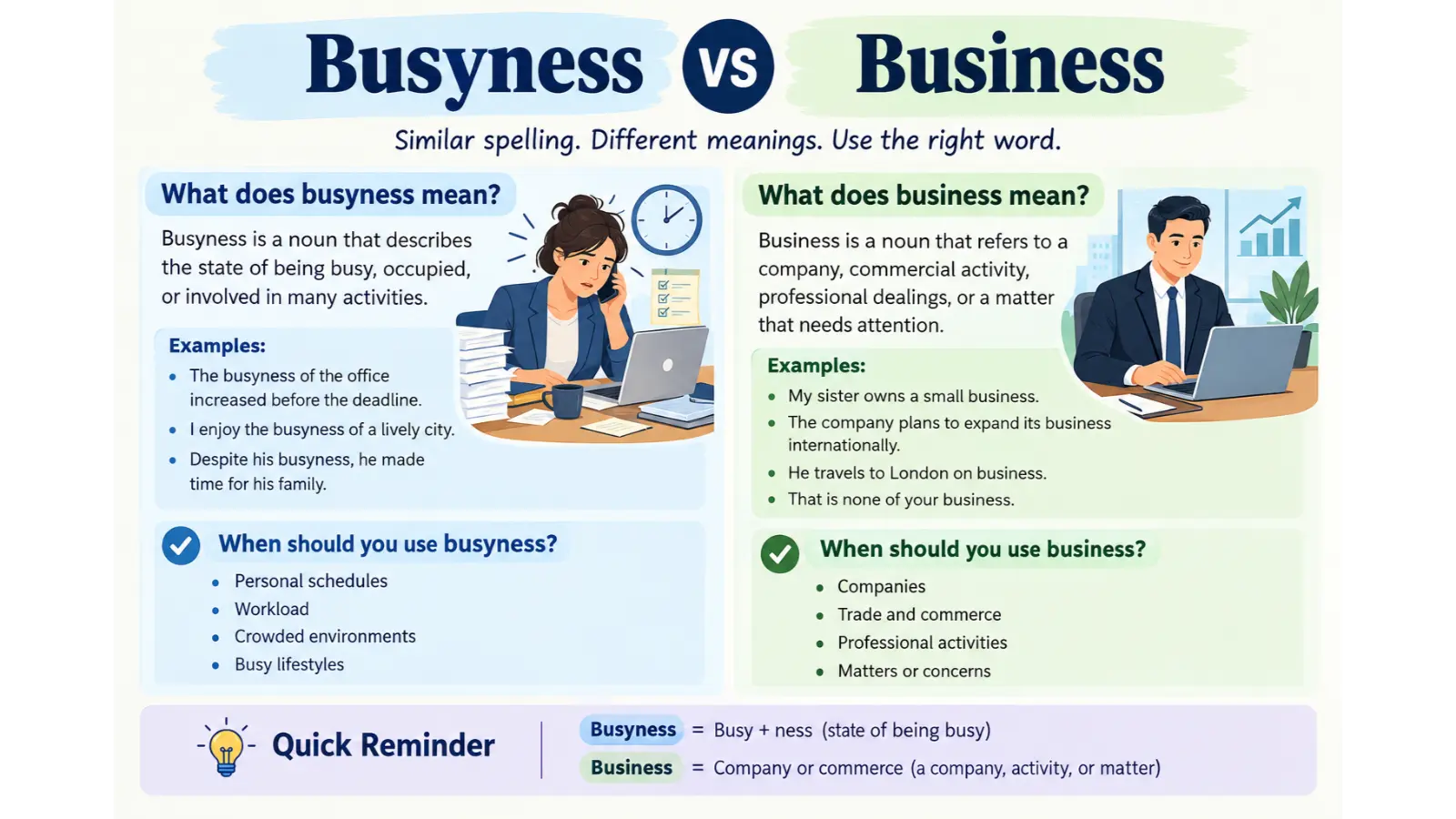
Understanding the difference between busyness vs business can help you improve your English spelling and writing. These two words look and sound similar, but they have different meanings. One describes the state of being busy, while the other usually refers to a company, commercial activity, or a matter that needs attention.
Although both spellings are correct, using the wrong word can change the meaning of a sentence. Whether you are writing a professional email, completing an assignment, or creating website content, learning when to use each word will help you communicate clearly.
Quick Answer: Busyness vs Business
Busyness means the state of being busy, occupied, or involved in many activities. Business refers to a company, commercial activity, professional dealings, or a matter requiring attention.
Examples:
- The busyness of my schedule makes it difficult to relax.
- She started a successful business last year.
- The busyness of the office increased before the deadline.
- We discussed the business proposal during the meeting.
Both words are correct, but they are not interchangeable.

What Does Busyness Mean?
Busyness is a noun that describes the condition of being busy. It refers to a situation in which a person, place, or period involves considerable activity or numerous responsibilities.
The word can describe a full schedule, a crowded environment, or a lifestyle filled with tasks. However, busyness does not necessarily mean productivity. Someone can have many things to do without making meaningful progress.
Examples of Busyness in Sentences
- The busyness of the holiday season makes shopping difficult.
- Her busyness prevented her from attending the event.
- I enjoy the busyness of a lively city.
- The busyness of the office increased during the afternoon.
- Despite his busyness, he always makes time for his family.
When Should You Use Busyness?
Use busyness when you want to describe the condition of being occupied or the amount of activity in a particular situation.
Common contexts include personal schedules, workplace responsibilities, crowded places, and busy lifestyles.
For example, the sentence “The busyness of my daily routine leaves little time for exercise” describes a demanding schedule rather than a company or commercial activity.

What Does Business Mean?
Business is a noun with several meanings. It commonly refers to an organization that sells products or services, the activity of buying and selling, or professional work. It can also describe a matter that concerns someone.
The word appears frequently in everyday conversations, workplace communication, education, finance, and commerce.
Examples of Business in Sentences
- My sister owns a small business.
- The company plans to expand its business internationally.
- He travels to London on business.
- We discussed the business plan yesterday.
- That is none of your business.
When Should You Use Business?
Use Busyness vs Business when referring to companies, trade, professional activities, or matters that require attention.
For example, “She wants to start an online business” refers to a commercial venture. In contrast, “She is dealing with the busyness of her schedule” refers to the number of activities she needs to manage.
Busyness vs Business: Key Differences
| Feature | Busyness | Business |
|---|---|---|
| Part of speech | Noun | Noun |
| Main meaning | State of being busy | Company, commerce, or matter |
| Related word | Busy | Businessperson |
| Common context | Activity and workload | Trade and professional dealings |
| Example | The busyness tired me. | Her business is growing. |
| Standard spelling | Busyness | Business |
The main difference is meaning. Busyness describes a condition, whereas business usually identifies a commercial activity, organization, or matter.
Origin and History of Busyness and Business
Although these words are related in meaning, their spelling histories are different.
Origin of Busyness
Busyness comes from the adjective “busy” combined with the suffix “-ness.” This suffix turns an adjective into a noun that describes a state or quality.
When the suffix is added to busy, the final “y” changes to “i,” producing “busyness.” Similar spelling changes appear in words such as happiness, readiness, and loneliness.
Origin of Business
Business developed from Middle English forms such as “bisinesse,” which referred to occupation, concern, care, or a state of being occupied. Over time, the word became strongly associated with trade, commerce, professional affairs, and commercial organizations.
This historical connection helps explain why people sometimes confuse the two words. However, modern English gives them distinct meanings.

Why Do People Confuse Busyness and Business?
Several factors contribute to confusion between these spellings.
Similar Spelling
Both words share many of the same letters. Their visual similarity makes it easy to select the wrong word when typing quickly.
Similar Pronunciation
The words sound similar in many English accents. Business is commonly pronounced “BIZ-nis,” while busyness is commonly pronounced “BIZ-ee-nis.” The additional syllable in busyness can help distinguish them.
Connection With Work
Both words can appear in discussions about work. However, a person can experience busyness while studying, completing household chores, or managing personal responsibilities without being involved in business.
Typing and Editing Errors
Writers sometimes use one word when they intend the other. Spell-checking may not catch the mistake because both spellings are valid English words.
Reading the complete sentence and checking its meaning is the best way to avoid this error.
Dictionary Recommendations and Modern Usage
Standard English dictionaries recognize both busyness and business as correct words.
Busyness describes the condition of being busy or the amount of activity in a situation. Business refers to commercial organizations, trade, professional dealings, and matters of concern.
In modern English, business is much more common, especially in workplace communication, finance, and commerce. Busyness is less frequent but useful when the writer wants to discuss the experience of being occupied.
For additional guidance, readers can consult Merriam-Webster, Cambridge Dictionary, and Oxford Learner’s Dictionaries. These resources provide definitions, pronunciations, and example sentences.
The appropriate choice depends on the context, not on which word appears more frequently.
Real-Life Examples of Busyness vs Business
Understanding both words in context makes the distinction easier to remember.
Everyday Conversation
- The busyness of my week left me exhausted.
- My brother runs a successful business.
- I need a break from the busyness of everyday life.
- We discussed your business over lunch.
Workplace Communication
- The busyness of the office increased before the deadline.
- Our business needs a better marketing strategy.
- Her busyness made scheduling the meeting difficult.
- The manager reviewed the business expenses.
Academic Writing
- The study examined the busyness of urban public spaces.
- The research explored the challenges faced by small business owners.
- Increased busyness may affect a person’s ability to relax.
- The course introduces students to international business.
Email Writing
Using busyness:
Subject: Meeting Availability
Hello Alex,
The busyness of my schedule this week makes it difficult to attend the meeting. Could we arrange another time next Monday?
Thank you for your understanding.
Best regards.
Using business:
Subject: Business Proposal
Hello Alex,
I would like to discuss our business proposal and review the next steps. Please let me know when you are available for a meeting.
Best regards.
These examples show that busyness describes a situation, while business identifies the subject of a professional discussion.
Common Mistakes to Avoid
Using Business to Describe a Busy Schedule
Incorrect: The business of my day made me tired.
Correct: The busyness of my day made me tired.
A more natural alternative is “My busy schedule made me tired.”
Using Busyness to Describe a Company
Incorrect: She opened a new busyness last year.
Correct: She opened a new business last year.
A company or commercial venture is a business, not a busyness.
Assuming Busyness Means Productivity
Busyness refers to being occupied or having many activities. Productivity refers to how effectively someone completes useful work.
For example, a person may spend the entire day handling small tasks but make little progress toward important goals. That person is busy, but not necessarily productive.
Treating Business as an Incorrect Form of Busyness
Both words are correct. Neither spelling is a substitute for the other.
Choose busyness when discussing a state of being busy. Choose business when discussing a company, commercial activity, professional dealings, or a matter.
Using Busyness When a Simpler Phrase Is Better
Although busyness is correct, phrases such as “busy schedule,” “heavy workload,” and “high level of activity” may sound more natural in certain sentences.
For example:
Less natural: My busyness has increased.
Clearer: My workload has increased.
The best choice depends on the meaning and tone you want to communicate.
Memory Trick: How to Remember the Difference
Use these simple reminders to remember the correct spelling.
Busyness = Busy + ness. Think about being occupied, having many tasks, or experiencing a lot of activity.
Business = Company or commerce. Think about customers, products, services, sales, and professional matters.
Before choosing a word, ask yourself whether you are describing how occupied someone is or referring to a company or matter.
If you mean the state of being busy, use busyness. If you mean commerce, a company, or a matter requiring attention, use business.
Professional Writing Recommendations
Choosing the correct word is important in professional emails, website articles, academic assignments, and business documents.
Use business when discussing companies, business plans, sales, commercial activities, or professional dealings. Use busyness when the condition of being busy is central to your message.
Writers should also consider clarity and readability. In many professional contexts, a phrase such as “heavy workload” may communicate the intended meaning more directly than busyness.
For example, “My workload has increased because of the new project” sounds natural and specific.
However, busyness remains appropriate when describing the general condition or experience of being occupied.
Always review the sentence in context instead of relying only on spelling tools. A grammar checker may accept both words without recognizing that one changes the intended meaning.
Frequently Asked Questions
Is busyness a real English word?
Yes. Busyness is a recognized English noun that describes the state of being busy. It is less common than business but is grammatically correct.
Is business the correct spelling for a company?
Yes. Business is the standard spelling when referring to a company, commercial activity, or professional dealings.
Why is busyness spelled with an i?
Busyness is formed by adding the suffix “-ness” to busy. The final “y” changes to “i,” producing busyness.
Is busyness the same as being productive?
No. Busyness describes a high level of activity or occupation, while productivity describes how effectively someone completes useful work. A person can be busy without being productive.
Which word is more common, busyness or business?
Business is much more common in everyday and professional English. Busyness is used when the writer specifically wants to describe the state of being occupied.
Can busyness and business be used in the same sentence?
Yes. Both words can appear in one sentence when their meanings are clear.
Example: “The busyness of the holiday season increased sales for her small business.”
Here, busyness refers to the high level of activity, while business refers to a commercial organization.
Is busyness formal or informal?
Busyness is a correct noun and can be used in formal writing. However, alternatives such as workload, activity, or a busy schedule may be clearer in some professional contexts.
Does business always mean a company?
No. Business can also refer to trade, professional activity, a task, or a matter that concerns someone. For example, “That is none of your business” refers to a personal matter rather than a company.
Conclusion
The difference between busyness vs business comes down to meaning and context. Busyness describes the state of being occupied or having many things to do, while business refers to a company, commercial activity, professional dealings, or a matter requiring attention.
Both words are correct, but they cannot be used interchangeably. Remember the simple rule: use busyness for the condition of being busy and business for commerce, companies, or matters.
By understanding this distinction and reviewing your sentences carefully, you can improve your spelling, write more clearly, and communicate confidently in everyday, academic, and professional English.