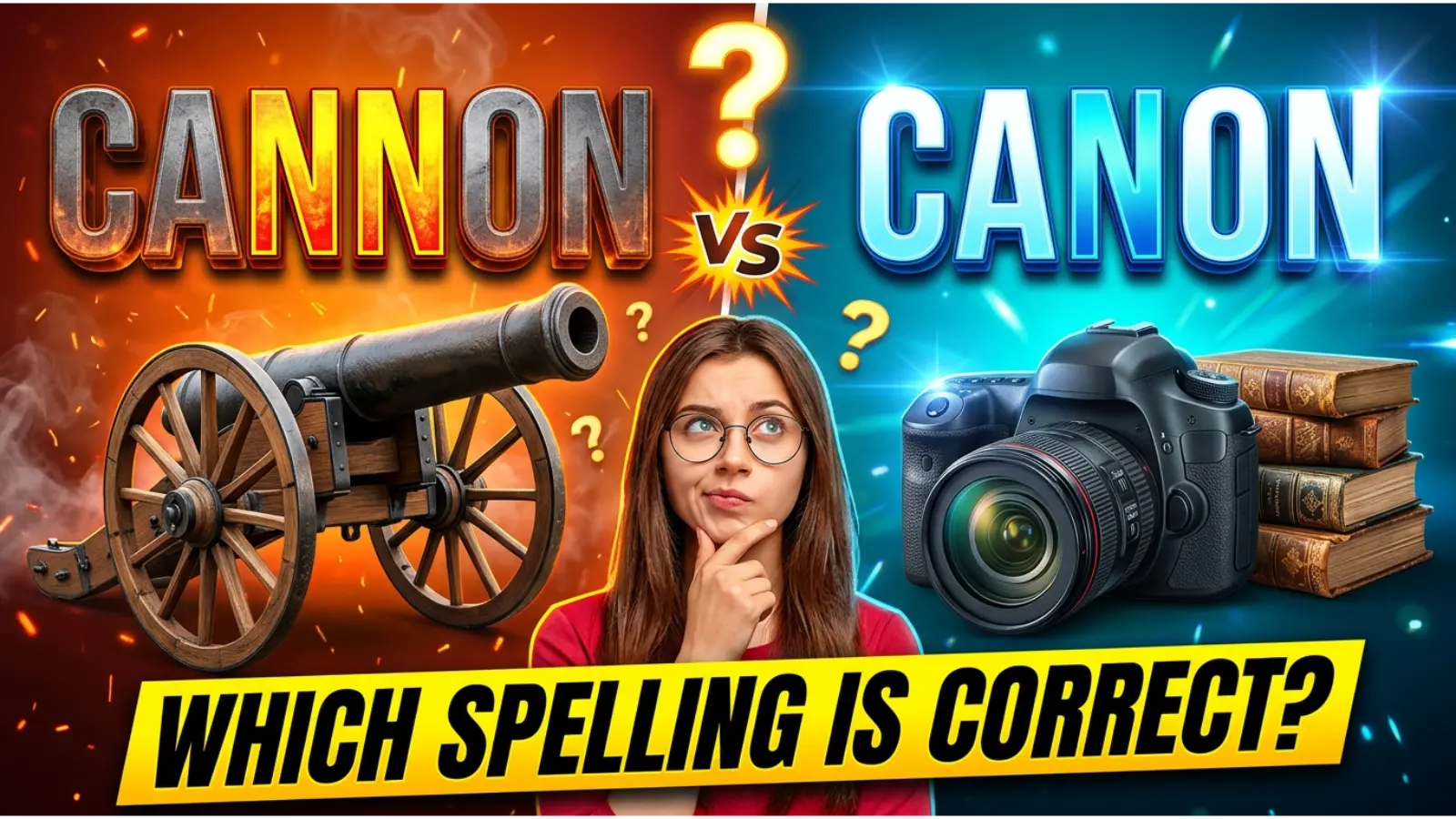
Many writers pause for a moment when they type this word. Indeed, “cannon” and “canon” look almost identical, yet their meanings are very different. As a result, a single extra letter can change the whole sentence, and sometimes it can make the sentence sound quite funny. Because spell-checkers accept both spellings, the error often slips through unnoticed. In this guide, you will learn what each word means, see clear examples, and pick up simple tricks to remember the difference for good.
Cannon or Canon: The Quick Answer
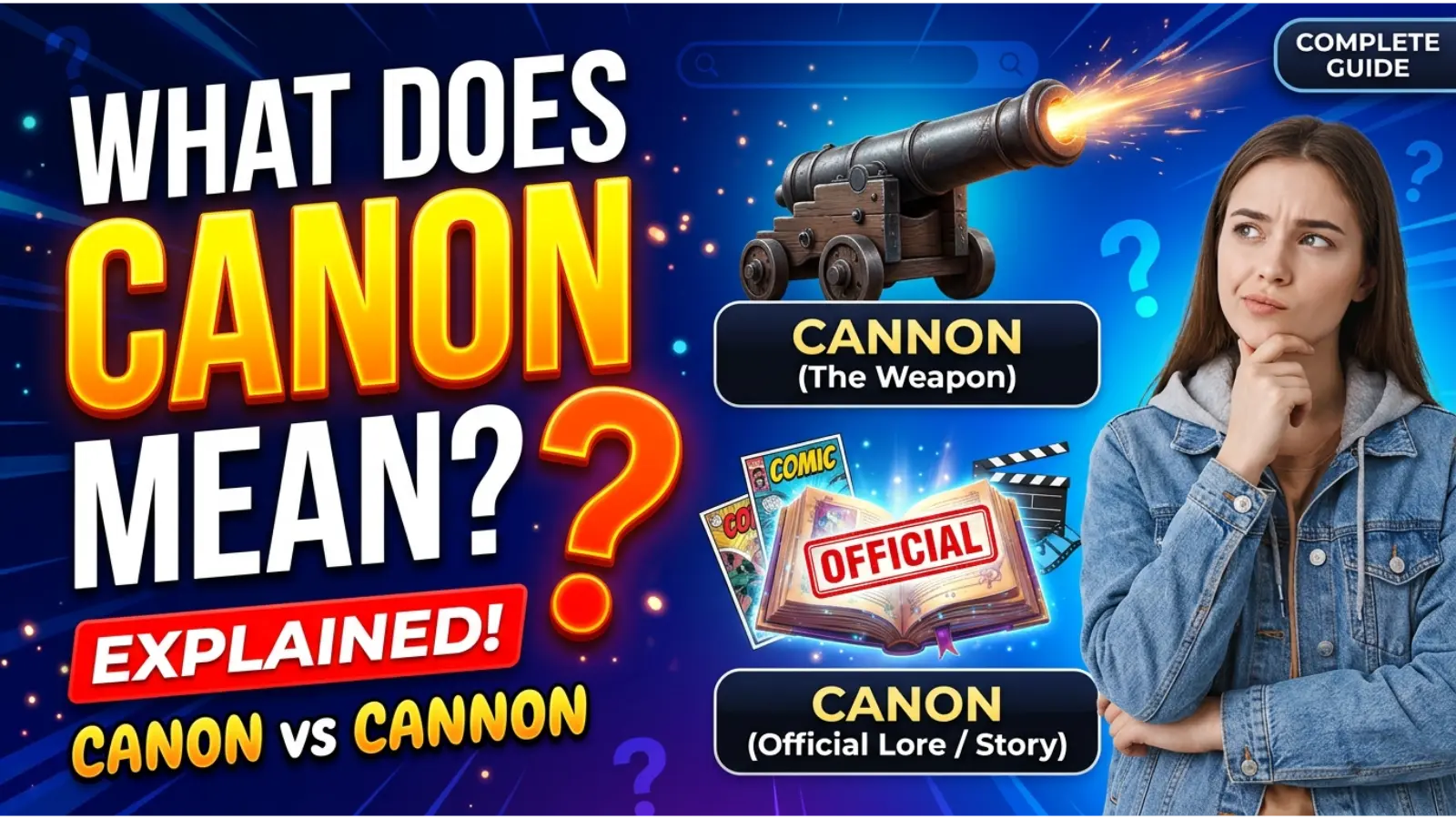
First, here is the short version. A cannon is a large, heavy gun that fires big projectiles. A canon, on the other hand, is a rule, a law, a principle, or an accepted body of work. Therefore, if you are talking about weapons, use “cannon” with two N’s. If you are talking about rules, official lists of books, church law, music, or the camera brand, use “canon” with one N.
That is the core of it. Nevertheless, both words have several extra meanings, and some of them overlap with everyday phrases. Let us look at each word in detail so that you never mix them up again.
What Does Cannon Mean?
The word “cannon” refers to a large military gun mounted on a base, a carriage, or wheels. Historically, armies used cannons to break down castle walls, to defend forts, and to fire from the decks of ships. Today, however, you mostly see them in museums, city parks, and ceremonies, where they are fired for salutes or celebrations.
Besides its main meaning, “cannon” has a few other uses. For example, modern machines sometimes carry the name because of their shape or power. A water cannon, a confetti cannon, and a snow cannon all take their name from the original weapon. In the same way, an aircraft may carry a cannon mounted in its wing or nose.
Here are some examples:
- The old fort still displays a bronze cannon at its main gate.
- At noon, the town fires a cannon to mark the start of the festival.
- Police used a water cannon to disperse the crowd.
- During the party, a confetti cannon filled the room with colorful paper.
The Origin of the Word Cannon
Interestingly, the word has a very practical history. It comes from the Italian word “cannone,” which means “large tube,” and that in turn traces back to the Latin word “canna,” meaning “reed” or “pipe.” Thus, the name simply describes the shape of the weapon: a big hollow tube. Once you know this, the double N feels natural, because the word looks “heavy” and “round” like the gun itself.
Cannon as a Verb and in Billiards
In addition to being a noun, “cannon” can work as a verb. To cannon into something means to collide with it forcefully. For instance, a runaway shopping cart might cannon into a parked car. Similarly, in British English, a cannon is a shot in billiards or snooker in which the cue ball strikes two other balls one after another. Americans usually call this shot a carom, so you may see both words depending on the country.
More examples:
- Suddenly, the runaway cart cannoned into the wall.
- She played a clever cannon and scored two points at once.
The Idiom “Loose Cannon”
Perhaps the most popular use of the word today is the phrase “loose cannon.” It describes a person who is unpredictable and who may cause damage without meaning to. The phrase comes from the age of sailing ships. A cannon that broke free from its ropes could roll across the deck, crushing sailors and damaging the vessel. Consequently, the image became a perfect way to describe someone who cannot be controlled.
Here is how it looks in a sentence:
- Because he often acts without thinking, his team calls him a loose cannon.
- The coach worried that the young striker was a loose cannon in front of the media.
What Does Canon Mean?
“Canon” has several meanings, and all of them relate to rules, standards, or official collections. First, it can mean a general principle or rule. For instance, honesty is a basic canon of good journalism. Second, it means a list of works that experts accept as genuine or important. Hence, people talk about the “literary canon” or the “Shakespeare canon.”
Moreover, the word appears in many other fields. Because it carries the sense of “an official standard,” it fits naturally in law, religion, art, and music. Although these uses may look unrelated at first, they all share one simple idea: something that has been formally accepted as correct.
The Origin of the Word Canon
Unlike “cannon,” this word comes from Greek. The Greek word “kanon” originally meant a straight rod or a measuring stick, and later it came to mean a rule or a standard. Afterward, Latin borrowed it, and early Christian writers used it to describe church rules and the list of accepted holy books. As a result, the single N and the idea of one official standard have been linked for more than two thousand years.
Canon in Literature and Art
In literary studies, the canon is the group of books that critics, teachers, and readers regard as the most important or influential. Works by Homer, Shakespeare, Austen, and Tolstoy are often listed in the Western canon. However, scholars constantly debate who should be included. Over the past few decades, many have argued for a wider canon that includes more voices from different countries, cultures, and backgrounds.
Similarly, art historians speak of a canon of masterpieces, and film critics talk about a canon of classic movies. In each case, the word suggests a core list that experts treat as essential.
Examples:
- The novel is now part of the Western literary canon.
- Critics argue that the film belongs in the canon of great cinema.
- Scholars have added several new authors to the modern canon.
Canon in Religion
Next, consider religion. The “biblical canon” is the list of books accepted as sacred scripture. In addition, “canon law” is the system of rules that governs a church, especially in the Catholic and Anglican traditions. Furthermore, a “canon” can also be a member of the clergy who serves at a cathedral or belongs to a religious community. The same word even gives us “canonize,” which means to declare a person officially recognized as a saint.
Examples:
- According to church canon, the ceremony must take place in daylight.
- The canon of the cathedral led the morning service.
- The church decided to canonize the founder of the hospital.
Canon in Music
Meanwhile, in music, a canon is a composition in which one voice starts a melody and other voices enter later, repeating the same tune. A familiar example is the round “Row, Row, Row Your Boat.” Another well-known piece is Pachelbel’s Canon in D, which many couples choose for their wedding. Here, the idea of strict rules fits perfectly, since each voice must follow the first one exactly.
Canon in Fandom and Storytelling
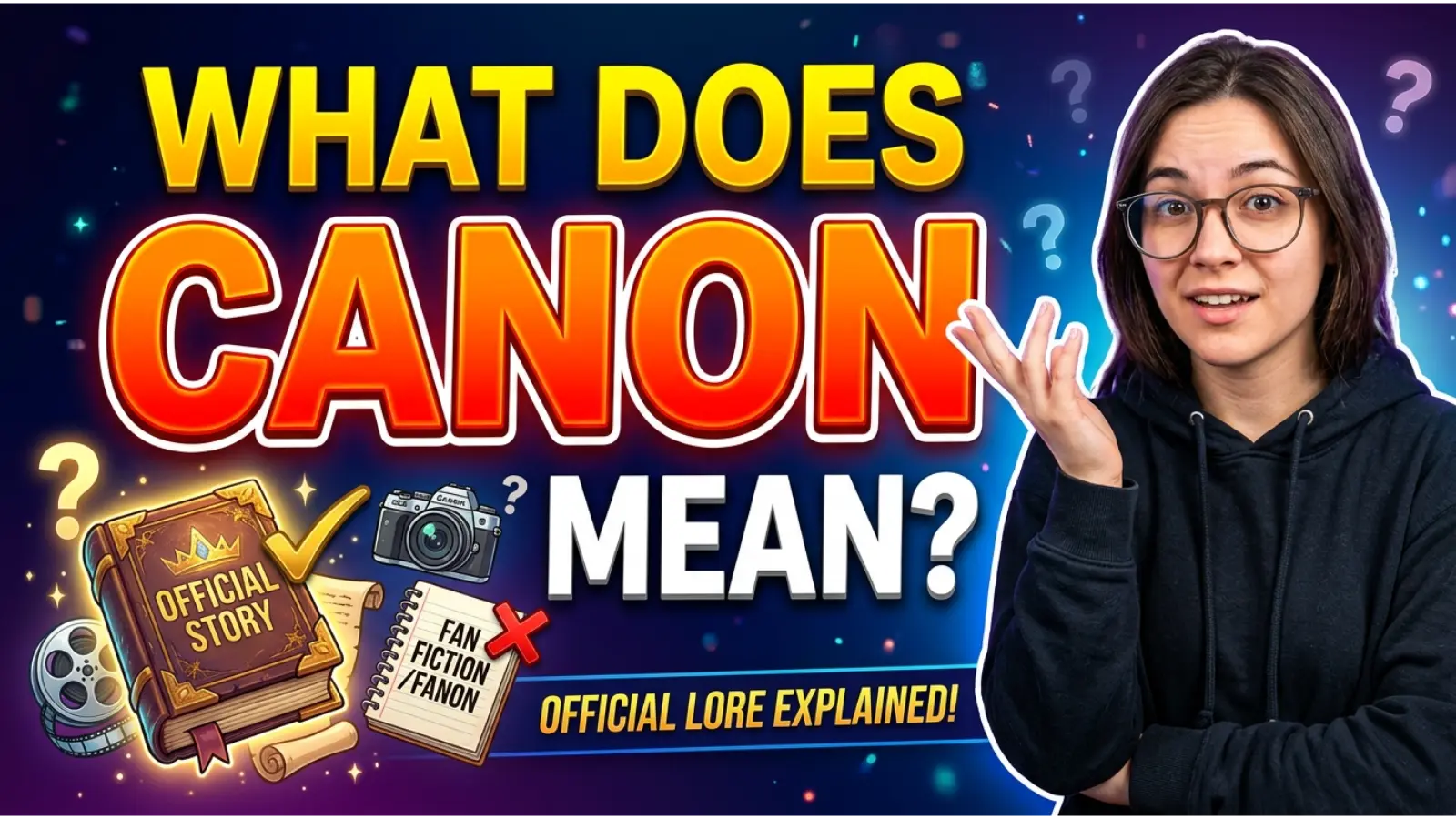
Today, fans of movies, comics, games, and novels use “canon” in a special way. In this sense, canon means the events, characters, and facts that officially belong to a story. By contrast, anything created by fans or outside the official source is called “non-canon” or “fanon.” For instance, a fan might say that a certain scene is not canon because the original author never wrote it. This modern use again follows the same pattern: canon equals “officially accepted.”
Examples:
- According to the director, the deleted scene is not canon.
- In fan communities, “canon” also means events that officially belong to a story.
Canon as a Brand Name
Finally, Canon is a world-famous Japanese company that makes cameras, lenses, and printers. Since it is a proper noun, it starts with a capital C. Interestingly, the company’s early camera prototype was named after the Buddhist figure Kwanon, but the founders later chose “Canon” because it sounded modern and stood for precision and accuracy. Thus, even the brand name connects back to the idea of a standard.
Example:
- She bought a new Canon camera for her trip.
Cannon vs Canon: Key Differences
To make things easier, the table below compares the two words side by side.
| Feature | Cannon | Canon |
|---|---|---|
| Main meaning | A large gun | A rule or accepted collection |
| Spelling | Two N’s | One N |
| Origin | Italian and Latin (a large tube) | Greek (a rule or measuring rod) |
| Typical use | War, history, billiards, idioms | Law, literature, religion, music, cameras |
| Related words | Cannonball, cannonade, cannon fodder | Canonical, canonize, canon law |
| Example | A cannon fired at noon. | This book joined the canon. |
Pronunciation: Do They Sound the Same?
Yes, in standard English, both words sound nearly identical. They are usually pronounced “KAN-un.” Because of this, you cannot rely on your ear when you write. Instead, you need to decide by meaning. In other words, they are homophones, which are words that sound the same but have different spellings and meanings. That is exactly why so many people confuse them.
Plural Forms
Another common question is how to make each word plural. For “cannon,” both “cannons” and “cannon” are acceptable, although most modern writers prefer “cannons.” For “canon,” the plural is simply “canons,” as in “the canons of poetry.”
Common Mistakes to Avoid
Many people mix up the two words in everyday writing. For example, writing “the literary cannon” is a frequent error, because the correct form is “literary canon.” Similarly, some writers type “canon fire” when they mean “cannon fire.” In another case, a student may write “the biblical cannon,” which sounds as if the Bible were a weapon.
Here is a quick list of wrong and right versions:
- Wrong: The professor discussed the literary cannon. Right: The professor discussed the literary canon.
- Wrong: The soldiers heard canon fire. Right: The soldiers heard cannon fire.
- Wrong: He is a loose canon. Right: He is a loose cannon.
- Wrong: She owns a Cannon camera. Right: She owns a Canon camera.
Because spell-checkers accept both words, they will not always catch the mistake. Therefore, always read the meaning of your sentence before you publish. In particular, check titles, headings, and captions, since errors in these places are the most visible.
Easy Memory Tricks
Fortunately, there are several simple ways to remember the difference.
Trick 1: Two N’s for the big gun. A cannon is a big, heavy thing, so give it the bigger spelling with two N’s. Meanwhile, “canon” is short and neat, like a single rule.
Trick 2: Think “can” and “one.” The word “canon” is made of “can” plus “on” or simply sounds like “one official list.” Alternatively, remember that there is only one official canon, so it gets only one N.
Trick 3: Picture two barrels. Imagine the two N’s as two wheels on the carriage of an old gun. In this way, the double letter reminds you of the weapon.
Trick 4: Ask a simple question. Whenever you are unsure, ask yourself, “Does this sentence involve a weapon or a rule?” If it is a weapon, write cannon. If it is a rule, a list, or a brand, write canon.
Frequently Asked Questions
Is it cannon or canon in “loose cannon”? It is “loose cannon,” with two N’s, because the phrase comes from a heavy gun rolling free on a ship’s deck.
Is it “literary cannon” or “literary canon”? The correct form is “literary canon.” In this case, the word means an accepted list of important works.
Is Canon the camera brand spelled with one N? Yes. The brand name uses one N and a capital C.
Can both words be used in the same sentence? Certainly. For example: “The museum’s cannon is not part of the official canon of exhibits.”
Do “cannon” and “canon” sound the same? Yes. Both are normally pronounced “KAN-un,” so you must rely on meaning and spelling rather than sound.
What does “canon” mean in movies and games? It means the events and facts that officially belong to the story. Anything outside the official material is called non-canon.
Is the plural of cannon “cannons” or “cannon”? Both are correct, but “cannons” is more common in modern writing.
Conclusion
In short, “cannon” is a gun, while “canon” is a rule, a collection, or a brand. Although the spellings look alike, the meanings never overlap. With the memory tricks above, you can now choose the right word with confidence. Next time you wonder about cannon or canon, simply ask yourself whether the sentence is about a weapon or about a rule. Then write the spelling that fits, and your readers will thank you for the clarity.