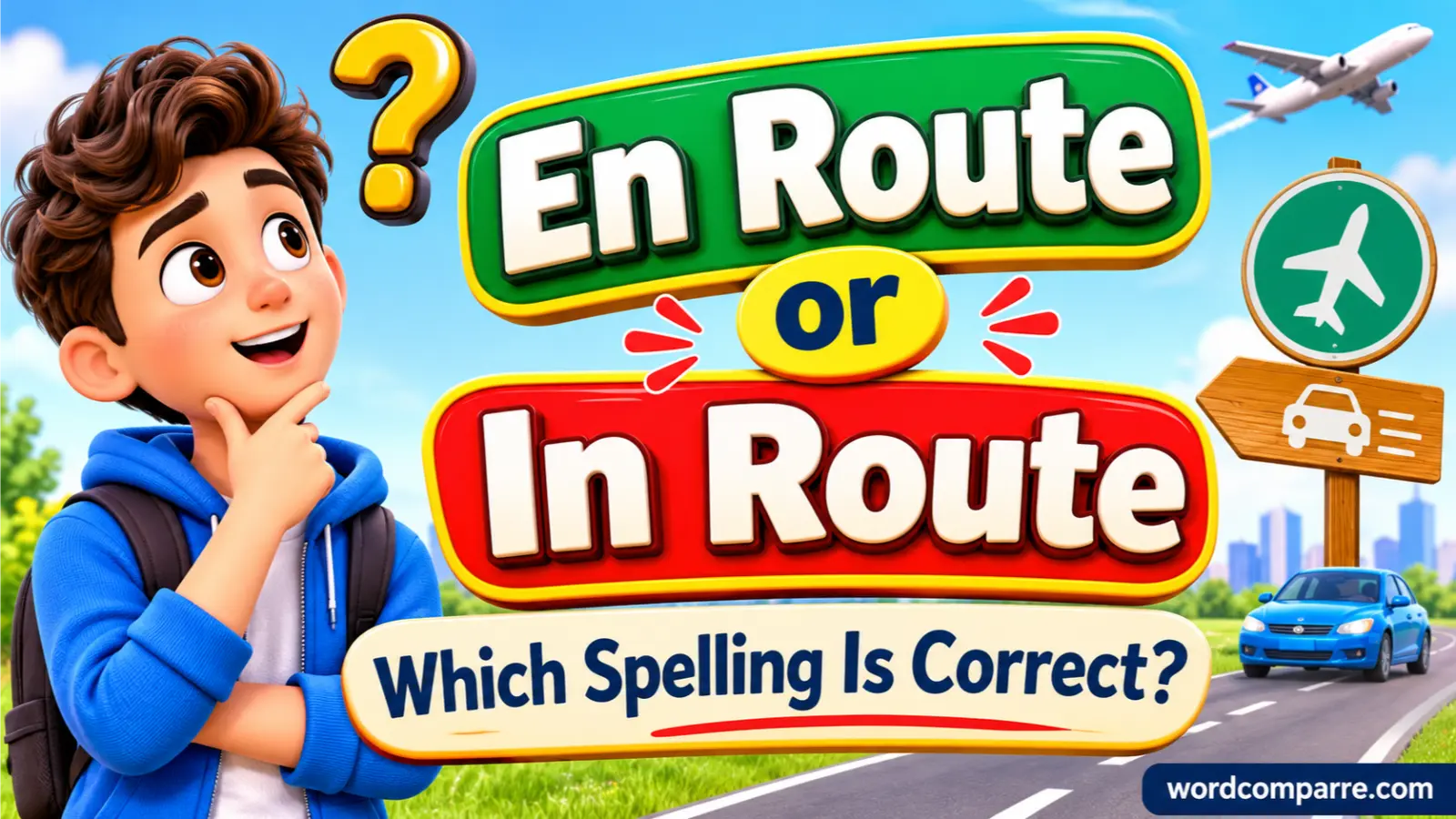
En route or in route is a common spelling and usage question, especially when describing someone who is traveling to a particular destination. Both expressions may look reasonable because the English word route refers to a way or path from one place to another. However, standard English uses On the Way to mean that someone or something is on the way to a destination.
The confusion often occurs because people associate the French expression On the Way with the familiar English preposition in. Although in route may appear in informal writing or occasional regional usage, it is not the standard expression. Understanding the difference will help you choose the correct phrase in emails, travel updates, business communication, and everyday writing.
Quick Answer
En route is the correct and widely accepted expression when you mean that someone or something is on the way to a destination.
- On the Way: Correct. It means traveling toward a destination.
- In route: Not standard for this meaning. Avoid it in formal and professional writing.
Example: The delivery driver is On the Way to your address.

Meaning of En Route and In Route
1. En Route
En route is a French expression used in English as an adverb and adjective. It means on the way, in transit, or traveling toward a particular place.
Writers commonly use it when discussing journeys, deliveries, flights, transportation, and travel arrangements.
Examples:
- The ambulance is On the Way to the hospital.
- We stopped at a small café On the Way to London.
- Your package is currently On the Way
- The flight experienced delays while On the Way to Dubai.
- She called her family while On the Way to the airport.
2. In Route
In route is a nonstandard expression when someone intends to say that a person or object is on the way to a destination.
The confusion comes from the familiar English preposition in. However, English speakers do not normally replace en with in in this established French expression.
If you want to communicate that someone is traveling, use On the Way instead.
Incorrect: The delivery driver is in route to our office.
Correct: The delivery driver is On the Way to our office.
En Route vs. In Route: Comparison Table
| Feature | En Route | In Route |
|---|---|---|
| Correct expression | Yes | No, for this meaning |
| Meaning | On the way | Intended to mean on the way |
| Origin | French | Incorrect substitution |
| Dictionary recognition | Established expression | Not standard in this context |
| Professional writing | Recommended | Avoid |
| Example | The train is en route. | The train is in route. |
Origin and History of En Route
The expression en route comes from French, where it literally means “on the way” or “on the road.”
English adopted this expression during the late eighteenth century. Historical language references date its English use to approximately 1779.
The French word en contributes the sense of being on or in a particular state, while On the Way refers to a road, path, or journey.
Over time, English speakers adopted the complete expression rather than translating each word separately. Today, it remains a familiar expression in travel, transportation, journalism, and everyday communication.

Why Do People Confuse En Route and In Route?
Several factors explain why writers sometimes choose the wrong expression.
1. Similar pronunciation
Depending on the speaker’s accent, On the Way can sound like “on route.” This similarity may cause people to write a different expression from the one they hear.
2. Familiar English prepositions
English speakers regularly use in in expressions such as:
- In transit
- In motion
- In progress
- In the car
Consequently, some writers mistakenly assume that in route follows the same pattern.
3. The influence of everyday speech
People sometimes use nonstandard expressions in casual conversations and messages. When these expressions become familiar, writers may assume they are grammatically correct.
4. Limited knowledge of French expressions
Some English expressions come directly from other languages. Writers who do not recognize the French origin of On the Way may try to replace its first word with a more familiar English preposition.
What Do Major Dictionaries Say?
Established dictionaries recognize On the Way as the standard expression for being on the way to a destination.
Here is what several respected references explain:
- Oxford Learner’s Dictionaries: Defines On the Way as being on the way or traveling from or to a particular place.
- Cambridge Dictionary: Explains that On the Way means on the way to or from somewhere.
- Collins Dictionary: Recognizes On the Way and identifies on route as a nonstandard spelling in this context.
- Dictionary.com: Defines On the Way as on the way and traces its adoption into English to the late eighteenth century.
The dictionary evidence supports one clear recommendation: use On the Way when describing travel or movement toward a destination.
Real-Life Examples of En Route
These examples demonstrate how to use the expression naturally in different situations.
Everyday Conversations
- I am On the Way to your house.
- We are On the Way, so please wait a few minutes.
- Dad is On the Way to pick us up.
- They are On the Way to the restaurant.
Business and Professional Communication
- The shipment is On the Way to the customer’s warehouse.
- Our representative is On the Way to the meeting.
- The replacement equipment is On the Way and should arrive soon.
- Your order is currently On the Way to the delivery location.
Travel and Transportation
- The passengers received refreshments On the Way to Paris.
- The aircraft encountered turbulence On the Way to New York.
- We visited several beautiful towns On the Way to the mountains.
- The bus stopped twice On the Way to the airport.
News and Formal Writing
- Emergency services were On the Way to the accident scene.
- The rescue team encountered difficult weather On the Way to the village.
- The package went missing while On the Way to its destination.
- The athlete suffered an injury On the Way to the final.
Common Mistakes to Avoid
Even experienced writers sometimes make mistakes when using this expression. Watch out for these examples:
| Incorrect Usage | Correct Usage |
|---|---|
| I am in route to work. | I am en route to work. |
| The package is in route. | The package is en route. |
| She was on route to school. | She was en route to school. |
| The ambulance is in route. | The ambulance is en route. |
| We stopped in route to Paris. | We stopped en route to Paris. |
Remember that On the Way can appear before a destination with to or after a verb without additional words.
For example:
- The driver is On the Way.
- The driver is On the Way to the airport.
Both sentences are correct.
Easy Memory Trick: How to Remember En Route
A simple memory trick can help you avoid this spelling mistake.
Remember that EN ROUTE starts with EN, not IN.
Think of On the Way as a complete French expression that English has borrowed. Do not change its first word just because in sounds more familiar.
You can also remember this simple sentence:
“EN route means ON the way.”
Whenever you want to describe someone traveling toward a destination, choose On the Way.
Frequently Asked Questions (FAQs)
1. Is it en route or in route?
En route is correct when you mean that someone or something is traveling toward a destination. In route is a nonstandard expression for this meaning.
2. What does On the Way mean in simple English?
On the Way means on the way to a particular place. For example, “I am On the Way to the office” means “I am traveling to the office.”
3. Is On the Way one word or two words?
The standard spelling is two separate words: en route. Writing it as one word, enroute, is not the recommended standard form.
4. Is On the Way formal or informal?
On the Way works in both formal and informal English. You can use it in professional emails, travel updates, business reports, and everyday conversations.
5. Is On the Way originally French?
Yes. On the Way comes from French and literally means on the way or on the road. English adopted the expression during the late eighteenth century.
6. Can I use On the Way without mentioning a destination?
Yes. You can use it without specifying a destination when the context already makes the journey clear.
Example: The driver has already left and is On the Way.
7. Should I use On the Way in professional emails?
Yes. En route is appropriate for professional communication, particularly when discussing deliveries, transportation, appointments, and travel arrangements.
Conclusion
The choice between en route or in route is straightforward once you understand the expression’s origin and meaning. On the Way is the standard spelling and means that someone or something is on the way to a destination. In route is a nonstandard alternative and should be avoided when expressing this idea.
Remember to keep the original two-word spelling, especially in professional emails, academic assignments, travel updates, and business documents. When in doubt, choose en route for clear, accurate, and professional English.