Have you ever wondered whether to write steer or stear? These two spellings look similar, which can make them confusing when writing emails, articles, or everyday messages. However, only one is the standard English spelling. The difference is important because using the wrong form can affect the clarity and professionalism of your writing.
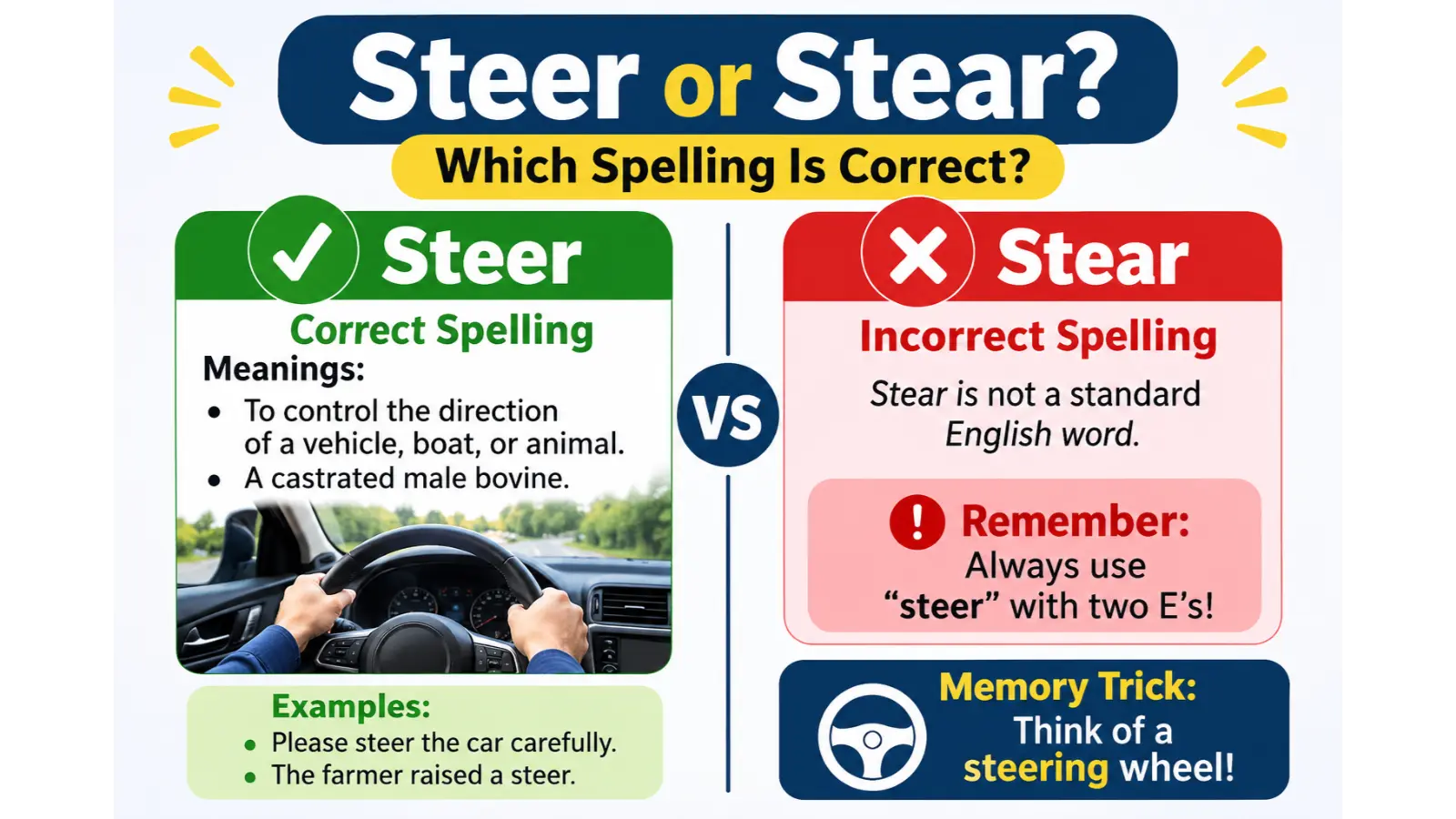
The correct spelling is steer, which means to control the direction of a vehicle, boat, or animal. It can also describe guiding someone toward a particular decision or result. On the other hand, stear is a misspelling and does not serve as a standard English alternative. Understanding the correct form will help you avoid spelling mistakes and communicate more confidently.
Quick Answer: Steer or Stear?
Steer is the correct spelling in standard English. It can function as a verb or a noun, depending on the sentence.
Stear is incorrect when you intend to use the word meaning to guide or control direction.
- Correct: Please steer the car carefully.
- Incorrect: Please stear the car carefully.
Remember to use steer whenever you discuss directing, controlling, or guiding something.

What Does Steer Mean?
The word steer has several related meanings. Most commonly, it describes controlling the direction of a vehicle, boat, or animal. It can also refer to guiding a person, organization, or situation toward a particular outcome.
As a verb, it describes the action of directing movement or influencing a decision.
Steer as a Verb
When used as a verb, steer means to control the direction of something or guide it toward a particular destination.
Examples:
- She learned to steer a boat during her summer vacation.
- Please steer the bicycle away from the parked cars.
- The driver managed to steer the vehicle safely around the obstacle.
- Good leaders steer their teams toward success.
- My parents helped steer me toward a successful career.
Steer as a Noun
The word can also function as a noun. In this context, a steer refers to a male bovine that has been castrated, usually raised for beef production.
Examples:
- The farmer raised a healthy steer on his ranch.
- The steer walked across the open pasture.
- They purchased a young steer at the livestock auction.
These meanings show that steer is a versatile English word with different uses in everyday and professional communication.
What Does Stear Mean?
Stear is not a standard English spelling of the word steer. It does not have an accepted dictionary meaning when someone intends to describe controlling direction or guiding something.
Writers sometimes use this spelling because they misunderstand the pronunciation or remember the word incorrectly.
For example:
- Incorrect: He tried to stear the boat.
- Correct: He tried to steer the boat.
If you are writing an email, school assignment, business document, or website article, always choose steer.
Steer vs. Stear: Comparison Table
| Feature | Steer | Stear |
|---|---|---|
| Spelling status | Correct | Incorrect |
| Dictionary recognition | Standard English word | Not a standard alternative |
| Meaning | Guide or control direction | No accepted meaning in this context |
| Part of speech | Noun and verb | Not standard |
| Professional usage | Recommended | Avoid |
| Example | Steer the vehicle | Stear the vehicle |
The comparison makes the difference clear: steer is the accepted spelling, while stear is a spelling mistake.
Origin and History of the Word Steer
The word steer has Old English roots. It comes from the Old English word stieran, which meant to guide, direct, or control.
Over time, the spelling developed into the modern English form steer. Its meaning remained closely connected to directing movement and controlling direction.
The word also developed a connection with animal terminology. In modern English, a steer can refer to a castrated male bovine raised for meat.
Its long history explains why steer appears in different contexts, including transportation, farming, leadership, and everyday conversation.

Why Do People Confuse Steer and Stear?
Although steer and stear look similar, several reasons explain why writers confuse them.
1. Similar Pronunciation
Both spellings may appear to represent the same pronunciation to someone unfamiliar with the correct spelling. Since the additional letters do not create an obvious difference in sound, people sometimes choose the wrong form.
2. English Spelling Patterns
English contains many words with similar vowel combinations. For example, words such as clear, fear, and dear may influence how people remember the spelling of steer.
3. Typing Mistakes
Fast typing can lead to accidental letter substitutions. Someone may type stear instead of steer without noticing the mistake.
4. Limited Reading Experience
People who rarely encounter the word in books or professional writing may have difficulty remembering its correct form.
Reading examples and practicing the spelling can help prevent these errors.
What Do Dictionaries Say About Steer and Stear?
Major English dictionaries recognize steer as the standard spelling.
- Merriam-Webster: Recognizes steer as a verb meaning to guide or control direction and as a noun referring to a castrated male bovine.
- Oxford English Dictionary: Records steer as an established English word with historical roots in Old English.
- Cambridge Dictionary: Recognizes steer as a verb associated with controlling the direction of a vehicle or guiding something.
These dictionary references support the standard spelling steer. Stear is not an accepted alternative spelling for these meanings.
Real-Life Examples of Steer in Sentences
The best way to understand a word is to see how people use it in different situations.
Everyday Conversation
- Can you steer the car while I check the map?
- She knows how to steer a bicycle.
- Please steer clear of the wet floor.
- He carefully steered the boat toward the shore.
Workplace and Professional Writing
- Effective managers steer their teams toward clear objectives.
- The company wants to steer its business toward sustainable growth.
- Our new strategy will help steer the project in the right direction.
- Strong leadership can steer an organization through difficult times.
Academic and Educational Writing
- Teachers can steer students toward useful learning resources.
- The research may steer future scientific investigations.
- Parents often help steer children toward positive decisions.
Farming and Agriculture
- The farmer sold a young steer at the livestock market.
- The steer grazed peacefully in the field.
- The ranch raised several steers for beef production.
These examples demonstrate how the correct spelling works in different situations.
Common Mistakes to Avoid
Even simple words can cause spelling problems. Here are some mistakes to watch for when using steer.
Mistake 1: Writing Stear Instead of Steer
Incorrect: She will stear the boat.
Correct: She will steer the boat.
Mistake 2: Using Steer When You Mean Stir
Incorrect: Please steer the coffee.
Correct: Please stir the coffee.
Steer means to guide or control direction, whereas stir means to mix something with a spoon or another object.
Mistake 3: Confusing Steer With Steering
Incorrect: He is stear the car.
Correct: He is steering the car.
The word steering is the present participle of steer and describes an ongoing action.
Mistake 4: Forgetting the Correct Spelling in Professional Documents
Incorrect: The manager will stear the project.
Correct: The manager will steer the project.
Always proofread important documents before publishing or sending them.
Easy Memory Trick: How to Remember Steer
A simple memory trick can help you remember the correct spelling.
Think of the word steering wheel.
A steering wheel helps a driver control the direction of a vehicle. Both words contain the same spelling pattern: STEER.
Remember this connection:
STEER = STEERING WHEEL = CONTROL DIRECTION
Whenever you need a word meaning guide or direct, remember the steering wheel and write steer.
Another useful trick is to remember that steer contains two consecutive letters E, not EA.
Professional Writing Recommendation
For professional communication, always use steer instead of stear.
The correct spelling is important in business emails, reports, educational materials, website content, and formal documents. Spelling mistakes can distract readers and reduce the credibility of your writing.
Here are some professional examples:
- The new manager will steer the company toward greater efficiency.
- Our team needs a clear strategy to steer the project forward.
- The organization aims to steer customers toward sustainable products.
- Strong leadership can steer employees through challenging situations.
If you are unsure about a spelling, consult a trusted dictionary or use a reliable spelling checker before publishing your work.
Frequently Asked Questions (FAQ)
1. Is it steer or stear?
Steer is the correct spelling. Stear is a misspelling when you mean to describe guiding or controlling direction.
2. What does steer mean?
Steer means to control the direction of a vehicle, boat, or animal. It can also mean guiding someone or something toward a particular goal.
3. Is stear a real English word?
Stear is not a standard English alternative to steer. Avoid using it when you mean to guide or control direction.
4. How do you spell steer correctly?
The correct spelling is S-T-E-E-R. Remember that it contains two consecutive E letters.
5. What is the past tense of steer?
The past tense of steer is steered.
Example: She steered the boat toward the harbor.
6. What is the difference between steer and steering?
Steer is the base form of the verb, while steering is its present participle or gerund form.
Example: I steer the car carefully. She is steering the car carefully.
7. Can steer be used as a noun?
Yes. A steer can refer to a castrated male bovine, usually raised for beef production.
8. What are some synonyms for steer?
Depending on the context, synonyms include guide, direct, lead, control, navigate, and influence.
9. Is steer used in American and British English?
Yes. Steer is the standard spelling in both American and British English. There is no regional spelling difference.
10. How can I remember steer instead of stear?
Connect steer with steering wheel. Since a steering wheel controls direction, this association can help you remember the correct spelling.
Conclusion
When choosing between steer or stear, always use steer in standard English. It is the correct spelling of the word meaning to guide, direct, or control the movement of something. It can also function as a noun referring to a castrated male bovine.
The confusion usually comes from similar-looking letter combinations, pronunciation, and typing mistakes. However, major dictionaries recognize steer as the standard spelling, not stear.
Remember the simple connection between steer and steering wheel. It will help you recall the correct spelling whenever you write. Whether you are preparing an academic assignment, professional email, or everyday message, choosing steer will keep your writing clear and accurate.