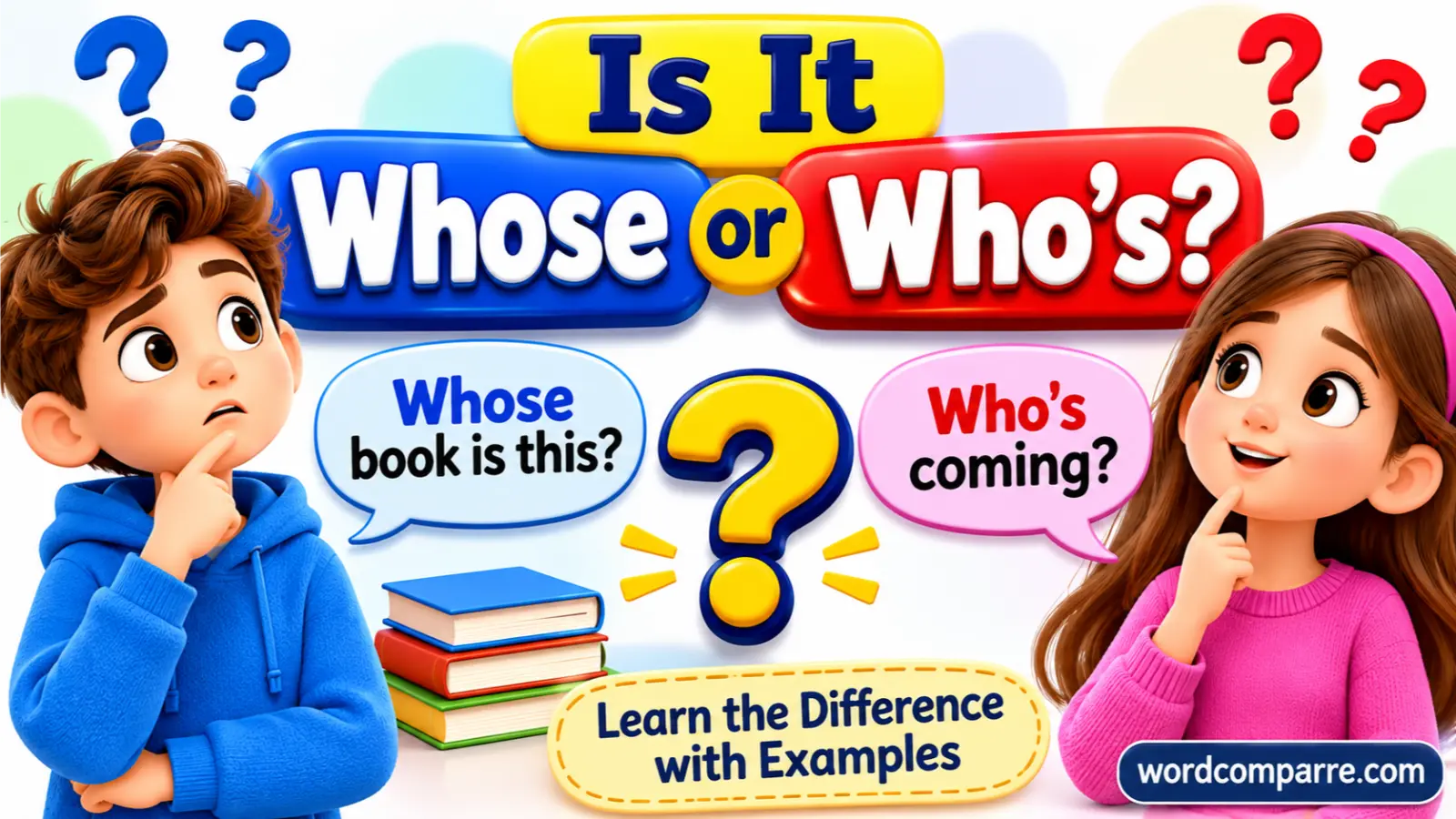
Is it whose or who’s? Both words are correct in English, but they serve different grammatical purposes. Whose indicates possession or ownership, whereas who’s is a contraction of who is or who has. Although these words sound exactly alike, their meanings and uses differ.
Understanding the difference between whose and Who Is can help you avoid grammar mistakes in emails, school assignments, conversations, and professional writing. This guide explains their meanings, grammar rules, sentence structures, examples, and practical ways to remember which word to use.
Quick Answer: Whose or Who’s?
Whose is a possessive word that asks who owns something or identifies something belonging to a person. Who’s is a contraction of who is or who has.
- Whose: Whose phone is this?
- Who Is: Who Is coming to the party?
- Who Is: Who Is finished the assignment?
Both spellings are correct, but they are not interchangeable.
What Does Whose Mean?
Whose is a possessive pronoun or possessive determiner that asks about ownership, relationships, or association. It helps identify the person who owns something or to whom something belongs.
Unlike Who Is, whose does not contain an apostrophe.
Examples of Whose in Sentences
- Whose jacket is hanging on the door?
- Whose keys are these?
- I know the woman whose dog won the competition.
- Whose idea was it to organize the event?
- The student whose notebook is missing should speak to the teacher.
In these sentences, whose connects something to a person, such as a jacket, keys, dog, idea, or notebook.
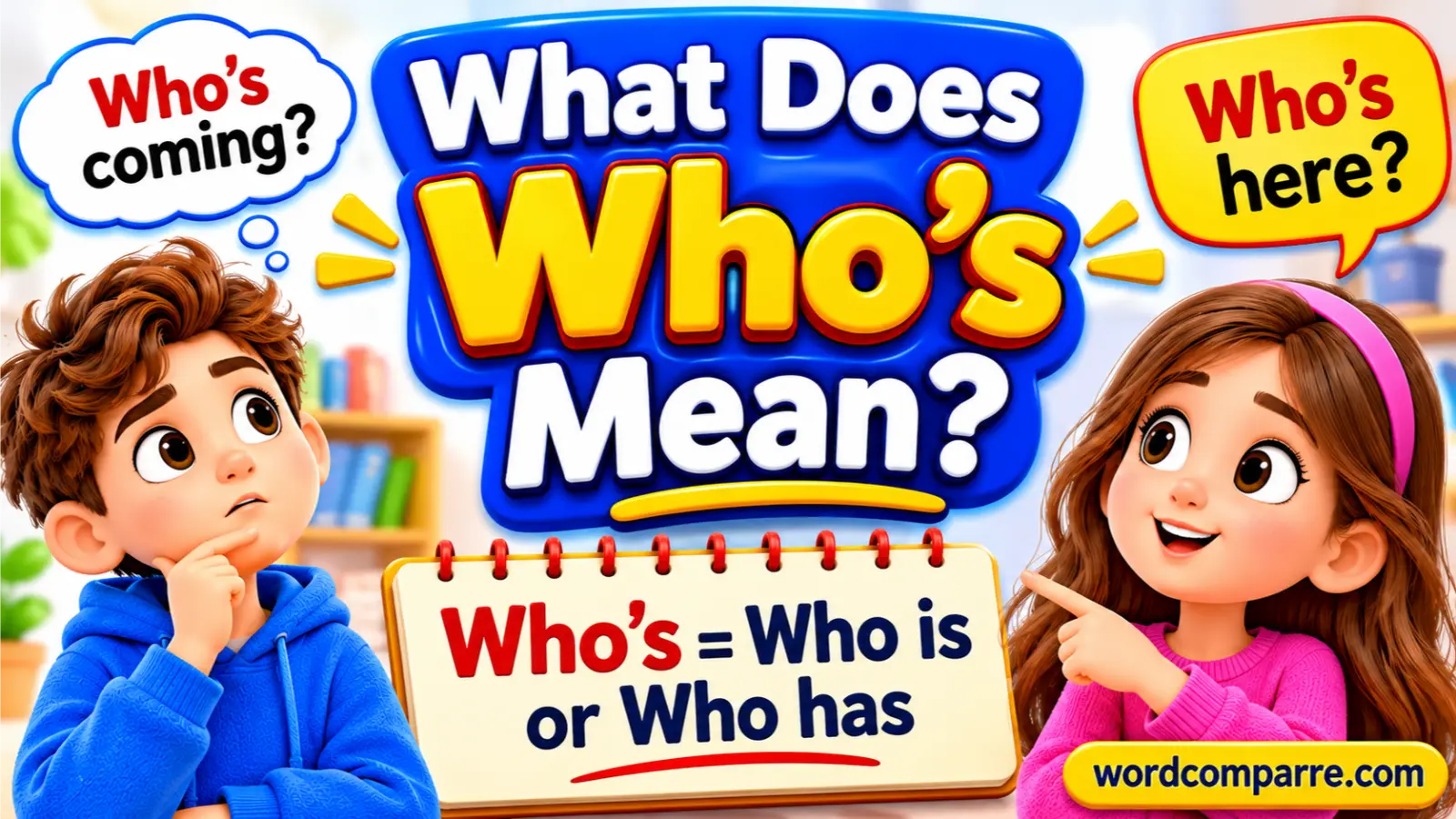
What Does Who’s Mean?
Who’s is a contraction of who is or who has. Writers use it to make sentences sound natural, especially in conversations, informal writing, and everyday communication.
The apostrophe replaces the missing letters in the original words.
Examples of Who’s in Sentences
- Who Is waiting outside?
- Who Is your favorite teacher?
- Who Is going to the meeting?
- Who Is completed the project?
- Who Is been working here for five years?
In the first three examples, Who Is means who is. In the last two, it means who has.
Whose vs. Who’s: Comparison Table
| Feature | Whose | Who’s |
|---|---|---|
| Meaning | Shows possession or association | Means who is or who has |
| Grammar | Possessive word | Contraction |
| Apostrophe | No apostrophe | Contains an apostrophe |
| Purpose | Identifies ownership or relationships | Shortens a question or statement |
| Example | Whose book is this? | Who’s reading the book? |
| Expansion | Not applicable | Who is or who has |
Grammar Rules for Whose and Who’s
Knowing a few simple grammar rules makes it easier to choose the correct word.
1. Use Whose to Ask About Ownership
Use whose when you want to know who owns something.
- Whose car is parked outside?
- Whose pencil did you borrow?
- Whose house are we visiting?
In each example, the question concerns ownership or association.
2. Use Whose to Connect a Person With Something
Whose can also appear in statements that describe relationships or identify someone through something associated with them.
- She is the girl whose mother is a doctor.
- We met a man whose paintings are famous.
- He hired an employee whose experience impressed him.
Here, whose connects a person to a family member, possession, or personal characteristic.
3. Use Who’s When You Mean Who Is
If you can replace who’s with who is without changing the basic meaning, who’s is the correct choice.
- Who Is responsible for this mess? (Who is responsible?)
- Who Is your new neighbor? (Who is your new neighbor?)
- Who Is speaking on the phone? (Who is speaking?)
This substitution test works in most sentences involving who is.
4. Use Who’s When You Mean Who Has
Who’s can also represent who has when the sentence uses the present perfect tense.
- Who Is seen my wallet? (Who has seen my wallet?)
- Who Is finished their work? (Who has finished their work?)
- Who Is been to London? (Who has been to London?)
However, Who Is does not replace who has in every situation. It works when has functions as an auxiliary verb, not when has expresses possession.
For example, in the sentence Who has a bicycle?, has expresses ownership. In standard writing, you would generally write the question without contracting it to Who Is.
Whose or Who’s in Sentence Structure
The sentence structure can help you identify the correct spelling.
Whose Sentence Structure
Whose commonly appears before a noun when asking about ownership or describing a relationship.
Structure: Whose + noun + verb?
Examples:
- Whose bag is this?
- Whose house is the largest?
- Whose phone rang during the meeting?
It can also introduce a relative clause.
Structure: Person + whose + noun + verb
Examples:
- I met a woman whose son studies abroad.
- He knows a teacher whose classes are popular.
- We visited a family whose home was recently renovated.
Who’s Sentence Structure
Who’s typically appears before a verb, adjective, or other expression when it means who is or who has.
Structure: Who’s + verb or description?
Examples:
- Who Is coming to dinner?
- Who Is available today?
- Who Is been waiting for an hour?
You can expand who’s into who is or who has to confirm whether the sentence makes sense.
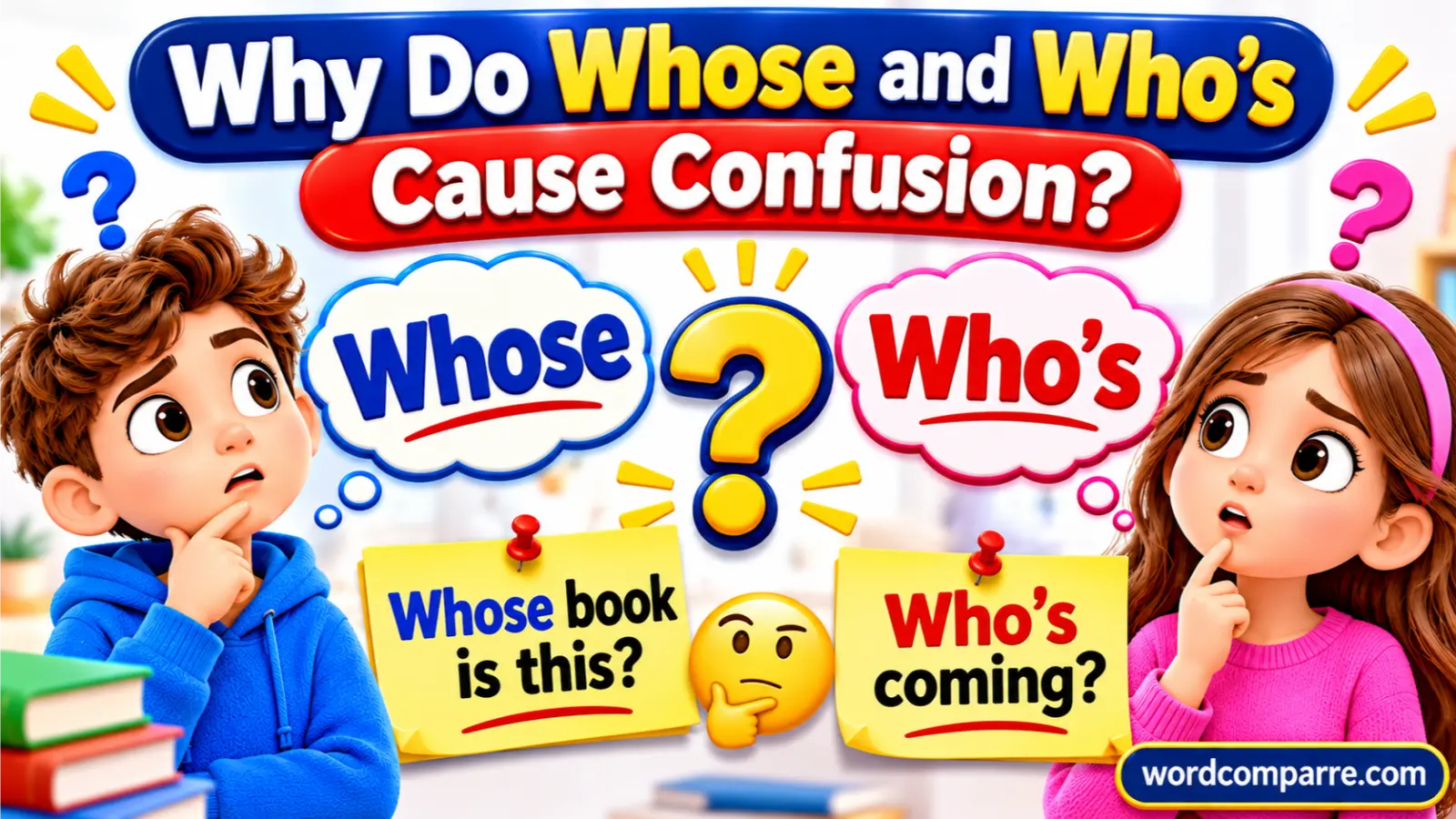
Why Do Whose and Who’s Cause Confusion?
Whose and who’s cause confusion because they sound identical when spoken. This similarity makes it difficult to distinguish them by pronunciation alone.
However, their spelling reflects different grammatical functions.
- Whose indicates possession or association.
- Who’s combines who with is or has.
English also uses apostrophes in possessive forms, such as someone’s or John’s. Therefore, some writers mistakenly assume that whose needs an apostrophe to indicate ownership. In fact, whose is already a possessive form and does not require one.
Meanwhile, who’s uses an apostrophe because it represents missing letters in who is or who has.
What Do Dictionaries Recommend?
Major English dictionaries recognize both whose and who’s as standard English words.
- Whose: Dictionaries define whose as the possessive form of who and, in some contexts, which.
- Who’s: Dictionaries define who’s as a contraction of who is or who has.
Neither word is a spelling error. The mistake occurs when writers use one in place of the other.
For formal writing, such as academic papers, business reports, and professional documents, writers should use the correct form according to the intended meaning. Contractions such as who’s may be less common in highly formal writing, but they remain grammatically correct in appropriate contexts.
Whose or Who’s: Real-Life Examples
The following examples demonstrate how both words work in everyday situations.
| Sentence with Whose | Sentence with Who’s |
|---|---|
| Whose shoes are these? | Who’s wearing those shoes? |
| Whose birthday is tomorrow? | Who’s celebrating tomorrow? |
| Whose laptop is on the desk? | Who’s using the laptop? |
| Whose child is playing outside? | Who’s watching the children? |
| Whose turn is it to cook? | Who’s cooking tonight? |
These examples show that whose asks about ownership or association, while who’s asks about a person performing an action or being in a particular situation.
Common Mistakes With Whose and Who’s
Writers often confuse these words because they sound the same. Here are common mistakes and their corrections.
| Incorrect Sentence | Correct Sentence | Explanation |
|---|---|---|
| Who’s shoes are these? | Whose shoes are these? | The question asks about ownership. |
| Whose coming today? | Who’s coming today? | The sentence means who is coming. |
| I know who’s car this is. | I know whose car this is. | Whose identifies the car’s owner. |
| Whose been waiting? | Who’s been waiting? | Who’s means who has. |
| Who’s book is on the table? | Whose book is on the table? | Whose modifies the noun book. |
Correcting these mistakes makes your writing clearer and more grammatically accurate.
Memory Trick: How to Remember Whose or Who’s
Use a simple substitution trick whenever you are unsure.
1: Replace who’s with who is or who has.
2: Read the sentence again.
3: If the expanded sentence makes sense, use who’s. If it does not, you may need whose.
Memory Trick Examples
- Who Is at the door? → Who is at the door? (Correct)
- Who Is completed the test? → Who has completed the test? (Correct)
- Whose bag is this? → Who is bag is this? (Incorrect)
If the sentence asks about ownership, use whose.
<bold>Easy reminder:</bold> Whose asks about ownership, while Who Is stands for who is or who has.
Whose or Who’s in Professional Writing
Both forms appear in professional writing, but their use depends on the sentence.
When to Use Whose
Use whose when identifying ownership, responsibility, or relationships in professional documents.
- Whose responsibility is it to approve the request?
- The manager whose team achieved the target received recognition.
- We identified the employee whose report contained the error.
When to Use Who’s
Who’s is grammatically correct in professional communication when the contraction fits the tone.
- Who Is responsible for reviewing the proposal?
- Who Is available for the client meeting?
- Who Is been assigned to the new project?
However, some formal documents prefer expanded forms. For example, writers may use who is instead of Who Is in formal reports or legal documents. This choice reflects style rather than a grammatical requirement.
Whose or Who’s: Examples in Conversations
Conversation 1: Asking About Ownership
Alex: Whose jacket is on the chair?
Sam: It’s mine. I left it there earlier.
Conversation 2: Asking About Someone
Alex: Who Is coming to the office today?
Sam: Sarah and David are coming.
Conversation 3: Asking About Work
Alex: Who Is finished the presentation?
Sam: I’ve finished it, and Sarah is reviewing the slides.
Conversation 4: Identifying a Person
Alex: Do you know whose car is parked outside?
Sam: Yes, it’s our neighbor’s car.
Conversation 5: Asking About Availability
Alex: Who Is available to help with the project?
Sam: I’m available this afternoon.
Frequently Asked Questions
Is who’s grammatically correct?
Yes, Who Is is grammatically correct. It is a contraction of who is or who has. For example, Who’s coming to dinner? means Who is coming to dinner?
Is whose grammatically correct?
Yes, whose is grammatically correct. It is a possessive word used to ask about ownership or describe relationships. For example, Whose phone is this?
Can whose and Who Is be used interchangeably?
No, whose and Who Is cannot be used interchangeably because they have different grammatical functions. Whose indicates possession or association, whereas Who Is means who is or who has.
Is Who Is the same as who has?
Who Is can mean who has when has acts as an auxiliary verb. For example, Who Is finished the work? means Who has finished the work? However, Who Is does not generally replace who has when has expresses possession.
Why does whose have no apostrophe?
Whose is already a possessive form of who. It does not require an apostrophe to show ownership. In contrast, Who Is contains an apostrophe because it shortens who is or who has.
Which word should I use in formal writing?
Use whose when asking about ownership or describing relationships. Use Who Is when you mean who is or who has. In highly formal writing, you may expand contractions such as Who Is into who is or who has.
Conclusion
The difference between whose and Who Is is simple once you understand their grammatical roles. Whose indicates possession or association, while Who Is is a contraction of who is or who has.
Although both words sound alike, they serve different purposes in English sentences. Use the substitution trick to check Who Is, and use whose when the sentence asks about ownership or connects a person to something.
By learning these rules and practicing with examples, you can confidently use whose or who’s in conversations, emails, essays, and professional writing.