Are you confused about Laying or Lying in Bed and wondering which phrase is grammatically correct? Many English learners mix up these expressions because they look and sound similar. However, both words have different meanings and grammatical uses. Understanding the difference between laying or lying in bed can help you avoid common grammar mistakes and improve your everyday English.
In this guide, we will explain Laying or Lying in Bed, including their meanings, grammar rules, sentence structures, and practical examples. You will also discover when to use each expression, learn common mistakes to avoid, and find simple tricks to remember the correct phrase. Whether you are writing a text message, an email, or a professional document, this comparison will help you choose the right words with confidence.
Quick Answer: Laying or Lying in Bed?
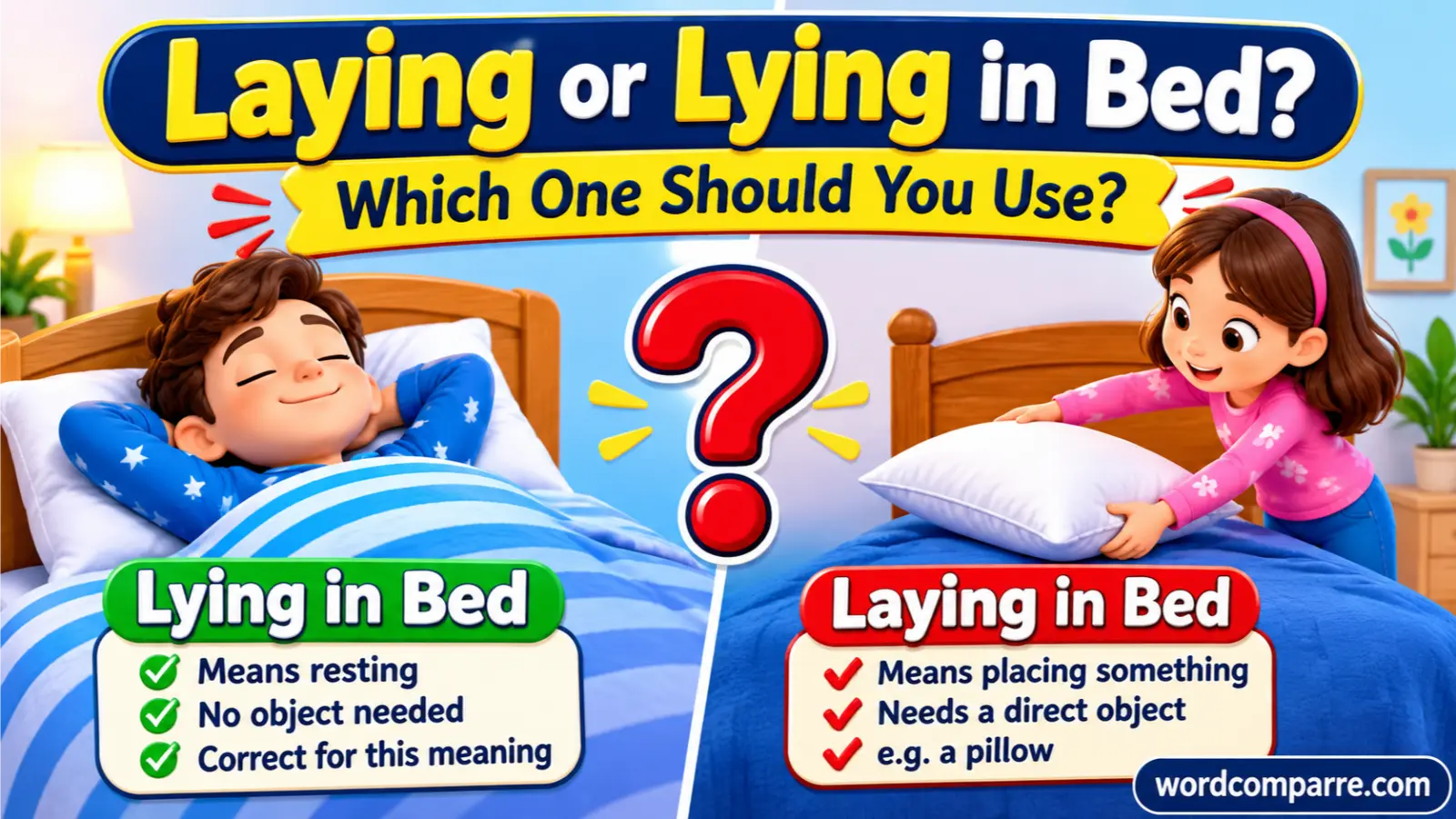
Lying in bed is the grammatically correct expression when you mean that someone is reclining or resting on a bed.
Use laying when someone places an object or another person on a surface.
Consider these examples:
- Correct: I am lying in bed because I feel tired.
- Correct: She is lying in bed and reading a book.
- Correct: I am laying a blanket on the bed.
- Correct: The mother is laying her baby in bed.
The main difference is simple: lie does not require a direct object when it means reclining, while lay requires something to be placed.
What Does Lying in Bed Mean?
The expression “lying in bed” describes someone resting, reclining, or remaining in a horizontal position on a bed.
It comes from the verb lie, which means to rest or position your body horizontally.
This verb does not need a direct object when describing a person’s position.
Examples:
- I am lying in bed and watching television.
- My brother is lying in bed because he has a headache.
- She was lying in bed when the phone rang.
- The children are lying in bed and talking.
- He enjoys lying in bed on Sunday mornings.
In each sentence, the person is resting rather than placing something somewhere.
What Does Laying in Bed Mean?
The word “laying” comes from the verb lay, which means to put or place something or someone down.
Unlike lie, this verb normally needs a direct object.
Examples:
- I am laying a clean blanket on the bed.
- She is laying her baby in bed.
- He is laying his clothes on the bed.
- They are laying pillows across the mattress.
- The nurse is laying the patient in bed.
Notice that every example answers the question “What is being placed?” or “Who is being placed?”
That direct object makes the sentence grammatically complete.
Lying vs. Laying: Understanding the Grammar Rules
The easiest way to understand these verbs is to learn what each one does.
1. The Rule for Lie
Use lie when someone or something rests in a particular position without an object receiving the action.
Its main verb forms are:
| Verb Form | Word | Example |
|---|---|---|
| Present | Lie | I lie in bed every morning. |
| Past | Lay | I lay in bed yesterday. |
| Past participle | Lain | I have lain in bed all morning. |
| Present participle | Lying | I am lying in bed. |
The past tense of lie is lay, which is one major reason people become confused.
2. The Rule for Lay
Use lay when placing something or someone somewhere.
Its main verb forms are:
| Verb Form | Word | Example |
|---|---|---|
| Present | Lay | I lay the book on the bed. |
| Past | Laid | I laid the book on the bed. |
| Past participle | Laid | I have laid the book on the bed. |
| Present participle | Laying | I am laying the book on the bed. |
The direct object is important because it receives the action.
3. Why Lying Is Correct for Resting
When you describe your own position, you are not placing another object somewhere. You are simply resting.
Therefore, you should write:
- I am lying in bed.
- He is lying in bed.
- They are lying in bed.
Avoid using laying in these sentences when you mean reclining.
Sentence Structure: How to Use Both Words
Understanding sentence patterns makes these verbs easier to use correctly.
Structure for Lying
Subject + am/is/are + lying + location
Examples:
- I am lying in bed.
- She is lying on the sofa.
- They are lying on the floor.
You can also use different tenses:
- Present: I lie in bed after lunch.
- Past: I lay in bed last night.
- Present perfect: I have lain in bed for two hours.
Structure for Laying
Subject + am/is/are + laying + direct object + location
Examples:
- I am laying a pillow on the bed.
- She is laying the baby in bed.
- He is laying his jacket on the chair.
These patterns help you identify which verb belongs in your sentence.
Comparison Examples: Lying and Laying
The following examples show how a small grammatical change affects the meaning.
| Lying | Laying |
|---|---|
| I am lying in bed. | I am laying a blanket on the bed. |
| She is lying on the mattress. | She is laying a pillow on the mattress. |
| He was lying in bed. | He was laying his clothes on the bed. |
| The baby is lying comfortably. | The mother is laying the baby down. |
| I have been lying here all morning. | I have been laying books on the table. |
Remember that the first column describes a position, while the second describes an action involving placement.
Common Mistakes to Avoid
Even fluent English speakers sometimes mix up these verbs. Here are some mistakes you should recognize.
Mistake 1: Saying “I Am Laying in Bed”
Incorrect: I am laying in bed and watching a movie.
Correct: I am lying in bed and watching a movie.
Why? The speaker is resting, not placing an object.
Mistake 2: Confusing the Past Tense
Incorrect: Yesterday, I lied in bed all morning.
Correct: Yesterday, I lay in bed all morning.
The verb lie changes to lay in the simple past tense when it means reclining.
Mistake 3: Using Lying Instead of Laying
Incorrect: She is lying the baby in bed.
Correct: She is laying the baby in bed.
The baby receives the action, so the sentence needs the transitive verb lay.
Mistake 4: Forgetting the Direct Object
Incorrect: I am laying on the bed.
Correct: I am lying on the bed.
If you mean that you are resting, use the intransitive verb. If you use laying, identify what you are placing.
Is There a Difference in Formal and Informal English?
The grammar distinction applies to both formal and informal English.
In casual conversations, you may hear people say “I’m laying in bed.” Although listeners usually understand the intended meaning, this usage is considered nonstandard when the speaker means reclining.
For professional writing, academic assignments, business communication, and published articles, choose the grammatically correct form.
For example:
- Informal conversation: I’m lying in bed right now.
- Formal writing: I am currently lying in bed while recovering from an illness.
Both sentences use the correct verb for the intended meaning.
Real-Life Conversations
Here are some short conversations that demonstrate how these words work naturally.
Conversation 1: Talking About Rest
Alex: What are you doing?
Sam: I’m lying in bed and reading a book.
Alex: Are you feeling tired?
Sam: Yes, I had a long day.
Conversation 2: Preparing a Bedroom
Mia: What are you doing with those pillows?
Emma: I’m laying them on the bed.
Mia: Can you put one near the window?
Emma: Sure!
Conversation 3: Talking About Yesterday
John: Why didn’t you answer my call yesterday?
David: I was lying in bed and had fallen asleep.
John: No problem. I just wanted to check on you.
These conversations show that the correct choice depends on whether someone is resting or placing something.
Easy Memory Tricks
Remember these simple tips to avoid confusing the two verbs.
Trick 1: Lie Means Recline
If you are resting your body, use lie or lying.
Example: I am lying in bed.
Trick 2: Lay Means Place
If you are putting something somewhere, use lay or laying.
Example: I am laying a blanket on the bed.
Trick 3: Ask Yourself a Question
Ask: “Am I placing something, or am I simply resting?”
- Simply resting? Use lying.
- Placing something or someone? Use laying.
This quick test works in most everyday situations.
Professional Writing Recommendations
Correct verb usage makes your writing clearer and more professional. Follow these guidelines when preparing articles, emails, reports, or academic assignments:
- Use “lying in bed” when describing someone resting.
- Use “laying” when describing the placement of an object or person.
- Remember that the past tense of lie is lay.
- Use laid as the past tense and past participle of lay.
- Check the direct object whenever you use the verb lay.
- Avoid confusing the verb meaning to recline with the separate verb meaning to tell an untruth.
Consistency with these rules will improve your grammar and make your sentences easier to understand.
Frequently Asked Questions
1. Is It Laying or Lying in Bed?
“Lying in bed” is correct when describing someone resting or reclining. “Laying” requires a direct object, such as a blanket, pillow, or person.
2. Why Do People Say Laying in Bed?
People often confuse the two verbs because the past tense of lie is lay. In casual speech, some speakers also use the incorrect form by habit.
3. Is Lying in Bed Grammatically Correct?
Yes. It is the standard expression for describing someone resting on a bed.
4. What Is the Past Tense of Lie?
When lie means to recline, its simple past tense is lay.
Example: I lay in bed yesterday.
5. What Is the Past Tense of Lay?
The past tense of lay is laid.
Example: She laid the blanket on the bed.
6. Should I Write Lying in Bed or Laying on the Bed?
Use “lying in bed” or “lying on the bed” when describing a person resting. Use “laying on the bed” when someone is placing something there, and include the direct object.
7. Can I Say I Was Lying in Bed All Day?
Yes. This sentence is grammatically correct because it describes a person remaining in a resting position.
8. Is Laying Ever Correct When Talking About a Bed?
Yes. For example, “She is laying a baby in bed” is correct because the baby is the direct object receiving the action.
9. What Is the Difference Between Lie, Lay, and Laid?
Lie means to recline, and its past tense is lay. Meanwhile, lay means to place something, and its past tense is laid.
10. Which Expression Should I Use in Professional Writing?
Use “lying in bed” when describing someone resting. Choose “laying” only when the sentence describes placing something or someone somewhere.
Conclusion
The difference between these two expressions comes down to the verbs lie and lay. When you describe someone resting, lying in bed is the grammatically correct choice. However, when someone places an object or another person on a mattress, use laying with a direct object.
Remember the simple rule: lying describes a position, while laying describes an action of placing something. Once you understand this distinction and learn the different verb forms, you can use both expressions confidently in conversations, academic work, and professional writing.