Writers often wonder whether to write midday or mid-day because both versions appear in English publications. The difference is easy to understand once you know how compound words work. One spelling combines two words, while the other uses a hyphen to connect them. Both communicate the middle part of the day, usually around noon. However, modern English generally favors the one-word version. Understanding this preference will help you write clearly and maintain consistency in professional documents, emails, articles, and everyday conversations.
Quick Answer: Which Spelling Is Correct?
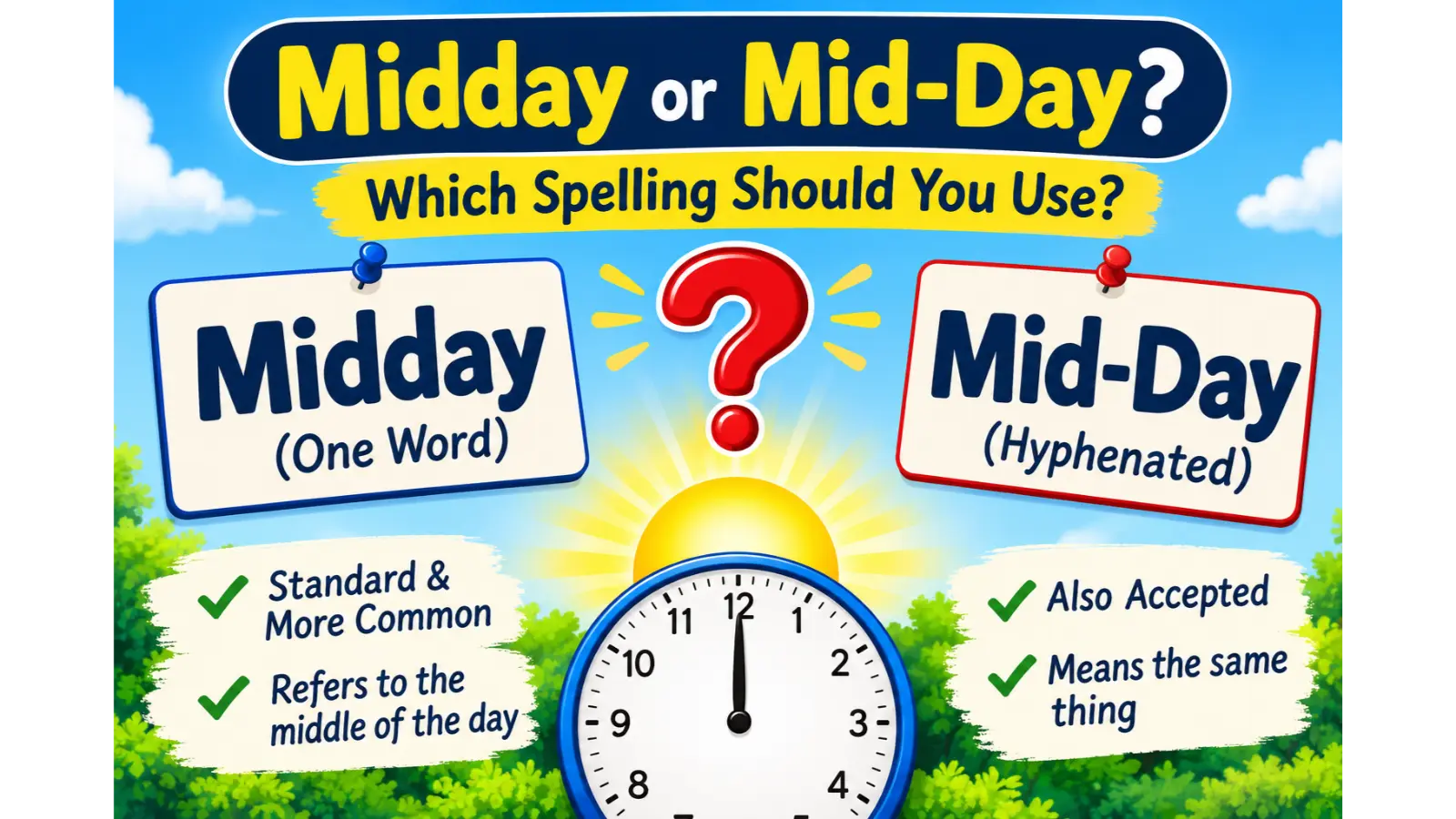
Midday is the standard and more widely preferred spelling in contemporary English. It refers to the middle of the day, especially the period around 12:00 noon.
Mid-day is also an established spelling variant. However, it appears less frequently in modern general writing.
If you are unsure which version to choose, use the closed form. It is a straightforward choice for academic work, business communication, and online publishing.

Understanding the Meaning of Midday
The word midday describes the central part of the day. People commonly associate it with noon, lunchtime, or the period when the sun is relatively high in the sky.
It can function as both a noun and an adjective.
As a noun:
- We arrived at midday.
- The temperature increased around midday.
- She plans to finish her work before midday.
- The train reached the station just after midday.
As an adjective:
- We enjoyed a midday meal.
- The midday sun was extremely bright.
- He scheduled a midday appointment.
- She took a short midday break.
In each example, the word describes a time close to the middle of the day.
Understanding the Meaning of Mid-Day
The hyphenated version carries the same basic meaning. It connects the elements mid and day with punctuation to create a compound expression.
Although some writers and publications prefer this spelling, it does not represent a different time or concept.
Examples include:
- The mid-day sun made the afternoon feel warmer.
- We arranged a mid-day meeting.
- She enjoys a mid-day walk.
- The mid-day break helped everyone relax.
These sentences communicate the same general idea as their closed-form alternatives.
Comparison Table
| Feature | Closed Form | Hyphenated Form |
|---|---|---|
| Spelling | Midday | Mid-day |
| Meaning | Middle of the day | Middle of the day |
| Word formation | Closed compound | Hyphenated compound |
| Grammar | Noun and adjective | Noun and adjective |
| Modern preference | More common | Less common |
| General recommendation | Preferred | Accepted variant |
The important distinction is the spelling style, not the meaning. Both versions are understandable, but the closed compound is generally the better choice.
Origin and History of the Word
The expression developed from two Old English elements.
The first element, mid, comes from Old English mid, meaning middle. The second, day, comes from Old English dæg, referring to a day or daylight.
English speakers combined these familiar elements to describe the central part of a day. As compound words developed, writers sometimes used hyphens to connect their parts.
Over time, many familiar compounds became established as single words. This development explains why the closed spelling gained wider acceptance in contemporary English.

Why Do People Confuse These Spellings?
Several features of English spelling explain this uncertainty.
1. Different Compound Word Styles
English compounds can appear as single words, separate words, or hyphenated expressions. For example, writers encounter forms such as lunchtime, ice cream, and well-known.
These different patterns can make it difficult to identify the preferred spelling of a particular expression.
2. Older Publications
Older books, newspapers, and printed materials sometimes use hyphens more frequently than modern publications.
Readers who encounter the hyphenated version in older texts may assume that it is equally common today.
3. Dictionary Variations
Some dictionaries list alternative spellings, while others emphasize one standard form. This variation can create uncertainty for students and people learning English.
4. Personal Writing Preferences
Some writers believe hyphens make compound expressions easier to read. Others prefer closed compounds because they look simpler and more familiar.
However, personal preference should not replace established spelling conventions.
What Do Major Dictionaries Recommend?
Major English dictionaries recognize the closed spelling as an established English word.
- Merriam-Webster: Includes midday as a standard dictionary entry.
- Cambridge Dictionary: Defines the word as the middle of the day, around noon.
- Oxford English Dictionary: Records the expression as an established English compound.
- Collins Dictionary: Recognizes its meaning as the middle of the day.
These references support using the one-word form in general contemporary writing.
When a dictionary includes a spelling variant, that does not necessarily mean both forms have equal frequency or preference. Therefore, following the main dictionary headword is a practical approach.
Real-Life Examples in Everyday English
Here are additional examples showing how the preferred spelling works in different situations.
Workplace Communication
- The manager scheduled the discussion for midday.
- Please submit your report before noon.
- Our office takes a lunch break around midday.
- The delivery team expects to arrive at noon.
Academic Writing
- The experiment began at midday.
- Researchers recorded the temperature around noon.
- The students returned to their classrooms after lunch.
- The observation period ended near the middle of the day.
Everyday Conversations
- What time will you arrive? Around midday.
- We usually eat lunch at noon.
- She went shopping before lunch.
- The weather became warmer around the middle of the day.
These examples demonstrate that you can often use expressions such as noon, lunchtime, and the middle of the day to avoid unnecessary repetition.
Common Spelling and Usage Mistakes
Even familiar time expressions can create writing problems. Avoid these common mistakes.
Mistake 1: Assuming the Closed Form Is Incorrect
Some people believe a hyphen is necessary to connect the two elements. However, the standard closed spelling is completely correct.
Mistake 2: Switching Between Spellings
Using different versions throughout the same article can make the content look inconsistent.
Better approach: Select one spelling and follow it throughout your document.
Mistake 3: Confusing Noon With Afternoon
Noon generally refers to 12:00 PM, while afternoon describes the period following noon.
For example:
- The appointment starts at noon.
- The appointment takes place in the afternoon.
These expressions describe related but different periods.
Mistake 4: Assuming the Word Always Means Exactly 12:00 PM
In everyday English, the expression can refer to a broader period around noon. Context determines whether the speaker means precisely 12:00 or a general time near it.
An Easy Memory Trick
Remember this simple formula:
Mid + Day = Midday
Think of the two elements joining together to form one familiar compound word.
Whenever you refer to the middle of the day, remember the closed spelling as your first choice.
You can also connect the word with noon. Both ideas relate to the central part of the daily cycle.
Professional Writing Recommendation
For professional communication, academic assignments, business reports, and website articles, the closed spelling is the safest general recommendation.
Follow these practical guidelines:
- Use the standard dictionary spelling in formal documents.
- Maintain consistency throughout your writing.
- Follow your organization’s preferred style guide.
- Avoid unnecessary hyphens in familiar closed compounds.
- Use noon when you specifically mean 12:00 PM.
- Choose lunchtime when referring specifically to a meal break.
These simple practices make your writing easier to understand and help maintain a professional tone.
Frequently Asked Questions
1. Is Midday or Mid-Day the Correct Spelling?
The closed form is the standard and more widely preferred spelling. The hyphenated variant is also recognized, but it is less common in modern general writing.
2. Is the Word Written as One Word or Two?
It is generally written as one word. The standard spelling combines mid and day without a space or hyphen.
3. Do Both Versions Have the Same Meaning?
Yes. Both refer to the middle part of the day, usually around noon. The difference concerns spelling rather than meaning.
4. Is This Spelling Used in British and American English?
Yes. The closed compound is widely accepted in both British and American English. Writers in either variety can use it confidently.
5. Can I Use the Hyphenated Version in Formal Writing?
You may encounter it in published material, but the closed spelling is generally preferable. Follow your chosen dictionary or organizational style guide.
6. Does the Word Always Refer to 12 PM?
No. Although people often associate it with noon, it can also describe the broader period around the middle of the day.
7. Is It a Noun or an Adjective?
It can function as both.
- Noun: We arrived at midday.
- Adjective: She prepared a midday meal.
8. What Is Another Word for This Time of Day?
Depending on the context, alternatives include noon, lunchtime, the middle of the day, and the central part of the day.
9. Should I Use the Same Spelling Throughout an Article?
Yes. Consistency improves readability and makes your writing look more professional. Choose the standard form unless a specific style guide requires otherwise.
Conclusion
The difference between these two spellings is simple: one combines the elements into a single word, while the other connects them with a hyphen. Both communicate the same general meaning, but the closed compound is more common and widely preferred in contemporary English.
For everyday conversations, academic assignments, business documents, and online articles, choose midday. Remembering this simple spelling preference will help you write more confidently and avoid unnecessary punctuation mistakes.