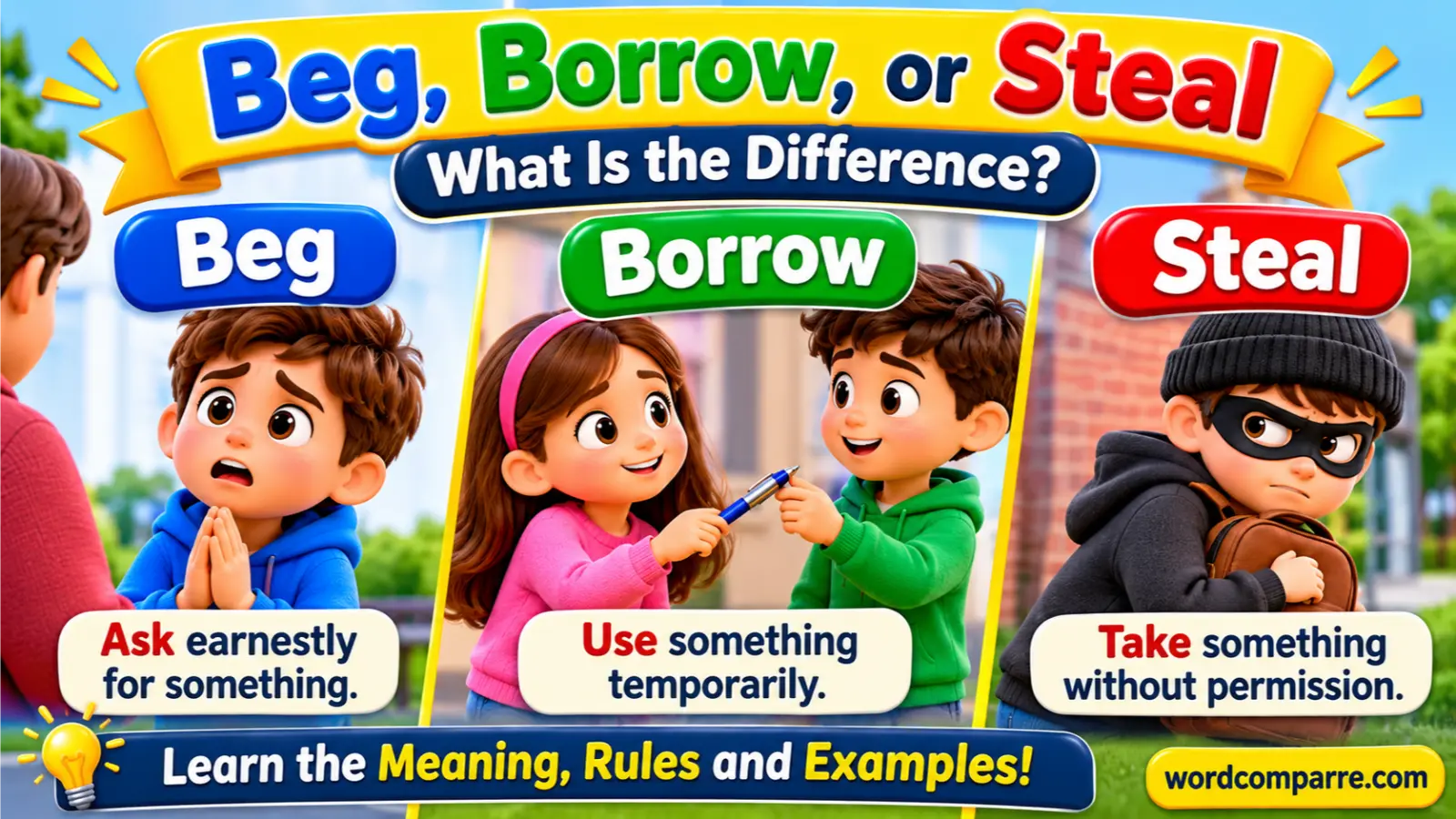
Beg, borrow, or steal are three English verbs that describe different ways of getting something. Although these words sometimes appear together in everyday expressions, each one has a different meaning. Beg means asking someone earnestly for something. Borrow means using something that belongs to another person with the intention of returning it. On the other hand, steal means taking something without permission.
Understanding the difference between beg, borrow, or steal can help you choose the correct word in conversations, emails, stories, and professional writing. Moreover, learning their grammar rules will help you avoid common mistakes. In this guide, you will discover the meanings, sentence structures, examples, and practical uses of all three verbs.
What Does Beg Mean?
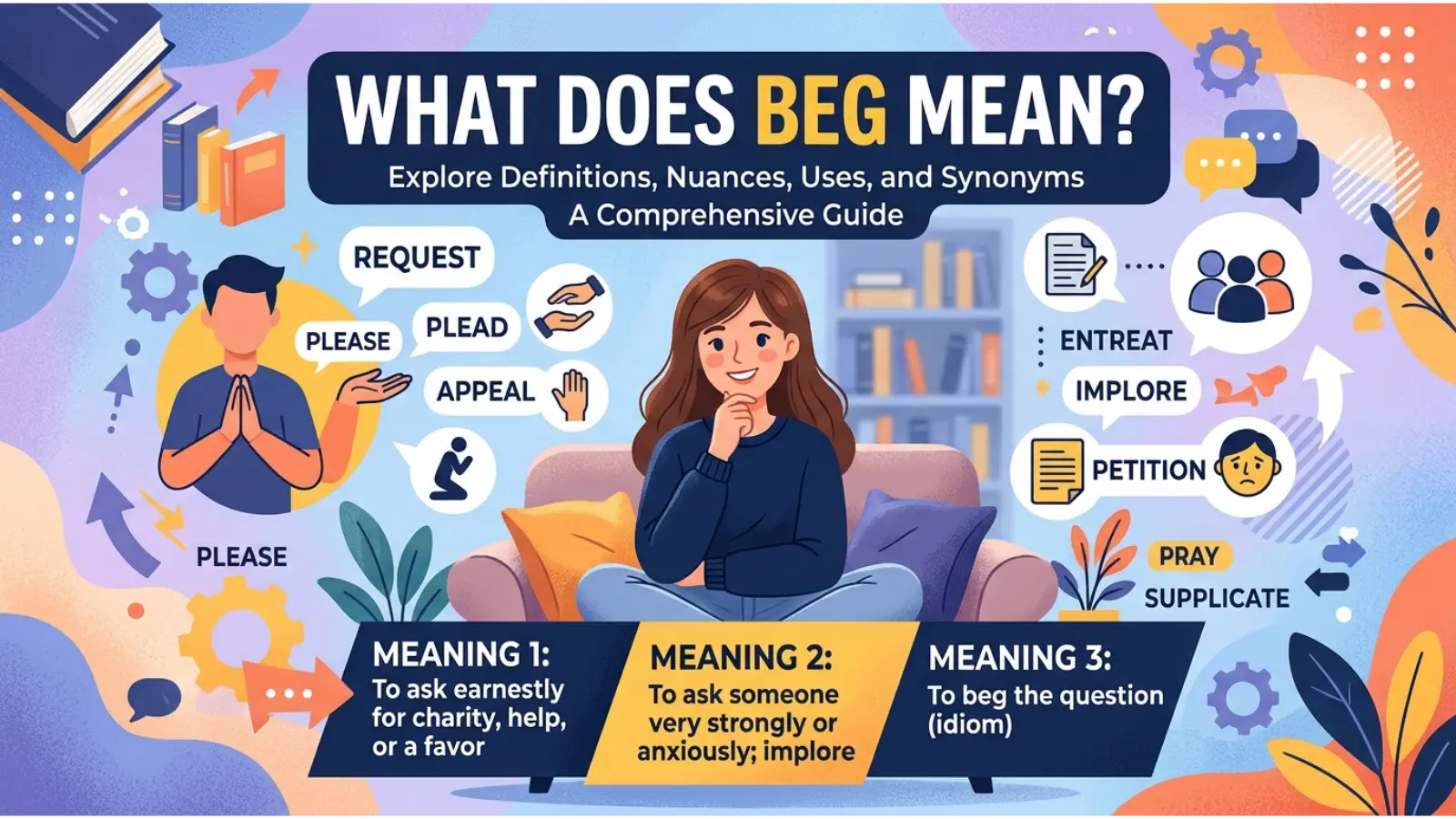
The verb beg means to ask someone for something urgently, sincerely, or repeatedly. People may beg for money, help, forgiveness, food, or another thing they need.
In many situations, begging suggests that someone strongly wants something or feels desperate. However, the word can also describe a playful or emotional request. For example, a child might beg for another piece of chocolate.
Examples:
- The homeless man begged for food.
- She begged her parents for permission to attend the concert.
- The child begged for another piece of chocolate.
- He begged his friend to forgive him.
- They begged the teacher for more time.
Grammar Rules for Beg
Beg is a regular verb. Therefore, you can form its past tense and past participle by adding the appropriate ending. However, the final consonant doubles before adding these endings.
| Verb Form | Example |
|---|---|
| Base form | Beg |
| Third-person singular | Begs |
| Past tense | Begged |
| Past participle | Begged |
| Present participle | Begging |
Notice that begged and begging contain a double g. This spelling follows the standard English spelling rule for short verbs ending in a consonant after a short vowel.
Common sentence patterns include:
- Beg someone for something: She begged her brother for money.
- Beg someone to do something: He begged me to stay.
- Beg for something: They begged for help.
When Should You Use Beg?
Use beg when someone makes a strong request or repeatedly asks for something. For instance, a student might beg a teacher for another chance after missing a deadline.
In addition, you can use this verb when describing emotional situations, such as asking someone for forgiveness or support.

What Does Borrow Mean?
The verb borrow means to receive or use something that belongs to another person for a limited time, with the intention of returning it. Unlike stealing, borrowing normally happens with the owner’s permission.
People commonly borrow money, books, clothes, tools, and other belongings. For example, you might borrow a friend’s laptop for a few hours or borrow a book from a library.
Examples:
- Can I borrow your pen?
- She borrowed a book from the library.
- I borrowed some money from my brother.
- He borrowed my car for the weekend.
- They borrowed chairs from their neighbors.
Grammar Rules for Borrow
Borrow is a regular verb. Its past tense and past participle both use the ending -ed.
| Verb Form | Example |
|---|---|
| Base form | Borrow |
| Third-person singular | Borrows |
| Past tense | Borrowed |
| Past participle | Borrowed |
| Present participle | Borrowing |
Here are some common sentence structures:
- Borrow something from someone: I borrowed a laptop from Sarah.
- Borrow something for a period: He borrowed the car for two days.
- Ask to borrow something: Can I borrow your notebook?
Remember that the person receiving an item borrows it. Meanwhile, the person giving that item lends it.
Borrow vs. Lend: What Is the Difference?
Many English learners confuse borrow with lend because both verbs describe the same exchange from different perspectives.
However, their meanings are opposite:
- Borrow: To receive something temporarily.
- Lend: To give something temporarily to another person.
Examples:
- I borrowed a book from Ali.
- Ali lent me a book.
- She borrowed my calculator.
- I lent her my calculator.
As you can see, both verbs describe the same situation. The correct choice depends on who receives the item and who gives it.

What Does Steal Mean?
The verb steal means to take something that belongs to another person without permission or legal right. Unlike borrowing, stealing does not involve an agreed arrangement to return the item.
Stealing can involve money, phones, bicycles, jewelry, documents, or other property. Furthermore, it is generally considered dishonest and may be a criminal offense.
Examples:
- Someone stole my bicycle.
- The thief stole money from the shop.
- He was arrested for stealing a phone.
- Never steal another person’s belongings.
- Someone stole her wallet on the bus.
Grammar Rules for Steal
Steal is an irregular verb. Consequently, its past tense and past participle have different forms.
| Verb Form | Example |
|---|---|
| Base form | Steal |
| Third-person singular | Steals |
| Past tense | Stole |
| Past participle | Stolen |
| Present participle | Stealing |
Pay special attention to stole and stolen. Although both are correct, they are used in different grammatical situations.
- Simple past: He stole my watch.
- Present perfect: He has stolen my watch.
- Past perfect: He had stolen my watch before the police arrived.
Common sentence patterns include:
- Steal something: Someone stole my bag.
- Steal something from someone: The thief stole money from the customer.
- Steal something from a place: Someone stole a laptop from the office.
Beg, Borrow, or Steal: Key Differences
The easiest way to understand these three verbs is to focus on how someone gets something. Each word describes a different action, so replacing one with another can completely change a sentence’s meaning.
| Word | Meaning | Permission | Example |
|---|---|---|---|
| Beg | Ask earnestly for something | You are requesting it | She begged for help. |
| Borrow | Use something temporarily | Usually required | I borrowed his book. |
| Steal | Take something without permission | Not given | Someone stole his phone. |
In short, beg means ask, borrow means use temporarily, and steal means take without permission. Therefore, remember the action before choosing the verb.
How to Use Beg, Borrow, and Steal in Sentences
Although these verbs can appear in similar situations, their sentence structures are different. Learning a few examples will make their correct usage easier.
Using Beg in a Sentence
Use beg when someone makes a strong or emotional request.
- I begged my father to buy me a bicycle.
- She begged for another chance.
- The children begged their mother for ice cream.
- He begged his manager to reconsider the decision.
For example, when someone desperately wants permission, help, or forgiveness, beg may be the right choice.
Using Borrow in a Sentence
Use borrow when someone temporarily receives or uses another person’s property.
- May I borrow your dictionary?
- We borrowed a car from our neighbors.
- He borrowed money to pay his bills.
- Sarah is borrowing my laptop for her assignment.
In these examples, the person expects to return the borrowed item or repay the borrowed money according to the agreement.
Using Steal in a Sentence
Use steal when someone takes property without permission.
- The man stole a wallet.
- Someone stole my phone yesterday.
- The employee was accused of stealing company property.
- A thief stole several items from the store.
Unlike borrowing, stealing does not involve the owner’s agreement. As a result, it carries a negative meaning.
Common Mistakes to Avoid
English learners sometimes confuse these words because all three relate to getting something. However, their meanings are not interchangeable. The following mistakes show how to choose the correct verb.
1. Using Borrow When You Mean Steal
Incorrect: He borrowed my phone without asking and never returned it.
Better: He took my phone without permission.
Why? Borrowing normally involves permission and an intention to return the item. Therefore, taking something without permission should not be described as ordinary borrowing.
2. Using Steal When You Mean Borrow
Incorrect: Can I steal your pen for a minute?
Correct: Can I borrow your pen for a minute?
Why? You are asking to use the pen temporarily. Consequently, borrow is the appropriate verb.
3. Using Beg With the Wrong Sentence Structure
Incorrect: She begged me for help her.
Correct: She begged me to help her.
Why? When beg is followed by a person and an action, use this structure: beg + someone + to + verb.
4. Confusing Stole and Stolen
Incorrect: Someone has stole my wallet.
Correct: Someone has stolen my wallet.
Why? Stole is the simple past form. However, stolen is the past participle and follows helping verbs such as has, have, and had.
5. Confusing Borrow and Lend
Incorrect: Can you borrow me your book?
Correct: Can you lend me your book?
Why? The person giving the book lends it. In contrast, the person receiving the book borrows it.
Beg, Borrow, and Steal in Professional Writing
These three verbs can appear in professional communication, but each one describes a different situation.
Beg is suitable when describing an earnest or urgent request. Nevertheless, words such as request, appeal, or ask may sound more appropriate in formal business communication.
Example: The organization appealed for additional funding.
Borrow is common in financial, educational, and workplace contexts. It describes the temporary use of resources that belong to another person or organization.
Example: The department borrowed equipment from another office.
Steal is appropriate when discussing theft, missing property, or allegations of unauthorized taking.
Example: The company reported that confidential documents had been stolen.
Ultimately, choose the verb that accurately describes the action. Do not use borrow as a softer substitute for steal when permission was never given.
Formal vs. Informal Usage
Beg, borrow, and steal are used in both formal and informal English. However, the best word choice depends on the situation and the tone of the conversation.
| Word | Informal Example | Formal Example |
|---|---|---|
| Beg | I begged him to help me. | The applicant appealed for assistance. |
| Borrow | Can I borrow your charger? | The department borrowed the necessary equipment. |
| Steal | Someone stole my bike. | The property was reported stolen. |
In everyday conversations, people commonly use all three verbs. By comparison, formal communication may use alternatives when a more professional tone is necessary.
For example, request can replace beg in some business situations. Similarly, obtain temporarily may explain borrow in technical writing. Nevertheless, steal remains the appropriate verb when describing unauthorized taking.
Easy Memory Tricks to Remember the Difference
Remembering these verbs becomes easier when you connect each one with a simple action.
- Beg = Ask: You want something and make a request.
- Borrow = Return: You use something temporarily and intend to give it back.
- Steal = Take: You take something without permission.
Consider this example: You need your friend’s bicycle.
- If you repeatedly ask your friend to let you use it, you beg.
- If your friend agrees to let you use it for a day, you borrow it.
- If you take it without permission, you steal it.
Therefore, the three simple words to remember are ask, return, and take.
Real-Life Conversations Using Beg, Borrow, and Steal
Practical conversations can help you understand how these verbs sound in everyday English. Here are three short examples.
Conversation 1: Using Beg
Emma: Why are you calling your brother again?
John: I am begging him to help me move my furniture.
Emma: Did he agree?
John: Not yet, but I hope he will.
Conversation 2: Using Borrow
Sarah: Can I borrow your umbrella?
David: Of course. Just return it tomorrow.
Sarah: Thank you. I will bring it back.
Conversation 3: Using Steal
Officer: What happened to your bicycle?
Mark: Someone stole it outside the supermarket.
Officer: Did you report the incident?
Mark: Yes, I reported it this morning.
Frequently Asked Questions
1. What is the difference between beg, borrow, and steal?
Beg means asking earnestly for something. Borrow means using something temporarily with the intention of returning it. Meanwhile, steal means taking something without permission.
2. Is borrowing the same as stealing?
No, borrowing and stealing are different actions. Borrowing normally involves permission and an intention to return the item. On the other hand, stealing means taking something without permission.
3. Can you borrow something without asking?
The word borrow usually suggests that the owner has given permission. If someone takes an item without permission, it may be considered unauthorized taking or theft, depending on the circumstances.
4. What is the past tense of beg?
The past tense of beg is begged. For example: She begged her parents for help.
5. What is the past tense of borrow?
The past tense of borrow is borrowed. For example: I borrowed a book yesterday.
6. Is stole or stolen correct?
Both forms are correct, but they have different grammatical uses. Stole is the simple past tense, whereas stolen is the past participle.
Examples:
- He stole my bag.
- He has stolen my bag.
7. Can beg mean asking for money?
Yes. Beg can describe asking someone for money, food, help, or other things, especially when the request is urgent or desperate.
8. What does the phrase beg, borrow, or steal mean?
The expression beg, borrow, or steal is an informal way of saying that someone is extremely determined to obtain something by almost any possible means. It is usually used for emphasis rather than as a literal instruction to steal.
Conclusion
Understanding the difference between beg, borrow, or steal becomes simple when you focus on the action behind each word. Beg means asking earnestly for something, borrow means using something temporarily with the intention of returning it, and steal means taking something without permission.
Although these verbs are connected with obtaining something, they are not interchangeable. Therefore, use beg when making a strong request, borrow when temporarily using someone else’s property with permission, and steal when describing an unauthorized taking. With these simple grammar rules, memory tricks, and practical examples, you can use all three verbs confidently in everyday conversations and professional writing.