The question “Lucy Letby guilty or innocent?” has attracted widespread attention in the United Kingdom and around the world. Lucy Letby, a former neonatal nurse at the Countess of Chester Hospital in England, was convicted of murdering seven babies and attempting to murder seven others. However, she has continued to maintain that she is innocent, and her legal team has challenged the convictions.
The question Lucy Letby guilty or innocent has attracted worldwide attention and sparked widespread debate about one of the most controversial criminal cases in recent British history. Lucy Letby, a former neonatal nurse, was convicted of murdering seven babies and attempting to murder six others at the Countess of Chester Hospital. Her case raised important questions about medical evidence, criminal investigations, and the legal system.
People searching for Lucy Letby guilty or innocent want to understand what happened, why she was convicted, and what evidence prosecutors presented during her trial. The case also attracted attention because of discussions surrounding medical experts and the reliability of some evidence.
To understand Lucy Letby guilty or innocent, it is important to examine the court proceedings, the prosecution’s arguments, and the legal challenges surrounding the convictions. This article explores the background of the case, the trial, the evidence, and the major developments.

Who Is Lucy Letby?
Lucy Letby is a former British neonatal nurse who worked at the Countess of Chester Hospital in Cheshire, England. She cared for premature and seriously ill babies in the hospital’s neonatal unit.
Concerns about unexpected collapses and deaths among babies eventually led to a police investigation. Prosecutors alleged that Letby deliberately harmed babies while working on the unit.
Her criminal trial began in 2022 at Manchester Crown Court. After hearing evidence from the prosecution and defence, a jury reached its verdicts in August 2023. A further trial in 2024 dealt with one attempted-murder charge on which the first jury had been unable to reach a decision.
What Does Guilty or Innocent Mean?
The words guilty and innocent have different meanings in everyday English and in legal discussions.
- Guilty: A person is legally guilty when a court or jury finds that they committed the offence charged.
- Innocent: In everyday language, this means someone did not commit the act. In criminal law, a person is presumed innocent unless the prosecution proves guilt to the required standard.
- Convicted: A person is convicted when a court formally records a guilty verdict.
- Acquitted: A person is acquitted when a court finds them not guilty of a particular charge.
These terms should not be confused. A conviction describes the result of a legal process. An appeal or review is a separate process that may examine whether that result should stand.
What Did the Court Decide in Lucy Letby’s Case?
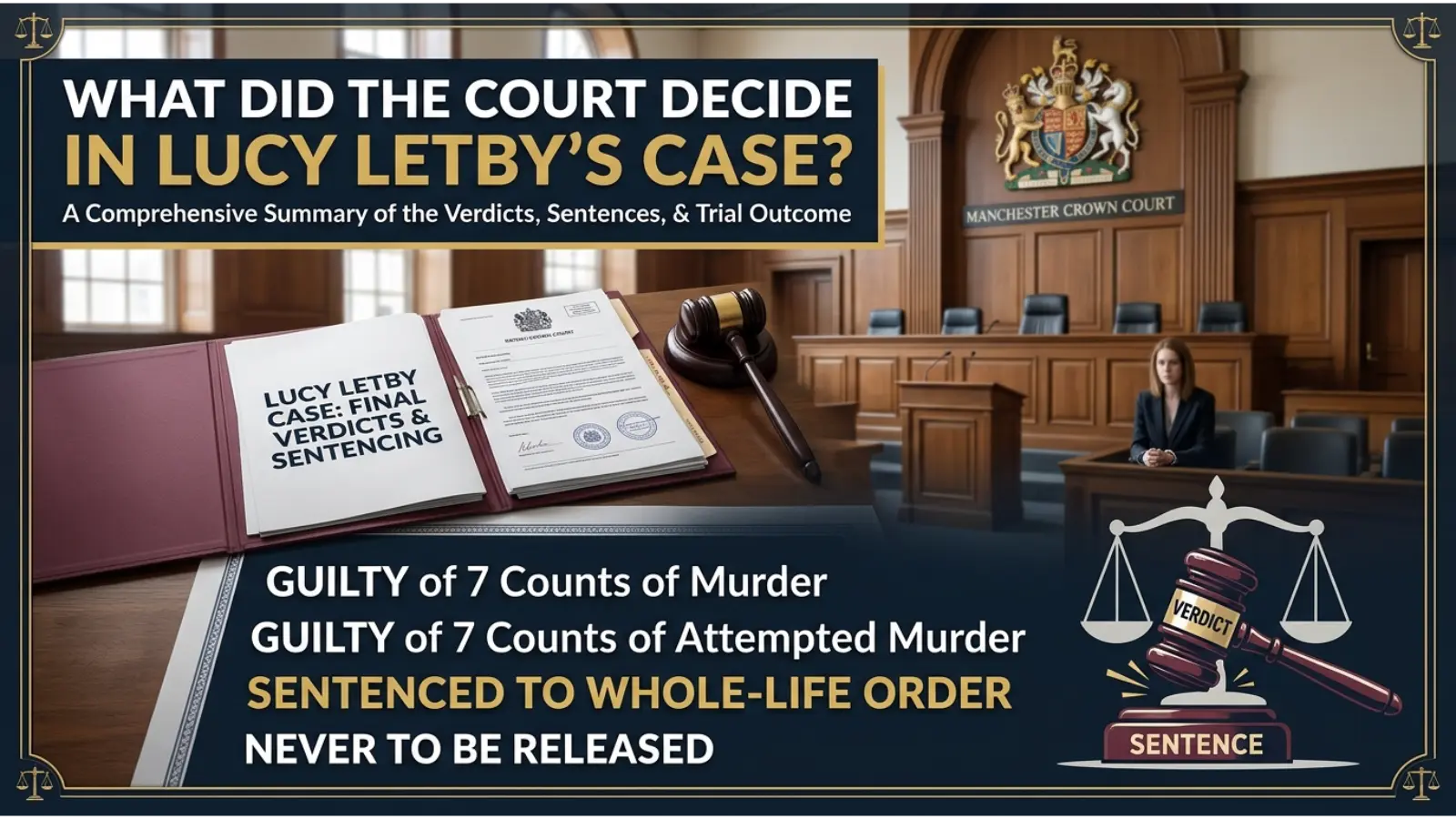
In August 2023, a jury at Manchester Crown Court convicted Letby of seven counts of murder and six counts of attempted murder. The jury could not reach a verdict on some other attempted-murder charges and found her not guilty of two attempted-murder charges.
In July 2024, following a retrial on one charge, another jury found her guilty of attempting to murder a baby. This brought the total number of convictions to seven murders and seven attempted murders.
The court imposed whole-life orders, meaning she must spend the rest of her life in prison unless a legally exceptional decision changes her sentence.
Therefore, the established legal position is that Lucy Letby has been convicted of these offences. That is the correct way to describe the court outcome. It is different from making an independent claim about what happened or predicting the outcome of future legal proceedings.
Did Lucy Letby Appeal Against Her Convictions?
Yes. Letby challenged her convictions through the Court of Appeal.
In 2024, the Court of Appeal refused her application for permission to appeal against the original convictions. The court also refused a later application connected with the attempted-murder conviction from the 2024 retrial.
It is important to understand what an appeal does. An appeal court examines specific legal grounds and considers whether the original proceedings or decisions involved an error serious enough to justify intervention. It does not automatically conduct an entirely new trial.
The refusal of Letby’s appeals meant that her convictions remained in place. However, it did not prevent her legal team from making a separate application to the Criminal Cases Review Commission.
Why Is the Criminal Cases Review Commission Examining the Case?
The Criminal Cases Review Commission, commonly known as the CCRC, is an independent body in England, Wales and Northern Ireland that investigates possible miscarriages of justice.
Letby’s representatives submitted an application to the CCRC in February 2025. The application argues that her convictions should be reconsidered.
The CCRC has confirmed that it received further material during 2025 and January 2026. Its February 2026 statement said that the review was underway.
The commission does not decide whether a person is guilty or innocent. Instead, it examines whether there is a real possibility that a conviction would not be upheld if the case were referred to an appeal court.
As of the latest official CCRC statement available for this article, the review was still underway. A review being open does not mean that a conviction has been overturned or that the commission has found a miscarriage of justice.
What Did the Thirlwall Inquiry Find?
The Thirlwall Inquiry was established to examine events at the Countess of Chester Hospital, including how hospital leaders and staff responded to concerns about babies’ safety.
Its final report was published on 15 September 2026. The report identified serious failures in hospital management, governance, communication, and safeguarding.
The inquiry found that there had been a complete failure to protect babies on the neonatal unit. It also criticised delays in responding to concerns raised by clinicians and delays in contacting the police.
However, the inquiry was not a criminal appeal and did not have the power to decide criminal guilt or innocence. Its purpose was to examine institutional failures and recommend changes to help protect patients in the future.
This distinction matters: findings about hospital management do not automatically cancel criminal convictions. The criminal case and the public inquiry had different purposes.

Why Do People Still Debate the Case?
The case continues to receive public attention for several reasons.
1. Questions about medical evidence
Some commentators and experts have publicly questioned aspects of the medical evidence presented during the trials. These arguments have contributed to calls for further examination of the convictions. However, public criticism is not the same as a court decision overturning a verdict.
2. The defence’s position
Letby’s legal representatives have argued that she was wrongly convicted. Their position is part of the ongoing review process, but it should not be presented as an established legal finding.
3. The role of hospital management
The Thirlwall Inquiry identified serious failures in how the hospital responded to concerns. This has raised wider questions about accountability and patient safety.
4. The CCRC review
The CCRC’s examination means that the possibility of further legal scrutiny remains open. Nevertheless, the commission has not announced a decision referring the convictions to the Court of Appeal in the official statement cited here.
Readers should be careful with social media posts and online videos that present disputed claims as proven facts.
Guilty vs. Innocent: How Are These Words Used?
The words guilty and innocent are opposites, but they are not interchangeable.
| Word | Meaning | Example |
|---|---|---|
| Guilty | Legally responsible for an offence after a guilty verdict | The jury found the defendant guilty. |
| Innocent | Not responsible for an offence; also the status presumed before guilt is proved | A defendant is presumed innocent until proven guilty. |
| Convicted | Officially found guilty by a court | The defendant was convicted after the trial. |
| Acquitted | Found not guilty of a specific charge | The defendant was acquitted of that charge. |
For accurate writing, use convicted when describing a court’s guilty verdict. Use maintains her innocence when explaining that a person denies the allegations. This wording reports each position without confusing a claim with a legal finding.
Common Mistakes When Discussing the Lucy Letby Case
Writers and readers can misunderstand the case by using legal terms carelessly. Here are some common mistakes to avoid:
- Saying that a review means an acquittal: A CCRC review is an examination, not a decision that someone is innocent.
- Treating an allegation as a conviction: An allegation is a claim that must be assessed through the legal process.
- Confusing a public inquiry with an appeal: The Thirlwall Inquiry examined hospital events and safeguarding failures; it was not an appeal court.
- Ignoring the individual charges: Letby was acquitted of two attempted-murder charges in the original trial, while the jury convicted her of other charges.
- Presenting opinions as established facts: Expert commentary, media reports, and online discussions should be clearly distinguished from official court decisions.
Accurate language helps readers understand a complicated case without exaggeration or misleading conclusions.
Frequently Asked Questions
Is Lucy Letby legally guilty?
Yes. She was convicted of seven murders and seven attempted murders by juries at Manchester Crown Court. Those convictions remained in place in the official legal updates cited in this article.
Does Lucy Letby say she is innocent?
Yes. Letby has maintained that she did not commit the crimes, and her legal representatives have challenged her convictions.
Were Lucy Letby’s appeals successful?
No. The Court of Appeal refused her applications for permission to appeal in 2024. Her convictions therefore remained in place.
Is the CCRC reviewing Lucy Letby’s convictions?
Yes. The CCRC confirmed in February 2026 that its review was underway. The commission investigates possible miscarriages of justice but does not decide guilt or innocence itself.
Did the Thirlwall Inquiry overturn Lucy Letby’s convictions?
No. The inquiry examined hospital management, safeguarding, and the response to concerns. It was not a criminal appeal and could not overturn her convictions.
Does not being charged with further offences mean Lucy Letby was cleared?
No. In January 2026, prosecutors decided not to bring further charges relating to other allegations. The CPS upheld that decision after an independent review in August 2026. That decision concerned additional allegations and did not cancel her existing convictions.
What is the difference between guilty and convicted?
Guilty describes the finding that a person committed an offence. Convicted describes the formal legal result after a court records a guilty verdict.
Conclusion
The question “Lucy Letby guilty or innocent?” needs a careful, fact-based answer. Legally, Letby was convicted of seven murders and seven attempted murders, and her appeals were refused in 2024. She continues to maintain her innocence, while the Criminal Cases Review Commission has been examining her application.
The Thirlwall Inquiry, published in September 2026, identified serious failures in hospital management and safeguarding, but it did not decide whether Letby was guilty or innocent and did not overturn her convictions.
For now, the accurate description is that Lucy Letby remains convicted of the offences, while her CCRC review is a separate process. Readers should follow official court and CCRC announcements for any future change in the legal position.