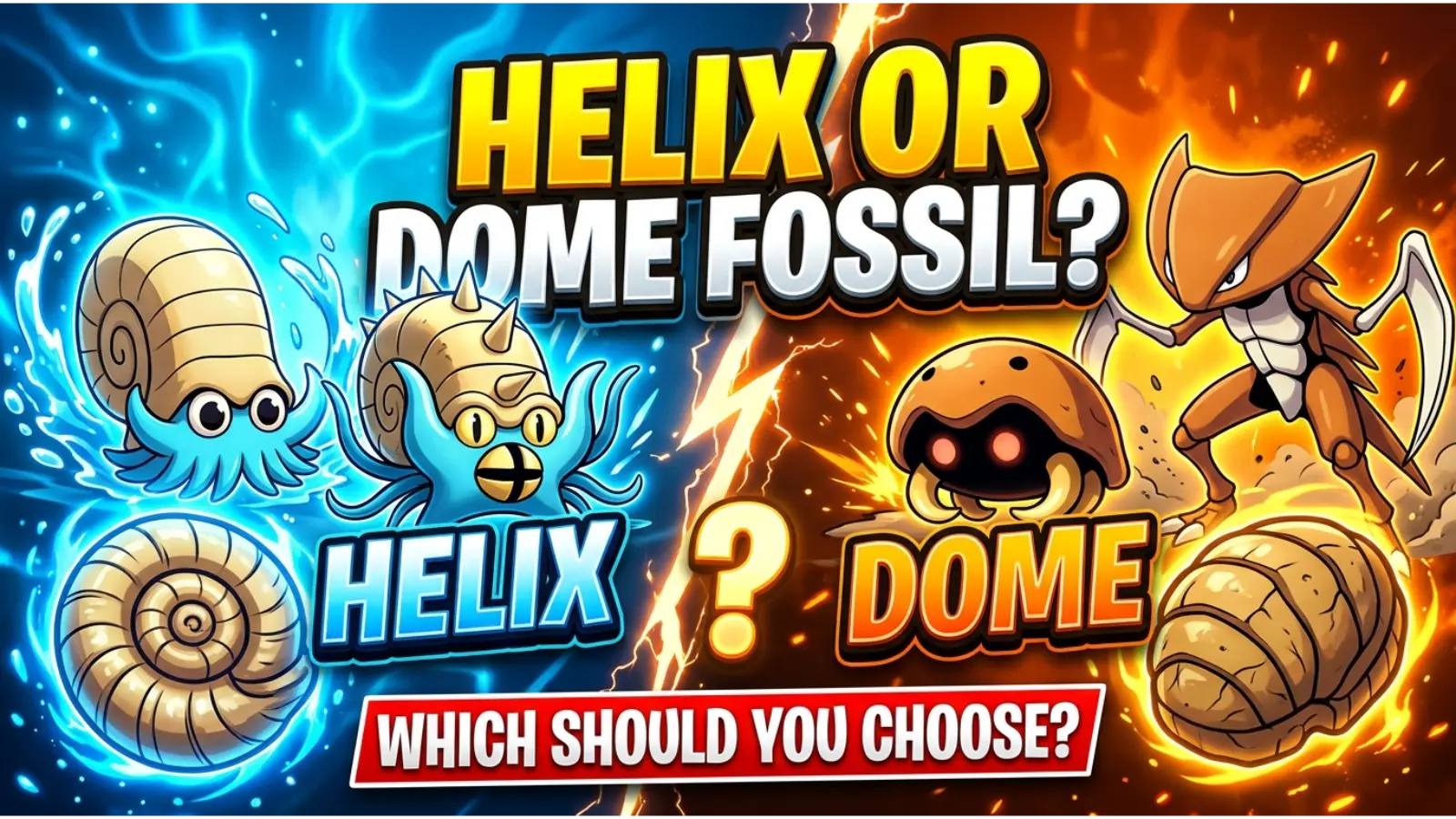
Choosing between the Helix or Dome Fossil is an important decision for Pokémon players who want to add a prehistoric Pokémon to their team. Both fossils appear in the Pokémon games, and each offers a different creature with its own appearance, evolution, strengths, and battle characteristics. However, they do not produce the same Pokémon.
The Helix Fossil restores into Omanyte, which evolves into Omastar, while the Dome Fossil restores into Kabuto, which evolves into Kabutops. Both evolutionary lines have Rock and Water typing in the main series games. Therefore, your decision depends on whether you prefer defensive and special attacking abilities or a more physically offensive Pokémon. This guide explains their differences to help you make the right choice.
Quick Answer: Helix or Dome Fossil?
Both fossils are correct choices, but they restore into different Pokémon.
- Helix Fossil: Restores into Omanyte, which evolves into Omastar.
- Dome Fossil: Restores into Kabuto, which evolves into Kabutops.
Choose the Helix Fossil if you prefer Omastar’s stronger Special Attack and Defense. Choose the Dome Fossil if you want Kabutops, which offers stronger physical Attack and better Speed.
What Is the Helix Fossil?
The Helix Fossil is a special fossil item in Pokémon games. It represents the ancient shell of a prehistoric sea creature and can be restored into Omanyte.
Omanyte is a small, spiral-shelled Pokémon with tentacles and a distinctive prehistoric appearance. It belongs to the Rock and Water types.
When Omanyte reaches level 40 in the main series games, it evolves into Omastar. This evolved Pokémon has stronger defensive abilities and impressive Special Attack potential.
Key Features of the Helix Fossil
- Restores into Omanyte.
- Omanyte evolves into Omastar.
- Both Pokémon have Rock and Water typing.
- Omastar has high Defense and Special Attack.
- Its design resembles an ancient marine creature with a coiled shell.
What Is the Dome Fossil?
The Dome Fossil is another special fossil item found in Pokémon games. It represents the remains of an ancient sea creature and can be restored into Kabuto.
Kabuto has a rounded, dome-shaped shell, a dark body, and distinctive eyes. Like Omanyte, it belongs to the Rock and Water types.
Kabuto evolves into Kabutops at level 40 in the main series games. Kabutops has a more aggressive appearance, with powerful scythe-like arms and stronger physical attacking abilities.
Key Features of the Dome Fossil
- Restores into Kabuto.
- Kabuto evolves into Kabutops.
- Both Pokémon have Rock and Water typing.
- Kabutops has high Attack and better Speed than Omastar.
- Its appearance resembles an ancient armored marine creature.
Helix Fossil vs. Dome Fossil: Main Differences
Understanding their differences makes it easier to choose the fossil that matches your playing style.
| Feature | Helix Fossil | Dome Fossil |
|---|---|---|
| Restored Pokémon | Omanyte | Kabuto |
| Final evolution | Omastar | Kabutops |
| Pokémon type | Rock/Water | Rock/Water |
| Evolution level | 40 | 40 |
| Main strength | Special Attack and Defense | Physical Attack and Speed |
| Appearance | Spiral shell | Rounded dome shell |
| Battle style | Special attacking | Physical attacking |
Both fossils provide useful Pokémon, but their final evolutions have different strengths.
What Pokémon Do the Fossils Become?
The most important difference between these fossils is the Pokémon they produce.
Helix Fossil Evolution Line
The Helix Fossil follows this evolutionary line:
Helix Fossil → Omanyte → Omastar
Omanyte is the first Pokémon restored from the fossil. It has a spiral shell and can develop into Omastar at level 40.
Omastar is particularly useful for players who prefer defensive Pokémon with strong Special Attack capabilities.
Dome Fossil Evolution Line
The Dome Fossil follows a different evolutionary line:
Dome Fossil → Kabuto → Kabutops
Kabuto is the Pokémon restored from the Dome Fossil. It has a rounded shell that protects its body.
At level 40, Kabuto evolves into Kabutops. This Pokémon is known for its powerful physical attacks and higher Speed compared with Omastar.
Omastar vs. Kabutops: Which Pokémon Is Stronger?
Comparing Omastar and Kabutops helps players understand which fossil offers the better final evolution.
Their base stats in the main series games are different.
| Base Stat | Omastar | Kabutops |
|---|---|---|
| HP | 70 | 60 |
| Attack | 60 | 115 |
| Defense | 125 | 105 |
| Special Attack | 115 | 65 |
| Special Defense | 70 | 70 |
| Speed | 55 | 80 |
| Total | 495 | 495 |
Omastar’s strengths:
- Higher Defense.
- Higher Special Attack.
- Better suited to special attacking strategies.
- Useful for players who prefer a defensive battle style.
Kabutops’ strengths:
- Higher physical Attack.
- Better Speed.
- More suitable for physical attacking strategies.
- Useful for players who prefer aggressive battles.
Neither Pokémon is automatically better in every situation. Their effectiveness depends on the opponent, moves, abilities, and battle strategy.
Are Helix and Dome Fossils Both Rock and Water Types?
The fossils themselves are items, not Pokémon, so they do not have battle types.
However, the Pokémon restored from them share the same typing.
- Omanyte: Rock/Water
- Omastar: Rock/Water
- Kabuto: Rock/Water
- Kabutops: Rock/Water
This means both evolutionary lines share similar type advantages and weaknesses.
For example, both lines must be careful against Grass-type attacks, which are particularly dangerous to Rock/Water Pokémon.
Which Fossil Should You Choose in Pokémon?
Your decision should depend on the Pokémon you want to use.
Choose Helix Fossil If:
- You want Omanyte and Omastar.
- You prefer high Special Attack.
- You want a Pokémon with strong Defense.
- You enjoy Omastar’s spiral-shell design.
- You prefer a more defensive battle strategy.
Choose Dome Fossil If:
- You want Kabuto and Kabutops.
- You prefer high physical Attack.
- You want better Speed.
- You like Kabutops’ scythe-like arms.
- You enjoy an aggressive battle strategy.
My recommendation: Choose the Dome Fossil if physical attacking power is your priority. However, the Helix Fossil is a strong alternative if you prefer Special Attack and Defense.
Why Do Players Confuse Helix Fossil and Dome Fossil?
Players often confuse these fossils because they appear in the same part of certain Pokémon games and serve a similar purpose.
Here are the main reasons:
1. Both are prehistoric fossils
Each fossil represents an ancient marine Pokémon. Their purpose is to restore an extinct creature rather than provide an ordinary battle item.
2. Both have the same Pokémon typing
The Pokémon restored from these fossils belong to the Rock and Water types. This similarity can make their differences less obvious to new players.
3. Both have two-stage evolutionary lines
Omanyte and Kabuto each evolve once, producing Omastar and Kabutops.
4. Players must sometimes choose between them
In Pokémon Red, Blue, and Yellow, players encounter both fossils at Mt. Moon but can select only one during that choice. This makes the decision especially important for players who want to complete their collection.
Common Mistakes Players Should Avoid
Understanding these differences helps prevent common mistakes.
| Common Mistake | Correct Information |
|---|---|
| Helix Fossil restores Kabuto. | Helix Fossil restores Omanyte. |
| Dome Fossil restores Omanyte. | Dome Fossil restores Kabuto. |
| Omanyte evolves into Kabutops. | Omanyte evolves into Omastar. |
| Kabuto evolves into Omastar. | Kabuto evolves into Kabutops. |
| Omastar has higher physical Attack. | Kabutops has higher physical Attack. |
| Kabutops has higher Special Attack. | Omastar has higher Special Attack. |
Remember the two evolutionary lines to avoid mixing them up.
Easy Memory Tricks: Helix vs. Dome Fossil
A simple memory trick can help you remember which fossil produces each Pokémon.
Helix = Spiral = Omanyte
The Helix Fossil has a spiral-shell appearance. Associate its spiral shape with Omanyte and its evolution, Omastar.
Dome = Rounded Shell = Kabuto
The Dome Fossil has a rounded appearance. Connect the word dome with Kabuto’s protective shell and its evolution, Kabutops.
You can also remember these two combinations:
- Helix → Omanyte → Omastar
- Dome → Kabuto → Kabutops
Learning these combinations makes it much easier to remember the correct fossil and evolutionary line.
Helix or Dome Fossil in Pokémon Games: Does the Choice Change?
The availability and restoration process can differ between Pokémon games.
In the original Pokémon Red, Blue, and Yellow games, players encounter the two fossils at Mt. Moon and choose one. The selected fossil can later be restored at the Pokémon Lab on Cinnabar Island.
In other Pokémon titles, fossils may appear in different locations or become available through different methods. Some games allow players to obtain both fossils, while others change how fossil restoration works.
Therefore, always check the specific game’s instructions before making your decision.
Frequently Asked Questions (FAQs)
1. Is Helix Fossil better than Dome Fossil?
Neither fossil is universally better. Helix Fossil provides Omanyte, which evolves into the defensive and special-attacking Omastar. Dome Fossil provides Kabuto, which evolves into the physically stronger and faster Kabutops.
2. What does the Helix Fossil turn into?
The Helix Fossil restores into Omanyte. Omanyte evolves into Omastar at level 40 in the main series games.
3. What does the Dome Fossil turn into?
The Dome Fossil restores into Kabuto. Kabuto evolves into Kabutops at level 40 in the main series games.
4. Are Omastar and Kabutops the same type?
Yes. Both are Rock/Water-type Pokémon. However, they have different base stats and battle strengths.
5. Which is stronger, Omastar or Kabutops?
Kabutops has higher physical Attack and Speed, while Omastar has higher Special Attack and Defense. The stronger choice depends on your battle strategy.
6. Can you get both Helix and Dome Fossils?
It depends on the Pokémon game. In the original Pokémon Red, Blue, and Yellow games, the player chooses one of the two fossils at Mt. Moon. Other games may offer different ways to obtain them.
7. Which fossil should beginners choose?
Beginners can choose either fossil. Kabutops is a good option for players who enjoy physical attacks, while Omastar suits players who prefer special attacks and defensive strength.
8. What is the difference between Helix Fossil and Dome Fossil in Pokémon TCG?
In the Pokémon Trading Card Game, fossil cards have their own effects and rules. Their functions can differ from the fossil-restoration mechanics in the video games. Always read the individual card text and follow the rules for that particular card.
Conclusion
Choosing between the Helix or Dome Fossil depends on the Pokémon you want to add to your team. The Helix Fossil restores into Omanyte, which evolves into Omastar, while the Dome Fossil restores into Kabuto, which evolves into Kabutops.
Both evolutionary lines offer Rock/Water-type Pokémon, but their battle strengths are different. Omastar focuses on Special Attack and Defense, whereas Kabutops offers greater physical Attack and Speed. Consider your preferred battle strategy before making your choice.