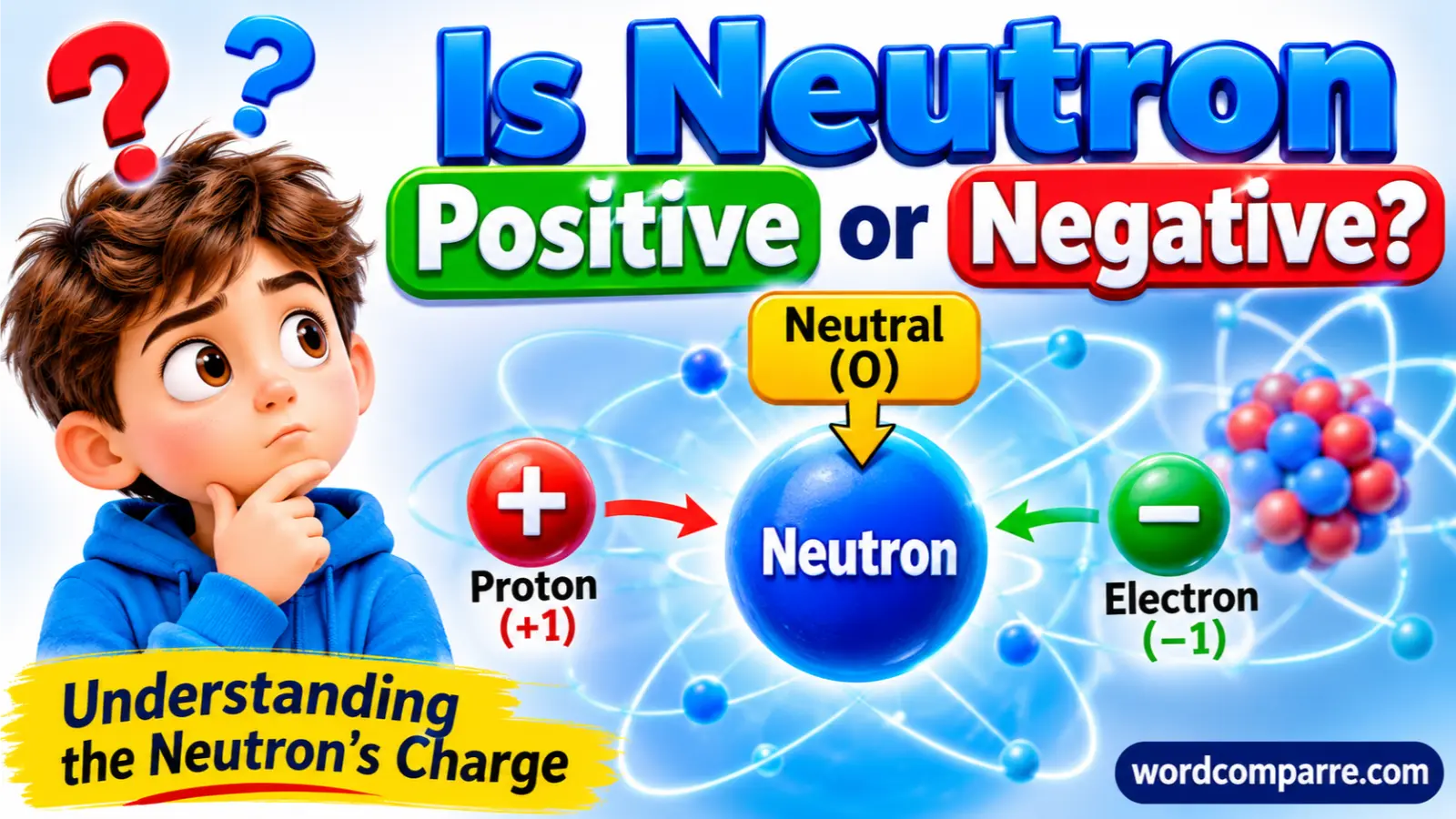
Is neutron positive or negative? A neutron is neither positive nor negative because it carries no electrical charge. It is a neutral subatomic particle found inside the nucleus of an atom, along with positively charged protons. Although neutrons have no electrical charge, they play an essential role in the structure, stability, and behavior of atoms. They also help scientists understand nuclear reactions, radioactive decay, and the fundamental building blocks of matter.
Understanding whether a neutron is positive or negative makes it easier to learn how atoms work and how protons, electrons, and neutrons interact. In this guide, we will explain the neutron’s electrical charge, its role in an atom, how it differs from other subatomic particles, and why it is important in chemistry and physics.
Is a Neutron Positive or Negative?
A neutron is electrically neutral, meaning it has neither a positive nor a negative electrical charge. Unlike protons, which carry a positive charge, and electrons, which carry a negative charge, neutrons have a net electrical charge of zero.
Neutrons exist inside the nucleus of most atoms. They help hold the nucleus together by contributing to the nuclear forces that keep protons and neutrons bound together. Although neutrons have no net electrical charge, they still contain charged particles called quarks.
Therefore, a neutron is not positive or negative. It is a neutral particle with a net charge of zero.
What Is a Neutron?
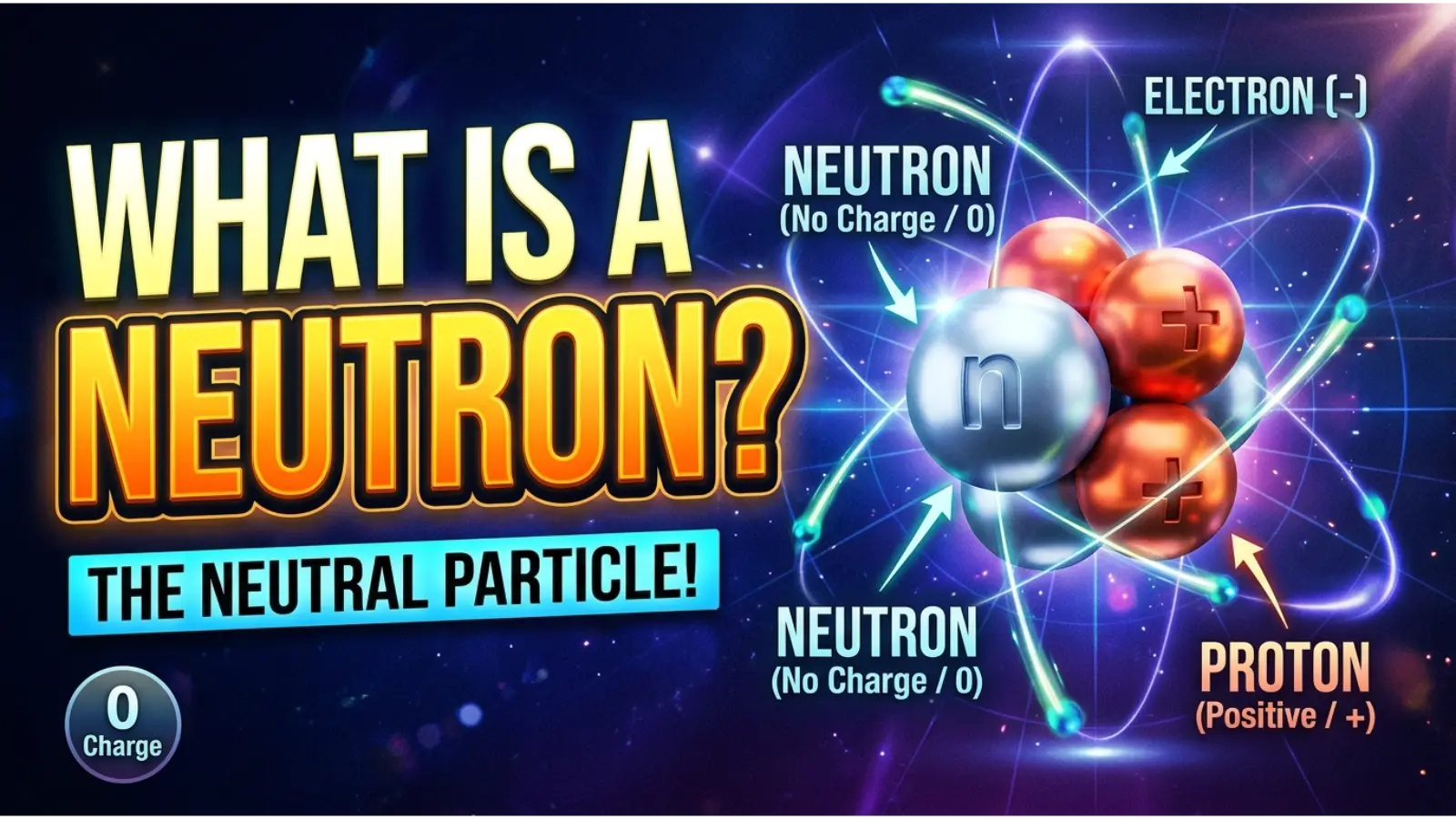
A neutron is a subatomic particle that forms part of the nucleus of an atom. It is one of the three main particles associated with atomic structure, alongside protons and electrons.
Neutrons are slightly heavier than protons and help stabilize atomic nuclei. They are particularly important in atoms containing multiple protons, because the positively charged protons repel one another.
Scientists discovered the neutron in 1932 through the work of physicist James Chadwick. This discovery helped researchers understand atomic structure more accurately and opened new possibilities in nuclear physics.
Neutrons are found in nearly every atomic nucleus except the nucleus of ordinary hydrogen, which contains only one proton.
What Is the Electrical Charge of a Neutron?
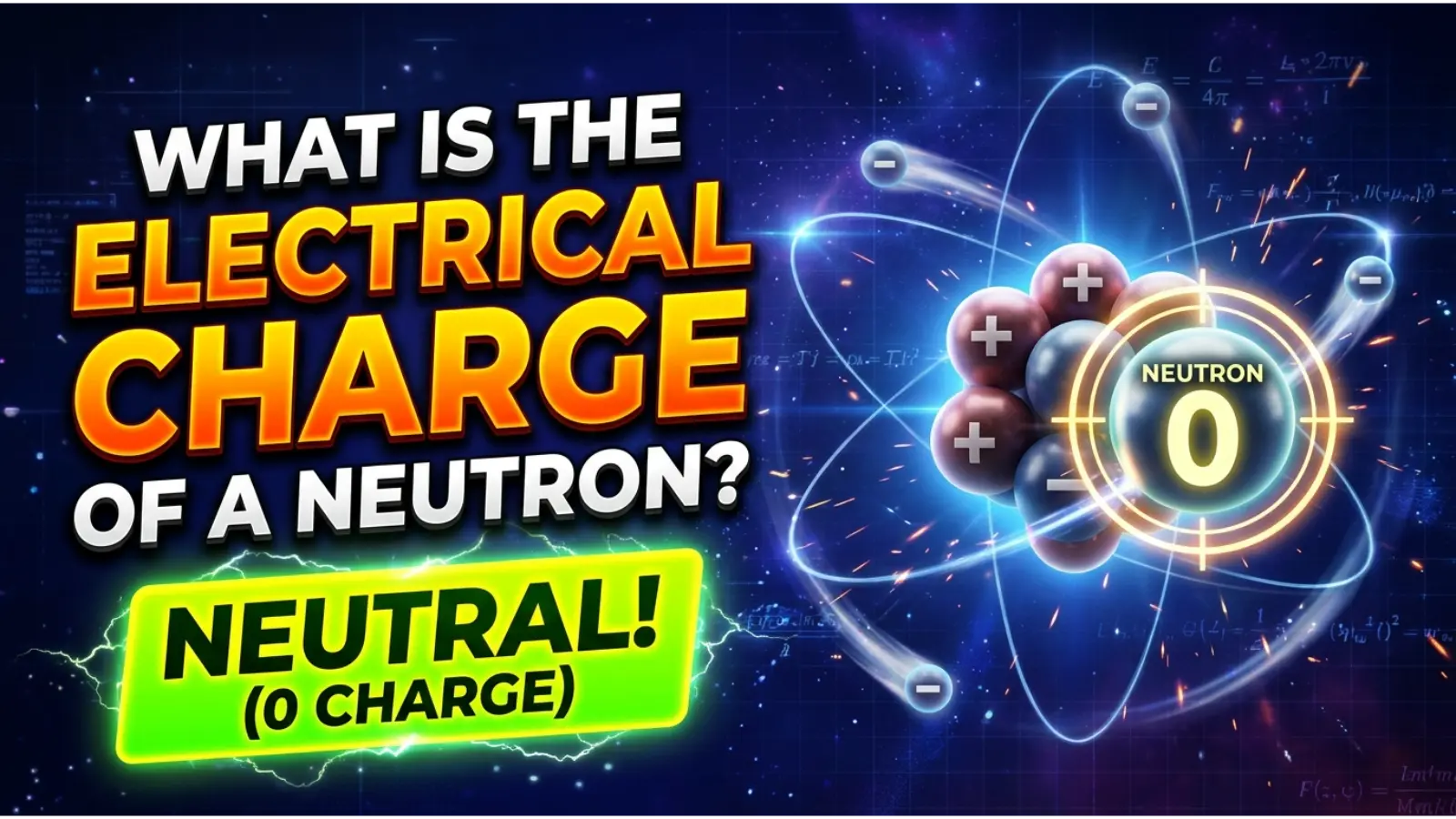
The neutron has a net electrical charge of zero. This means it does not experience electrical attraction or repulsion in the same way that charged particles do.
However, a neutron is not made of electrically neutral components. It contains three quarks:
- Two down quarks, each carrying a charge of −1/3.
- One up quark, carrying a charge of +2/3.
When these charges are combined, they cancel out.
[
+\frac{2}{3}-\frac{1}{3}-\frac{1}{3}=0
]
<text color=”#16A34A” weight=”semibold”>The result is a net electrical charge of zero.</text>
Although the neutron contains electrically charged quarks, the combined charge of the particle remains neutral.
Why Is a Neutron Neutral?
A neutron is neutral because the electrical charges of its constituent quarks cancel each other out. It contains one up quark and two down quarks.
The up quark has a positive fractional charge, while each down quark has a negative fractional charge. Together, their charges balance perfectly.
For this reason, the neutron does not carry an overall positive or negative electrical charge.
However, its internal structure is more complicated than simply adding three quark charges. Quarks interact through the strong nuclear force, which binds them together and contributes to the neutron’s internal energy and structure.
What Is the Difference Between a Neutron, Proton, and Electron?
Neutrons, protons, and electrons are three important particles involved in atomic structure. Each has different properties, including electrical charge, mass, and location.
| Particle | Electrical Charge | Approximate Mass | Location |
|---|---|---|---|
| Neutron | Neutral (0) | 1 atomic mass unit | Atomic nucleus |
| Proton | Positive (+1) | 1 atomic mass unit | Atomic nucleus |
| Electron | Negative (−1) | 1/1836 of a proton | Electron cloud |
Protons determine the identity of an element, while neutrons influence its isotope and nuclear stability. Electrons, on the other hand, play a major role in chemical bonding and electrical interactions.
Although these particles have different properties, they work together to form the structure of atoms.
Where Are Neutrons Found in an Atom?
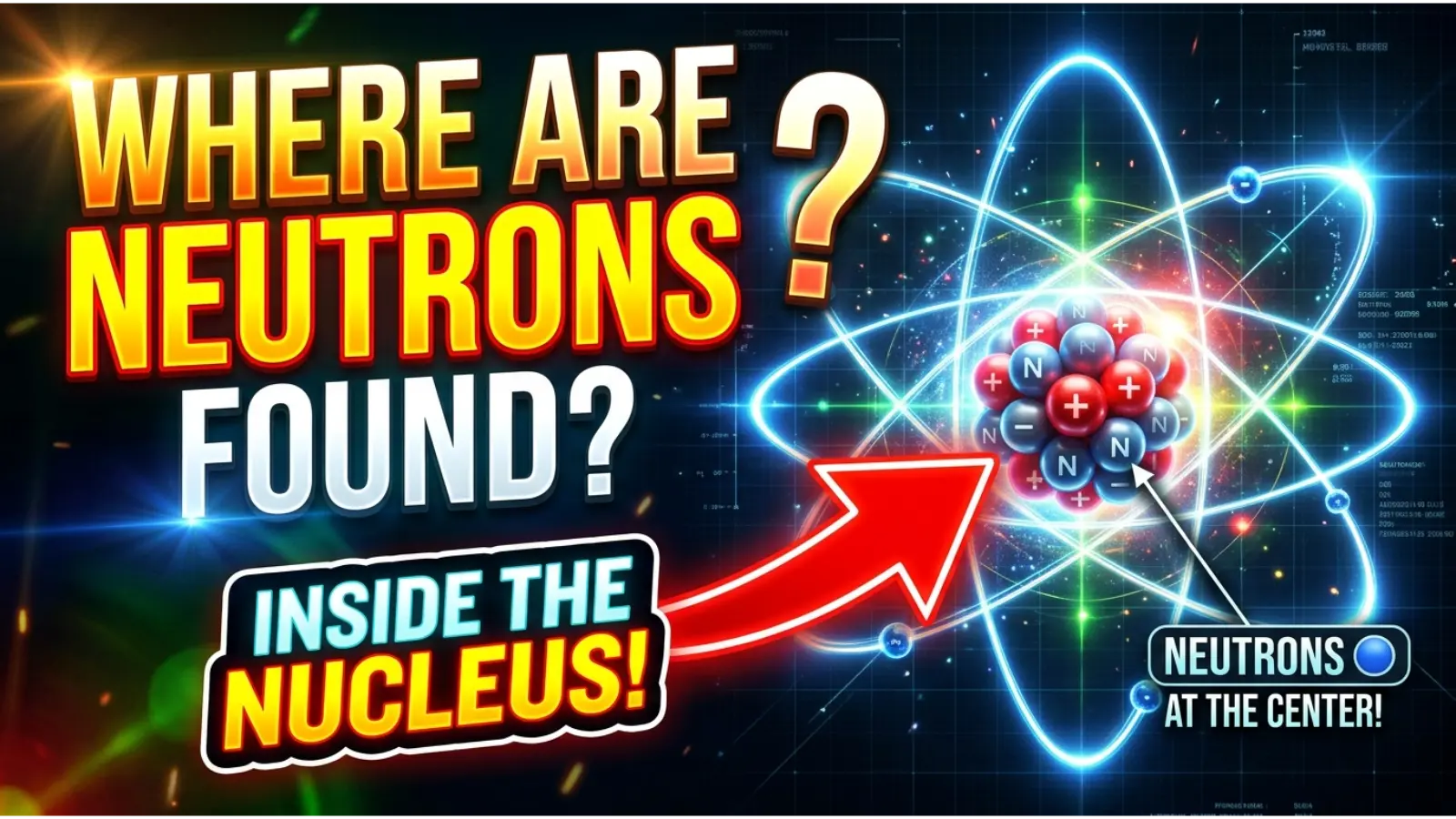
Neutrons are located inside the nucleus, which is the central region of an atom. The nucleus also contains protons and holds nearly all the atom’s mass.
Electrons occupy regions around the nucleus known as electron clouds. These regions are much larger than the nucleus itself.
Neutrons do not move around the nucleus like electrons in the electron cloud. Instead, they exist within the atomic nucleus, where strong nuclear interactions help bind them together with protons.
Most atoms contain neutrons, although ordinary hydrogen is an important exception.
Do Neutrons Help Stabilize an Atom?
Yes, neutrons play an important role in stabilizing atomic nuclei. Protons carry positive electrical charges, so they naturally repel one another.
As the number of protons increases, the electrical repulsion within the nucleus becomes stronger. Neutrons help counterbalance this effect through the strong nuclear force, which acts between nucleons, including protons and neutrons.
This force helps hold the nucleus together when the arrangement of particles is suitable.
However, adding more neutrons does not always make an atom more stable. If a nucleus contains too many or too few neutrons relative to its protons, it may become unstable and undergo radioactive decay.
Therefore, neutrons are essential for nuclear stability, but the balance between protons and neutrons matters.
Can a Neutron Become Positive or Negative?
A neutron does not have a positive or negative net charge under ordinary conditions. However, neutrons can participate in nuclear reactions and particle interactions that transform them into other particles.
For example, a free neutron can undergo beta-minus decay. During this process, it transforms into a proton, an electron, and an antineutrino.
The reaction can be represented as:
[
n \rightarrow p + e^- + \bar{\nu}_e
]
Here, the neutron becomes a positively charged proton, while an electron and an antineutrino are also produced.
This process does not mean that the neutron was originally negative. Instead, the neutron transforms into different particles during radioactive decay.
Why Are Neutrons Important in Nuclear Physics?
Neutrons are extremely important in nuclear physics because they can interact with atomic nuclei without being electrically repelled by their positive charge.
This property allows neutrons to enter certain nuclei and trigger nuclear reactions.
Neutrons are important for several reasons:
- Nuclear fission: Neutrons can trigger the splitting of certain heavy atomic nuclei.
- Nuclear reactors: Nuclear reactors use neutron interactions to sustain controlled fission reactions.
- Isotope production: Scientists use neutrons to produce or study different isotopes.
- Scientific research: Neutron experiments help researchers investigate the structure and properties of materials.
- Radioactive decay: Neutron-related processes help scientists understand how unstable nuclei transform.
Neutrons are therefore essential to many scientific, industrial, and technological applications.
Examples of Neutrons in Different Atoms
Different elements contain different numbers of neutrons in their nuclei. Even atoms of the same element can have different neutron counts, which creates isotopes.
Here are a few examples:
| Atom or Isotope | Protons | Neutrons |
|---|---|---|
| Hydrogen-1 | 1 | 0 |
| Hydrogen-2 (Deuterium) | 1 | 1 |
| Carbon-12 | 6 | 6 |
| Carbon-14 | 6 | 8 |
| Oxygen-16 | 8 | 8 |
These examples show that neutron numbers can vary even when the element remains the same.
For example, Carbon-12 and Carbon-14 both contain six protons. However, Carbon-12 contains six neutrons, while Carbon-14 contains eight. This difference affects their nuclear stability and physical behavior.
Frequently Asked Questions
Is a neutron positive or negative?
A neutron is neither positive nor negative. It has a net electrical charge of zero, which makes it a neutral subatomic particle.
Does a neutron have an electrical charge?
Yes, a neutron contains electrically charged quarks, but their charges cancel out. Therefore, the neutron has no net electrical charge.
Is a neutron heavier than a proton?
Yes, a neutron is slightly heavier than a proton. This small mass difference plays an important role in nuclear reactions and radioactive decay.
Why does an atom need neutrons?
Neutrons help stabilize the atomic nucleus by contributing to the strong nuclear force that binds protons and neutrons together. However, not every atom requires a neutron, as ordinary hydrogen contains only one proton.
Can a neutron exist outside an atom?
Yes, a neutron can exist outside an atomic nucleus as a free neutron. However, free neutrons are unstable and typically undergo beta-minus decay after an average lifetime of approximately 15 minutes.
Do neutrons affect the atomic number?
No, neutrons do not change an atom’s atomic number. The atomic number depends only on the number of protons. However, neutrons affect the mass number and help determine which isotope an atom represents.
Conclusion
A neutron is neither positive nor negative because it has a net electrical charge of zero. It is a neutral subatomic particle located inside the nucleus of an atom, where it works alongside protons to help maintain nuclear stability. Although neutrons contain electrically charged quarks, their combined charges cancel out.
Moreover, neutrons play important roles in isotope formation, nuclear reactions, radioactive decay, and scientific research. Understanding the neutron’s charge and properties helps explain how atoms are structured and why matter behaves the way it does. Therefore, the neutron is a neutral particle, but its contribution to atomic and nuclear physics is incredibly important.