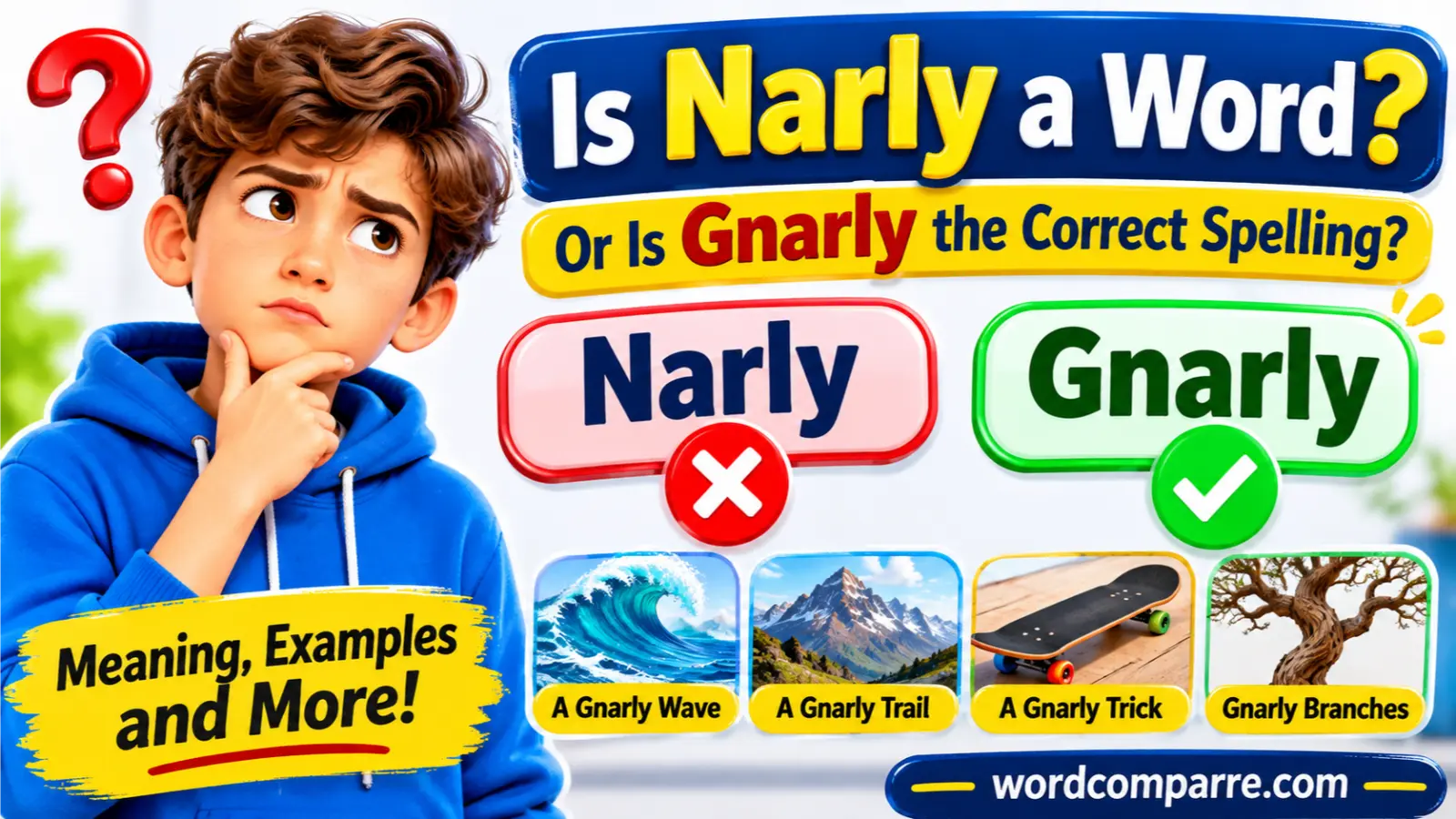
Is narly a word? If you have seen someone write narly, you may wonder whether it is an acceptable English spelling or simply a typo. The standard English word is gnarly, not narly. Gnarly is an informal adjective that can describe something rough, complicated, difficult, dangerous, or impressive, depending on the context. Although people sometimes drop the letter g when typing or speaking casually, gnarly is the recognized standard spelling.
Moreover, gnarly has different meanings in modern English, particularly in slang, surfing culture, and everyday conversations. Therefore, understanding its spelling and meaning can help you use it correctly in messages, social media posts, articles, and informal conversations. In this article, you will learn whether narly is a word, why the confusion exists, what gnarly means, and how to use the correct spelling naturally.
Quick Answer: Is Narly a Word?
<text color=”success” weight=”semibold”>Gnarly is the standard spelling. Narly is generally considered a misspelling of gnarly in ordinary English usage.</text>
- Gnarly: The standard English spelling.
- Narly: Generally a misspelling of gnarly.
- Meaning: Rough, twisted, difficult, dangerous, unpleasant, or impressive, depending on context.
For example, “That was a gnarly wave” is a correctly spelled sentence. However, writing “That was a narly wave” is generally considered a spelling mistake.
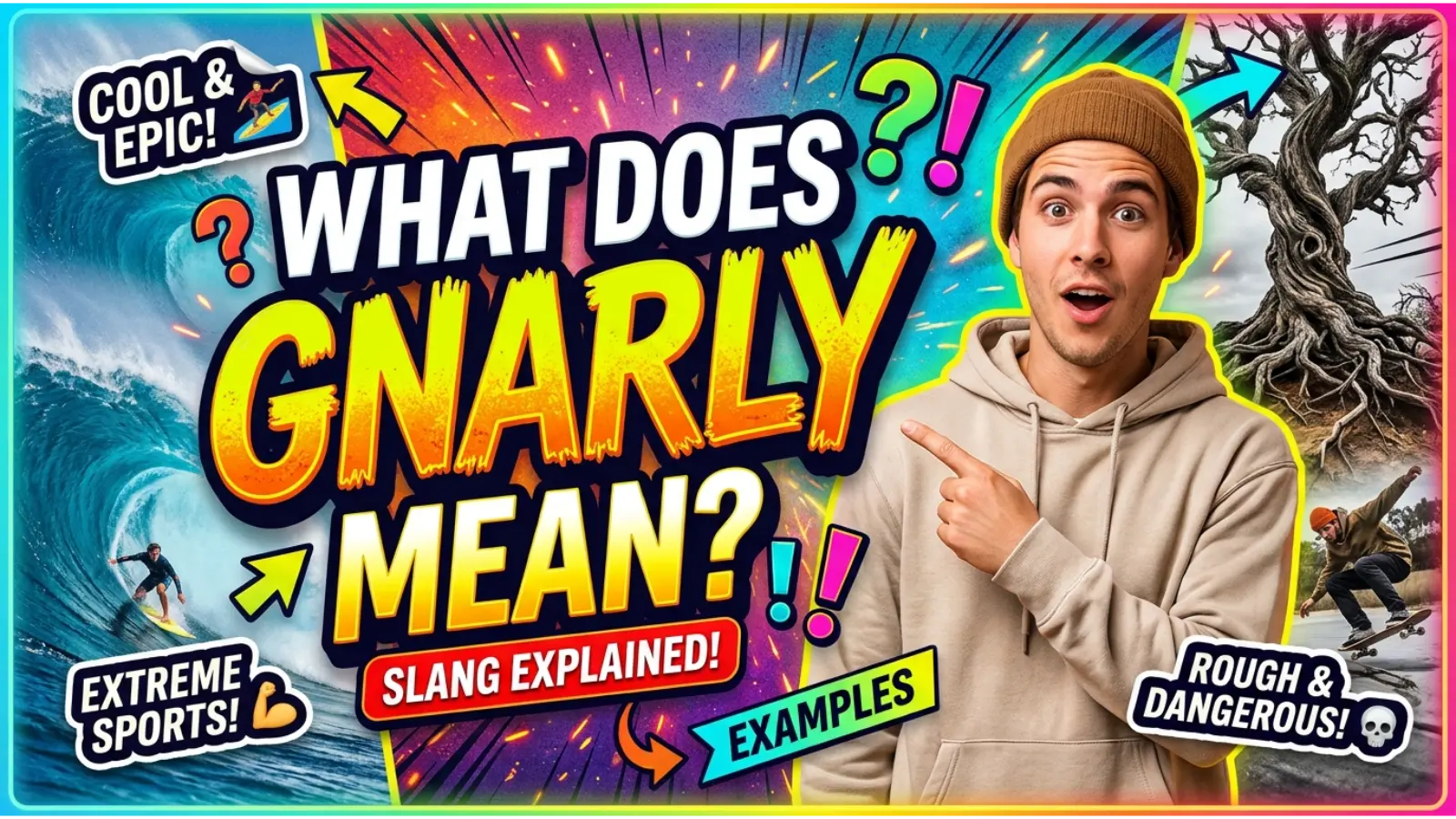
What Does Gnarly Mean?
Gnarly is an informal adjective with several meanings. Its meaning depends on the situation, the speaker’s tone, and the surrounding words.
Gnarly Means Rough or Twisted
Gnarly can describe something physically rough, twisted, or irregular, especially when talking about tree roots, branches, or surfaces.
Examples:
- The old tree had gnarly branches.
- We climbed over some gnarly roots.
- The fence was covered with gnarly vines.
In these examples, gnarly describes the physical appearance of something rough or twisted.
Gnarly Means Difficult or Dangerous
In informal English, gnarly can describe something challenging, risky, unpleasant, or difficult to deal with.
Examples:
- That was a gnarly mountain trail.
- He had a gnarly accident while skiing.
- The traffic situation was pretty gnarly.
Therefore, gnarly can communicate that something was difficult, intense, or unpleasant.
Gnarly Means Impressive or Awesome
In slang, particularly in surfing and skateboarding culture, gnarly can also express admiration. In this context, it often describes something exciting, impressive, or exceptionally skillful.
Examples:
- That skateboard trick was gnarly!
- She caught a gnarly wave.
- The snowboarder performed a gnarly jump.
Although gnarly can sound negative in some sentences, it can also express excitement or admiration.
Is Narly a Word or a Misspelling of Gnarly?
When people search for “is narly a word,” they usually want to know whether the spelling without the g is acceptable. In standard English, gnarly is the correct spelling of the adjective.
Narly is generally not recognized as a standard spelling of gnarly in ordinary English writing. Nevertheless, people may use narly informally online, in usernames, creative names, or stylized text. Such uses do not make it the standard dictionary spelling of the adjective.
| Word | Standard Spelling? | Meaning or Usage |
|---|---|---|
| Gnarly | <text color=”success” weight=”semibold”>Yes</text> | Rough, difficult, dangerous, or impressive |
| Narly | <text color=”warning” weight=”semibold”>Generally no</text> | Usually a misspelling of gnarly |
| Gnarled | Yes | Twisted, rough, or knotty in appearance |
| Gnar | Yes, informal slang | A slang term associated with challenging or exciting surfing and action sports |
Consequently, if you are writing an article, school assignment, professional message, or standard English sentence, choose gnarly rather than narly.
Why Do People Confuse Narly and Gnarly?
People often confuse narly and gnarly because the initial g in gnarly is silent. As a result, the word may sound like “narly” when someone pronounces it.
Here are some common reasons for the confusion:
- Silent letter: The g is not pronounced in gnarly.
- Pronunciation: The word sounds similar to narly.
- Typing mistakes: People may write the word according to how they hear it.
- Informal communication: Social media and text messages often encourage quick spelling.
- Unfamiliar vocabulary: Some English learners may not recognize the unusual spelling.
However, the silent g is part of the correct spelling. Similarly, English contains other words with silent initial letters, such as knight, knee, and know.
What Do Dictionaries Say About Gnarly?
Standard English dictionaries recognize gnarly as an adjective. It commonly describes something twisted, rough, complicated, difficult, or unpleasant. In slang, the word can also describe something exciting or impressive.
Meanwhile, narly is generally not the standard spelling of this adjective. Therefore, writers should use gnarly when they intend to describe something using this word.
Dictionary usage and slang meanings may vary slightly between regions and contexts. Nevertheless, gnarly remains the accepted spelling in standard English.
Origin and History of Gnarly
The word gnarly is associated with the word gnarl, which refers to a knot or twisted growth, particularly in wood or trees.
The adjective gnarly developed from this idea of something rough, twisted, or knotty. Later, informal slang expanded its meaning to describe challenging, unpleasant, exciting, or impressive situations.
Moreover, the word became particularly associated with surfing and skateboarding culture, where people used it to describe difficult waves, risky tricks, and impressive performances.
Today, gnarly appears in informal conversations, entertainment, online discussions, and everyday slang. However, its meaning depends heavily on the context in which someone uses it.
Real-Life Examples of Gnarly in Sentences
Understanding examples makes it easier to remember the correct spelling and meaning.
Gnarly Examples Describing Something Rough
- The tree had gnarly roots across the path.
- We admired the gnarly branches of the old oak.
- The wooden sculpture featured several gnarly shapes.
Examples of Gnarly Problems and Challenges
- That was a gnarly problem to solve.
- The hike became gnarly after the rain.
- He faced a gnarly challenge at work.
Gnarly Examples in Slang
- That wave was gnarly!
- You performed a gnarly trick.
- The skateboarding competition was gnarly.
These examples show that gnarly can describe physical appearance, difficult situations, and impressive experiences. Therefore, context is important when interpreting the word.
Common Spelling Mistakes Related to Gnarly
Writers sometimes make mistakes when spelling gnarly because the word contains a silent initial letter.
| Incorrect or Confusing Form | Correct Form | Explanation |
|---|---|---|
| Narly | Gnarly | Missing the silent g |
| Gnarley | Gnarly | Incorrect letter order |
| Gnarly | Gnarly | Correct spelling |
| Gnarled | Gnarled | Correct related word |
For example, “That was a narly ride” should be written as “That was a gnarly ride.”
Similarly, “The tree had gnarley branches” should be written as “The tree had gnarly branches.”
Therefore, remember the silent g and the correct letter order when writing gnarly.
Memory Trick: How to Remember Gnarly Correctly
A simple memory trick can help you remember gnarly.
Gnarly starts with G, just like Gnarled.
Both words are associated with twisted, rough, or knotty shapes. For example, gnarled branches often look rough and twisted. Similarly, gnarly can describe something physically rough or challenging.
Whenever you write gnarly, remember the silent g at the beginning. This small trick can help you avoid writing narly by mistake.
Professional Writing Recommendation: Narly or Gnarly?
For professional, educational, or standard English writing, use gnarly if you intend to use this adjective. Although the word is informal, it is recognized in English and can work in articles, conversations, descriptive writing, and informal content.
However, gnarly may not suit every professional context. If you are writing a formal report, academic paper, or business document, consider using a more precise alternative.
| Instead of Gnarly | Consider Using |
|---|---|
| Gnarly problem | Complicated problem |
| Gnarly situation | Difficult situation |
| Gnarly injury | Severe injury |
| Gnarly branches | Twisted branches |
| Gnarly performance | Impressive performance |
Moreover, choosing a more specific adjective can make your writing clearer and more professional.
Frequently Asked Questions About Is Narly a Word?
Is Narly a Word in the English Dictionary?
Narly is generally not the standard spelling of the adjective gnarly. The recognized standard spelling is gnarly. However, narly may appear as a stylized name or informal spelling in certain contexts.
Is Gnarly a Real Word?
Yes, gnarly is a recognized English adjective. It can describe something rough, twisted, difficult, dangerous, unpleasant, or impressive, depending on the context.
Why Is Gnarly Spelled With a G?
Gnarly is related to the word gnarl, which refers to a knot or twisted growth. The initial g is silent, but it remains part of the standard spelling.
Does Gnarly Mean Cool?
Yes, in informal slang, gnarly can mean cool, impressive, exciting, or awesome. However, it can also describe something unpleasant, dangerous, or difficult.
Is Gnarly a Formal Word?
Gnarly is generally informal. Although it is a recognized English word, it is more suitable for conversations, informal writing, descriptive content, and slang than highly formal or academic writing.
Is Narly or Gnarly Correct?
Gnarly is the standard correct spelling. Narly is generally a misspelling when someone intends to write gnarly.
How Do You Pronounce Gnarly?
Gnarly is commonly pronounced as “nar-lee.” The initial g is silent, which is one reason people sometimes misspell the word as narly.
Conclusion
Gnarly is the standard English spelling, while narly is generally considered a misspelling of the word. Gnarly can describe something rough, twisted, difficult, dangerous, unpleasant, or impressive, depending on the context.
Although the silent g makes the word confusing, remembering its connection to gnarl and gnarled can help you spell it correctly. Moreover, understanding its different meanings allows you to use it more confidently in everyday conversations and informal writing.