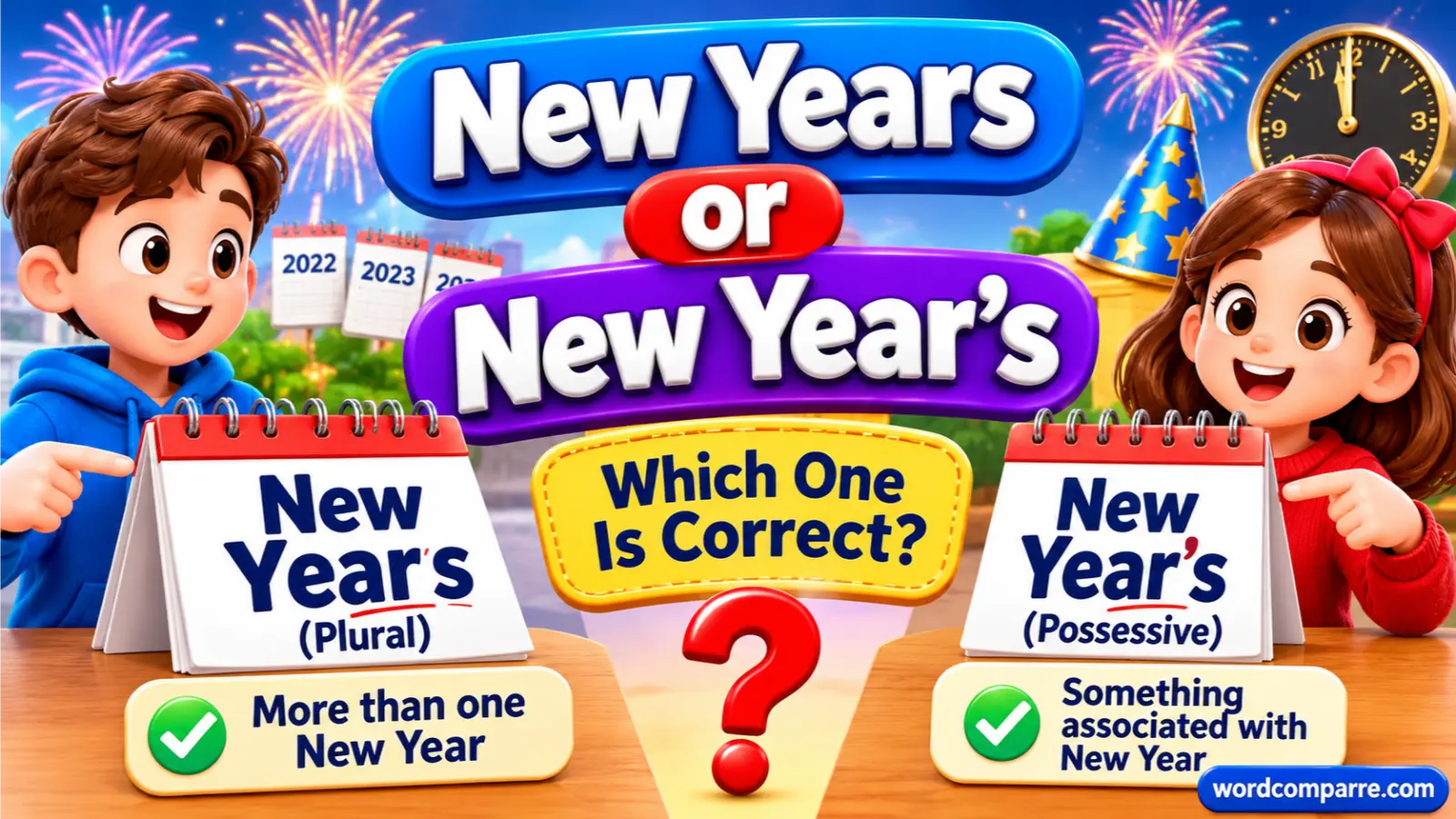
The difference between New Years or New Year’s can be confusing because both forms look almost identical. However, the apostrophe changes the meaning and grammatical function of the phrase. One form refers to more than one New Year, while the other shows possession or a relationship with the New Year holiday.
Understanding when to use New Years or New Year’s can help you avoid punctuation mistakes in everyday writing, holiday greetings, professional communication, and social media posts. Although both forms can be correct, they are not interchangeable. The right choice depends on what you want to express.
New Years vs. New Year’s: Quick Comparison
Before exploring the grammar rules, look at the main differences between these two expressions.
| Expression | Meaning | Usage |
|---|---|---|
| New Years | More than one New Year | Plural noun |
| New Year’s | Something associated with New Year | Possessive form |
| New Year’s Day | The first day of the year | Holiday name |
| New Year’s Eve | The evening before January 1 | Holiday name |
The key difference is the apostrophe. New Years is plural, whereas New Year’s is generally possessive.

What Does New Years Mean?
New Years is the plural form of New Year. It refers to multiple New Year celebrations or occasions across different years.
Writers use this expression when discussing several New Year holidays, particularly when comparing celebrations from different years.
For example:
- We have celebrated many New Years together.
- Those New Years brought wonderful memories.
- Different New Years have been special for our family.
- The previous New Years were full of excitement.
Notice that New Years does not contain an apostrophe. The word simply becomes plural by adding an s.
However, when referring to the annual holiday in general, writers usually say New Year rather than New Years.
What Does New Year’s Mean?
New Year’s is the possessive form of New Year. The apostrophe before the final s indicates a relationship or association with the holiday.
This form commonly appears in expressions connected with New Year celebrations, traditions, and activities.
Examples include:
- New Annual Day
- New Annual Eve
- New Year’s resolution
- New Annual celebration
- New Annual party
For instance:
- We are planning a New Annual party.
- Her New Annual resolution is to exercise regularly.
- New Annual Eve is an exciting occasion.
- Our family enjoys New Annual celebrations.
In these examples, New Annual describes something associated with the New Year holiday.
People also commonly use New Annual as informal shorthand for the celebration itself, as in “What are you doing for New Annual?” This usage is widely understood in everyday English.
Grammar Rules: When Should You Use Each Form?
Understanding the basic grammar rules makes choosing between these expressions much easier.
1. Use New Years for Multiple Occasions
Use New Years when you are talking about more than one New Year.
The plural form does not require an apostrophe because it simply indicates quantity.
Correct examples:
- We have spent five New Years in different countries.
- Several New Years have passed since we last met.
- I remember those wonderful New Years.
2. Use New Year’s for Possession or Association
Use New Year’s when describing something connected with the holiday.
The apostrophe shows a possessive relationship, even though the expression often works as a modifier rather than indicating literal ownership.
Correct examples:
- New Annual Day is a public holiday in many countries.
- She made a New Annual resolution.
- They organized a New Annual dinner.
3. Do Not Confuse New Annual with New Year
New Year and New Annual have different grammatical uses.
For example:
- Happy New Year! (A standard holiday greeting.)
- New Annual Day is January 1. (A holiday name.)
- What are your plans for New Annual? (Informal reference to the celebration.)
Both forms can be correct, but their meanings and sentence structures differ.
New Years or New Year’s in Sentence Structure
The sentence structure can help you identify which expression belongs in your writing.
New Years as a plural noun:
Subject + plural verb + additional information.
Example: Several New Years have passed since we graduated.
New Year’s as a possessive modifier:
New Year’s + noun.
Example: We attended a New Year’s celebration.
New Year’s as an informal holiday reference:
Preposition + New Annual.
Example: We are going out for New Annual.
Paying attention to the surrounding words makes the correct choice easier.
Common Mistakes to Avoid
Even experienced English writers sometimes confuse these expressions. Here are some common mistakes and their corrections.
| Incorrect or Intended Meaning | Correct Form |
|---|---|
| New Years Day | New Year’s Day |
| New Years Eve | New Year’s Eve |
| New Years resolution | New Year’s resolution |
| Several New Year’s have passed | Several New Years have passed |
| Happy New Year’s! | Happy New Year! |
One important point concerns holiday greetings. Although people sometimes write “Happy New Year’s,” the standard greeting is “Happy New Year.”
Similarly, do not add an apostrophe simply because a word ends in s. Apostrophes indicate possession or certain contractions, not ordinary plurals.
Professional and Formal Usage
In professional writing, correct apostrophe placement helps maintain clarity and consistency.
Use New Annual when writing about official holiday names, workplace celebrations, annual events, or resolutions.
For example:
- The office will remain closed on New Year’s Day.
- Employees are invited to attend the New Annual reception.
- The company has introduced a New Annual wellness initiative.
Use New Years when comparing multiple celebrations across different years.
For example:
- The organization has hosted several New Years events over the past decade.
In formal writing, avoid unnecessary apostrophes and follow the style guide used by your organization or publication.
Examples of New Years and New Year’s in Everyday English
These examples demonstrate how both expressions work in natural sentences.
Examples using New Years:
- We have celebrated ten New Years as friends.
- Those New Years were unforgettable.
- Some New Years are more memorable than others.
- I spent several New Years away from home.
- Our family has enjoyed many wonderful New Years.
Examples using New Year’s:
- New Annual Eve is my favorite celebration.
- We are preparing for a New Annual party.
- She wants to achieve her New Annual resolution.
- New Annual Day falls on January 1.
- They invited us to their New Annual dinner.
These examples show that the apostrophe depends on the intended meaning, not personal writing preference.

Easy Memory Tricks to Remember the Difference
If you frequently confuse these expressions, use these simple tricks.
Remember the S in New Years: If you mean multiple New Year occasions, use New Years without an apostrophe.
Remember the apostrophe in New Year’s: If you are describing something associated with the holiday, use New Year’s.
Check the following noun: Words such as Day, Eve, resolution, and party commonly follow New Annual.
Think about quantity: If you mean several celebrations across different years, New Years is usually the appropriate choice.
These simple reminders can help you select the correct form without memorizing complicated grammar rules.
Real-Life Conversations
Here are a few short conversations showing how people naturally use both expressions.
Conversation 1:
Alex: How many New Years have you celebrated abroad?
Sam: I have celebrated three New Years outside my country.
Conversation 2:
Emma: Are you attending the New Year’s party tonight?
Olivia: Yes, I am looking forward to it!
Conversation 3:
James: What is your New Annual resolution?
Daniel: I want to improve my fitness and read more books.
Conversation 4:
Sophia: Do you usually spend New Annual Eve with your family?
Mia: Yes, we celebrate together every year.
Frequently Asked Questions
1. Is New Years or New Year’s correct?
Both forms are correct, but they have different meanings. New Years is plural, while New Year’s is possessive or associated with the holiday.
2. Should I write New Years Day or New Year’s Day?
The correct spelling is New Annual Day. The apostrophe indicates the possessive form used in the holiday’s name.
3. Is it New Years Eve or New Year’s Eve?
New Year’s Eve is correct. It refers to December 31, the evening before New Annual Day.
4. Is Happy New Year’s grammatically correct?
Happy New Year is the standard greeting. Although Happy New Annual appears in informal writing, it is generally unnecessary to include the apostrophe and final s.
5. Should New Year’s always have an apostrophe?
No. Use the apostrophe when expressing possession or association with the holiday. Use New Years without an apostrophe when referring to multiple New Year occasions.
6. Is New Year’s Day capitalized?
Yes. New Annual Day is the standard capitalization of the holiday’s name. Both New Year’s and Day begin with capital letters.
7. Can I say New Year’s without adding another noun?
Yes. In informal English, New Year’s can stand alone when the holiday or celebration is understood from context. For example, “What are you doing for New Year’s?”
Conclusion
Choosing between New Years or New Year’s becomes simple once you understand the role of the apostrophe. New Years refers to multiple New Year occasions, while New Annual describes something associated with the holiday or serves as an informal reference to the celebration.
Remember to write New Annual Day, New Annual Eve, and New Annual resolution with an apostrophe. However, when discussing multiple celebrations across different years, use New Years without one. Most importantly, remember that the standard holiday greeting is “Happy New Year.”
With these simple grammar rules and examples, you can use both expressions confidently in everyday conversations, professional writing, and holiday messages.